California’s Wolves Are Nearly Impossible to Photograph. Here’s How Aaron Huey Did it.
After months of failed attempts, the acclaimed photographer finally glimpsed these elusive wolves on the last morning of his assignment for our December issue.
Photographer Aaron Huey has covered war, landed several National Geographic covers, walked across America, and even captured images inside the metaverse. But California’s elusive gray wolves nearly beat him.
Gray wolves were trapped, poisoned, and hunted out of California by the 1920s, largely to protect livestock. Nearly a century later, they came back. Their growing numbers have brought new tension with ranchers, local communities, and the state. One pack’s summer diet consisted of 92 percent livestock.
Huey set out to photograph these wolves for the December 2026 issue of our magazine. After months of failed attempts to capture one up close, it came down to his last hour on assignment. We spoke with him about the lengths it took to pull it off—which included bear proof bunkers, a makeshift blind, or hiding place, and working beside rotting cow carcasses.
This interview has been edited for length and clarity.
Wild wolves in California are rarely photographed up close. What makes it so hard?
In California, the wolves are almost impossible to spot. There's no snow for them to stand out against, they're hidden in the trees, and there are very few of them.
When you look for pictures of wild wolves in California, you don't find much, or the ones you find are really a picture from somewhere else. Most of the pictures out there were taken by science teams that sedated the wolves, studied them, and released them. I had seen a couple where the wolves are far away. But I'd never seen a close-up image of a California wolf in the wild by a professional, un-sedated, in its true spirit.
This story is as much about the ranchers as the wolves. How did you approach photographing them?
I do really well at the intersection of people and wildlife. I’m really good at getting in very deep with communities to understand the people that are interacting with the animals. And the best images are the ones that bring them together, the human and the animal, into a single image.
(How Does the Endangered Species Act Protect Animals At Risk?)
This is a story about conflict. It’s a wolf-rancher conflict, and who are the characters at that intersection? That [meant] photographing the ranchers independently, the ranchers meeting the wolves, and the wolves independently.
Your first plan was to set up the cameras in a bone pit. Tell me about that idea.
When I realized how hard it was going to be to get to wolves, I thought, Okay, I've got to find a place that I know they're coming.
There's a slaughterhouse on one ranch property, and they raise cattle for beef. Some of those cows die and get dumped in this pit. I knew [the wolves] were coming to this place where ranchers were dumping bones and heads and whole cows that had died.
I wanted to disguise the cameras by making special containers that make them look like they're part of the edge of the pit so there wasn't just a big, scary-looking box there for the wolves.
You left the cameras there in disguise overnight. What did you find when you came back?
Both cameras were covered with [cattle] guts from bear noses smearing it on the lens.
I realized the wolves would probably only come in pitch black, and I couldn't use a flash. A flash going off could have meant that the entire pack stops visiting. To make this work, a wolf would have to show up in the last minutes of daylight, or the first in the morning, when there was enough light to capture them, before a bear had gotten to the lens.
When I saw what was happening to the lenses and the timing, I thought, There is not a chance in hell that this is going to work.
What was your next plan?
I moved [the cameras] to a watering hole that I heard the pack was visiting. The wolves usually came twice a day. But when I first started going there, they took a day and a half break, and that made me think they were gone. That's when I realized what it would take: the light doing just the right thing, in a very narrow slice of time, with a wolf in just the right place. The odds were ridiculous.
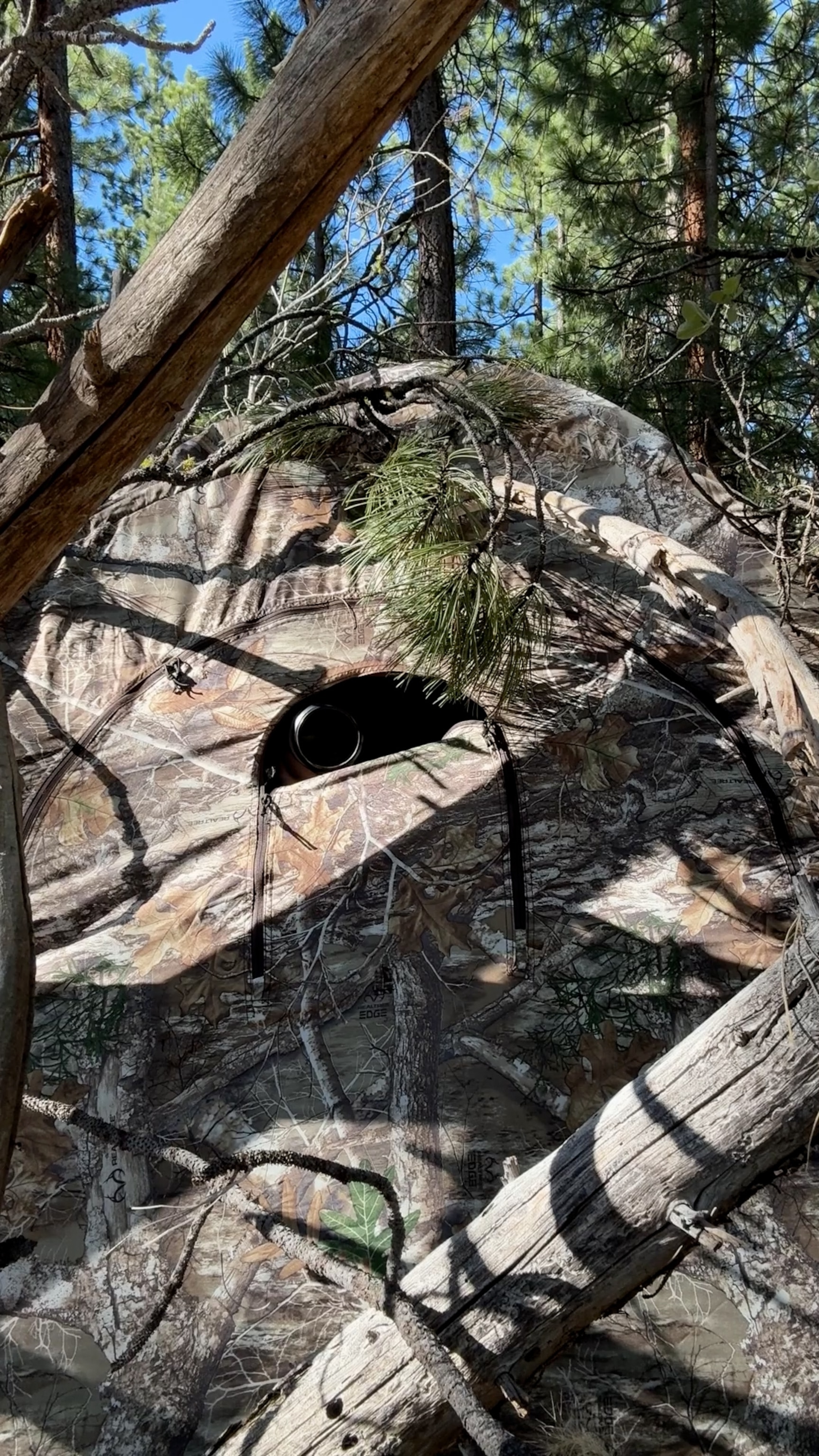
You also set up a blind, camouflaged tent you could hide in and shoot out of through a tiny slit. What was it like in there?
I sat there and stared out this little hole at the one area I knew they were always coming from. There were only four or five little areas where they could appear without being blocked.
I kind of just had to stare. I couldn't listen to anything, because I needed to be able to hear if wolves came. I might only have one second to get a shot.
At that point, I didn't have a lot of hype left. I was pretty worn down and constantly aware of how low the odds were.
It's your last morning, your bags are packed, and you have a flight scheduled. What happened next?
When my last full day ended and there were no frames, I felt totally defeated. I was devastated that I wouldn't have the true spirit of a wild wolf in a story about wolves in California.
I thought, If I get up at four in the morning, I technically have one last window, just before sunrise. One last, last, last chance. It felt like a long shot.
Then, five pups came through; I could just see the tops of them in the distance. Too obscured for a photo. I was like, Was that really it? Is that the end of this assignment? I thought, I'll just wait until the last possible minute.
Maybe 10 or 15 minutes later, one single pup came back. It stopped exactly between two of the trees, looked straight toward me, cocked its head, and started prancing in my direction, completely oblivious. For a second and a half, maybe two seconds. Then it took off to the right and was gone.
What went through your mind when it ran toward you?
I don't think I was processing. It was still before sunrise, and I was pushing what my lens could do in that light. Then I scrolled back through the images and realized I got it.

You said that it is not your best photo compositionally, but you also called it one of your most special. Why is that?
Because of everything that went into it. What had to happen to make it, and the level of intimacy with a wild California wolf pup, make it so crucial for this story. It was the payoff for the most ridiculous efforts, over months of trips.
What do you hope your photos to show people?
An understanding of the incredible complexity of the landscape this is taking place in. I want to show the depth and bring out some compassion for all the people and animals involved.
Any advice for a photographer chasing a shot that might never happen?
It takes a lot of tolerance for suffering to be a National Geographic photographer. It might be staying in a blind for weeks, or it might be spending time in communities that see the world differently than you do. What makes great photos and storytelling is going beyond the discomfort and staying, for any amount of time, until you get it. Because National Geographic doesn't publish excuses.
Elaina Killeen is a video producer and editor at National Geographic. She produces stories about science, wildlife, and the natural world.
