After 175 years, Galápagos giant tortoises return home
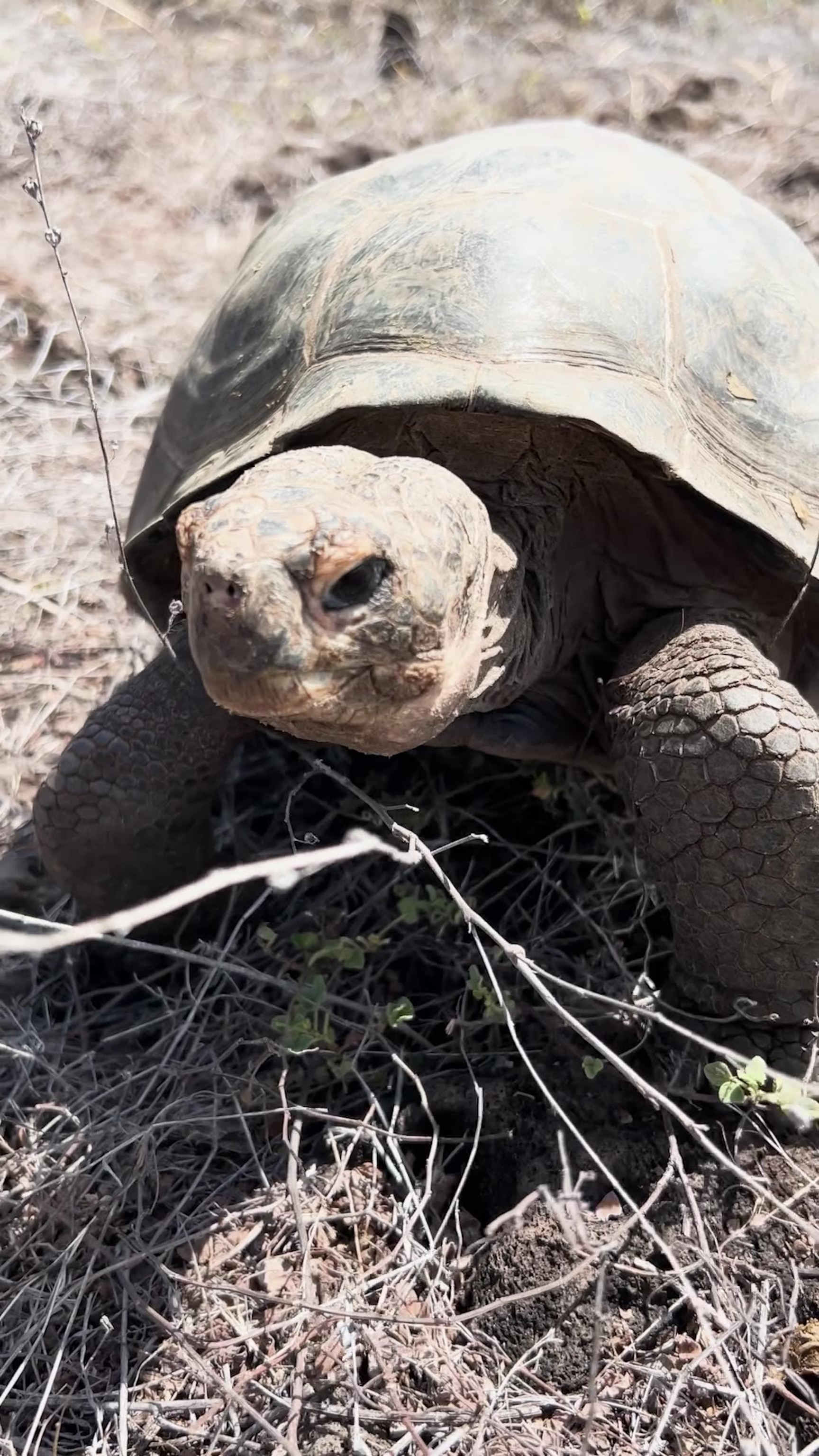
On a hot February morning, Galápagos National Park rangers released 50 giant tortoises back to Floreana Island—marking the beginning of a historic comeback.
FLOREANA ISLAND, ECUADOR — Nine men walk single file like an army, marching uphill and under the equatorial sun with hundred-pound plastic crates strapped to their backs.
When they finally crest the ridge—a path pocked by knife-edged lava rocks and geologically active cinder cones—they're dripping with sweat. But they don't rest or stop. They carefully place the crates down and the real work begins.
"Put them in the shade," yells a man with a balaclava and glasses hiding his face from the sun.
"Over here," points another masked man, crunching through dry grass to reach a strand of palo santo trees. The troops lift and follow, and the contents of the crates seem to come alive.
These men could be mistaken for soldiers—or traffickers. In a way they're both—plus porters, explorers, even babysitters. That's because these men are Galápagos National Park rangers, front-line defenders of wildlife in one of the most biodiverse places in the world. And what's rattling in these crates are the descendants of a species that hasn’t been seen on this island for 175 years.
Giant tortoises.
"This is history," declares the team's leader, Christian Sevilla, the director of ecosystems at the Galápagos National Park Directorate.

There are 50 giants coming home this morning, 158 in total over the coming days, with hundreds ready for release and hundreds more at the park's breeding center on Santa Cruz Island.
But these tortoises in the crates aren't giants yet—they range from 7 to 15 years old and weigh 10 to 40 pounds.
They're also hybrids of the now extinct Floreana tortoise species. These tortoises carry both Floreana and Wolf Volcano tortoise lineages. Some of the hybrids also have genes from species found on the region’s Santiago and Española islands too.
For the past 15 years, a breeding program has raised 720 new Floreana hybrid tortoises whose final step toward returning to the wild depends on riding on the backs of Sevilla and his team on this hot February morning.
"Vamos," Sevilla chirps as a bead of sweat streaks his face. He's been working nonstop for the last forty-eight hours, moving these animals by ship, truck, and hand.
When the crates are opened a pair of youngsters crawl out and start munching a creeping vine. A soft-spoken New Englander in a floppy hat and combat boots closes his umbrella and picks up his camera.
"This is a good sign," James Gibbs says while snapping photos. The conservation biologist and National Geographic Explorer is in many ways most responsible for this moment.
As he watches the tortoises slowly walk off, he dotes like a proud dad, admitting: "I never thought this would happen."
It almost didn't.
Thanks to an accidental discovery, an army of rangers and researchers are now at the precipice of what may be the most ambitious island recovery ever attempted, a decades-long restoration aimed at getting rid of invasive species like rats and cats—a painstaking and bloody process that's delayed the release by several years—and a $15 million project that's mapped plant recovery, land management, and human conflict, all to create the conditions for the return of the island’s famous giant tortoises.
"You can't do this in other parts of the world"
Once a hub for whalers and pirates, Floreana was the first Galápagos island to be settled.
Humans not only brought rats and cats, they also brought horses, cows, pigs, dogs, donkeys, and goats, animals that outcompeted—or killed—native animals. Ten out of 22 bird species have gone extinct on Floreana since the arrival of humans, according to Birgit Fessl, principal investigator of landbird conservation at the Charles Darwin Foundation.
Floreana has always had a dark history: the first colony ended in bloodshed and by the 1830s the island was a prison. A hundred years later, a handful of Germans started an idyllic and naive Eden, a story that ended in murder and was dramatized in a Ron Howard film.
"People caused these problems, and people have the responsibility to fix them," says Jonathan Miles, whose new novel Eradication focuses on that exact challenge of invasive species, and is based in part on his reporting here.
Today's plan is difficult, admit those behind it, but far less naive than earlier Floreana failures.

Yes, there are over 1,600 introduced species in the islands, but goats were in many ways the worst. Multiplying unchecked, they ate their way across Floreana for years, destroying the land.
But in 2007, the last Floreana goat was removed, and now getting rid of rats and cats truly means turning back generations of destruction. That's why tortoises are key. They shape the ecosystem from the ground up, dispersing seeds and cutting paths, sort of like natural architects.
"That's critical for plant growth," and other species, even nesting birds, notes Rakan Zahawi, the executive director of the Charles Darwin Foundation, which has supported the restoration for years. For such an iconic and critical species, conservationists have been willing to spend millions of dollars and years of time removing plants and animals that shouldn't be here.
"You can't do this in other parts of the world," Zahawi says, noting the scale and attention these famous islands command. "Should we restore or not, that's the age-old question."
Killing animals is always controversial, but fewer rats and cats has already sparked a rebound in birds, and the ground-dwelling Galápagos rail is back after nearly 200 years.
"We joke and say we're undoing the work of pirates but that is what we're doing," agrees Penny Becker, the CEO of Island Conservation, a nonprofit that's helped shape the Floreana plan for the past 15 years.
That plan helps locals too, who say eliminating rats means more food, with crop yields up 80 percent.
"It all makes me very emotional," admits Claudio Cruz, a 66-year-old farmer, as he thinks about the ecological damage being undone. Cruz calls Floreana "the capital of Galápagos," and says the return of the giants means Floreana will now be complete—and more crowded, he adds with a laugh.
Home to about 125 corn and guava farmers, there will soon be more tortoises than people. But while there have been conflicts between tortoises and farmers elsewhere, Cruz, the eighth of twelve siblings, describes a wildlife connection that's "critical" to Floreana's culture. "When you look at a tortoise, into its eyes," he says, "they recognize you. They're smart. They want to communicate. Now we have that chance."
The population will still be a fraction of its heyday. Floreana was once covered with tortoises, thousands as far as the eye could see, "spread in all directions over the plains and low grounds near the sea," according to Commodore John Downes, a whaling captain who hunted them for their meat and oil.
Tortoises were critical on long voyages where men regularly starved, easy food to sail with.
There were once as many as 350,000 giants across the archipelago, but when Darwin arrived in 1835, the species was already in decline. By 1850, Floreana's tortoises were gone. Until today.

How baby giants were found
There are between 30,000 and 35,000 giants left today, about 10 percent of the original population.
Beyond tortoises, twelve locally-extinct species are also slated to return in the coming years, including the Floreana mockingbird, Floreana racer snake, and the little vermilion flycatcher.
But that all depends on these next moments going right.
Will captive-born animals instinctively know how to survive on this rocky and dry island? What will happen when the baby giants are freed from the crates?
No one knows what to expect as the temperature races past 90, the crates are opened, and the baton passes to another team. Gloves are donned and shells scrubbed as tiny sensors are secured with epoxy adhesive to secure the GPS tracking devices researchers place on all 50 tortoises.
"The sensors should last ten years," explains Martin Wikelski, a migration expert and animal sensor pioneer at the Max Planck Institute of Animal Behavior. Powered by Starlink, the devices will track and monitor the youngsters as they disperse, which is just what happens when they're released.

As the toddlers take their first steps—quite literally heading for the hills—many of those responsible for this moment audibly sigh, including the stern-faced Sevilla, who cracks a smile.
Gibbs, smiling too as he watches the young tortoises crawl away, has been waiting decades for this moment.
Twenty-six years ago, he led an expedition across all the Galápagos islands to find out just how many giants were left. After scaling a volcano on the western edge of the archipelago, his team accidentally stumbled on what he called "an alien species."
The tortoises they found on Isabela weren't supposed to be there. There were supposed to be the becki tortoise species, also known as Wolf Volcano tortoises. Instead, he found another type of giant tortoise living in the volcano's shadow, "and it was all wrong," he recalls.
Floreana tortoises were known for saddle-backed shells, but Wolf tortoises have domed shells.
So why were there saddlebacks on the volcano? And just what were they doing here?
Gibbs has been studying these islands since the 1980s, spending six months stints as an 18-year-old field assistant chasing Darwin's finches and "seeing evolution in action."
"Tent, tarp, one chair," that's all he often had.
By the 1990s, the postings became so remote that dinner meant shooting goats with an old bolt action rifle.
Now 63, his Robinson Crusoe days are largely behind him—although he is planning a helicopter release of even more tortoises on another island and casually mentions a rough-and-tumble resume that includes a three-day interrogation by police after tracking snow leopard poachers on the Russian-Chinese border—but without that fearlessness we wouldn't be here.
"He's a legend," says Hugo Mogollón, the president and CEO of the Galápagos Conservancy, where Gibbs serves as the vice president of science and conservation.
After they saw the alien saddle-backed tortoises, Gibbs would mount three return expeditions, collecting blood samples that would eventually be sequenced, revealing the aliens were Floreana hybrids.
It took years for all the pieces to fit, years spent capturing, relocating, and breeding the hybrids, but that work convinced Gibbs that the men responsible for killing Floreana's tortoises were also responsible for helping disperse their genetics.
(Learn more about what it took to breed new Floreana tortoises.)
The first fateful moment was in 1813, with the first of two ships called Essex. According to the diary of David Porter, the captain of a U.S. Navy frigate stationed in the Galápagos to scuttle British whalers during the war of 1812 (a war that went on until 1815), there was a battle in Banks Bay, a whaling stop on the edge of Wolf Volcano.
"There were two British whaling ships in the bay," Gibbs discovered when he read the diary, "and when they cleared the decks for their guns, they threw their tortoises overboard."
Tortoises are known to float and Porter described seeing floating tortoises 10 days after the battle. Gibbs believes some of the tortoises picked up in Floreana may have washed up on the volcano, spawning the aliens he found in 2000.
Gibbs also thinks even more Floreana tortoises may have ended up on the island of Isabela just a few years later.
A Nantucket whaler, also called the Essex, took "nine months to get to Galápagos," says Gibbs, and when they arrived after rounding the tip of South America in 1820, "they came starving."
They spent three weeks turpining, collecting hundreds of Floreana giants. At one point a crewmember lit a fire as a joke and soon the island went up in flames, a blaze that burned for months. By then the jokers had left to whale, with hundreds of tortoises stacked on deck.
A hundred miles west of the archipelago—not far from Isabela’s Wolf Volcano—a sperm whale rammed the ship. Then it rammed it again. "I think it was a bull whale that finally recognized the menace of the whalers," Gibbs says, "there's no other reason for a sperm whale to attack."
As the ship went down, the crew rushed into longboats with their tortoises. The boats ended up getting separated and only five men survived.
When they were found, Gibbs says, "the remains of sailors and tortoise bones" littered the bottom of the boat, a tale that would inspire Moby Dick, and support a theory that proved true when DNA sequences found that the alien tortoises were castaways that interbed and survived.

What comes next for tortoises?
Today's tortoises face a new version of an old threat: they are worth big money in a country known for corruption, and there's a long and recent history of trafficking and poaching giants.
"There's even been thefts from breeding centers," says Karen Noboa, an environmental biologist for TRAFFIC, who reveals big tortoises can go for $60,000 a piece as pets.
There's also a local market for tortoise meat, with some believing their flesh has sexual power.
"The people who traffic tortoises from Galápagos are also involved in many other crimes," says Andrea Crosta, who leads Earth League International, a nonprofit that investigates the connection between environmental crime and criminal networks, a problem here and globally.
Gibbs acknowledges these challenges. When people visit Galápagos, they marvel at wildlife that seems to be flourishing and ecological protections, and in many islands that's true, he says.
The irony is what's on display is a fraction of what was, underscoring why restoration is key.
"We're in it for the long haul," he says. In the next fifty years, with breeding and more releases, "there will be thousands of giant tortoises in Floreana again. That's what we're fighting for."
