This Florida Angler Saw Dolphins as a Nuisance. Now They’re His Hunting Buddies.
Scientists have documented humans and dolphins teaming up to fish together in a handful of places around the world—and now, for the first time, in the United States.
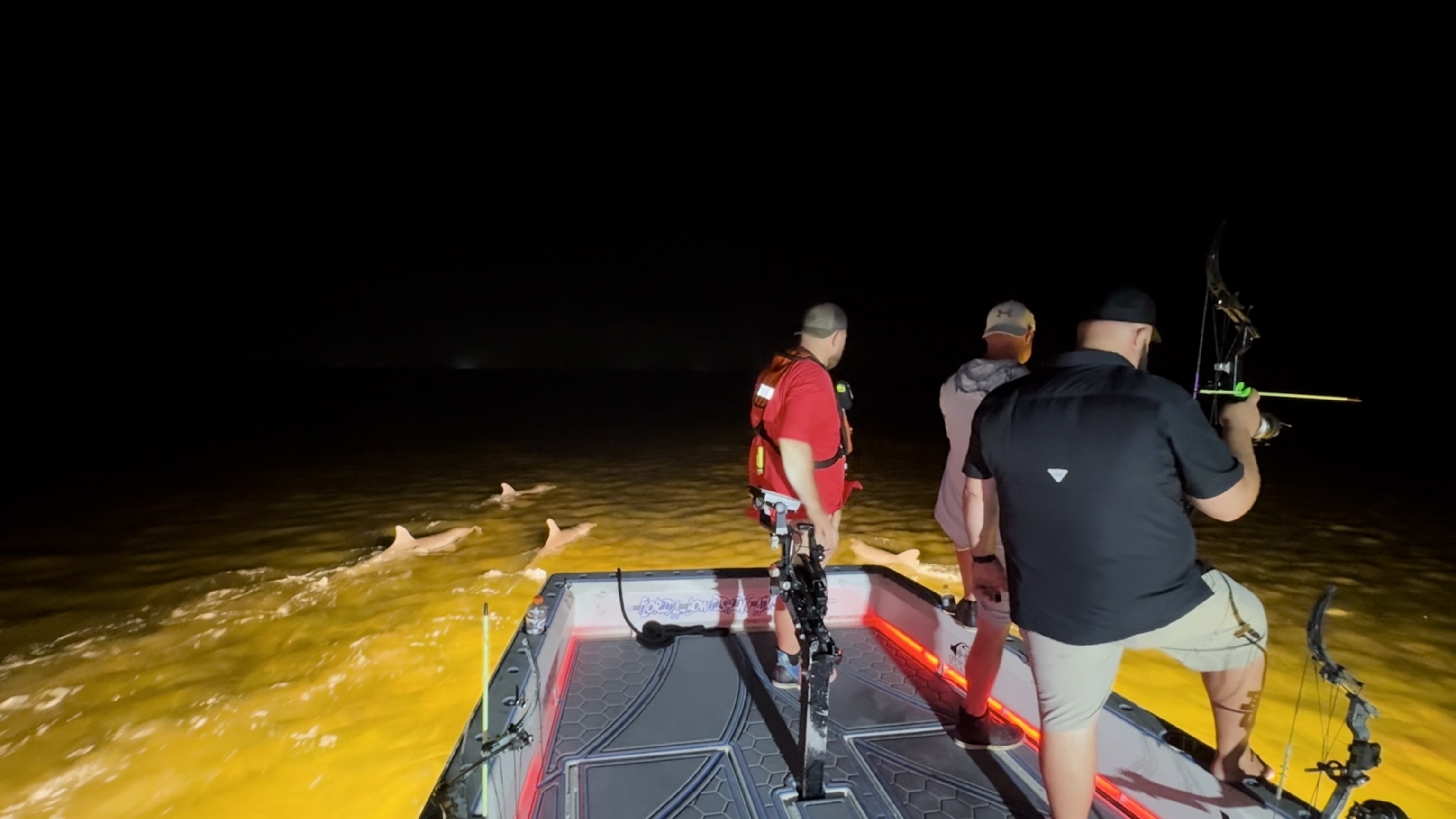
One evening in July, just before sunset, Captain Justin Dymond steers his boat away from a marina on Florida’s Nature Coast toward a quiet stand of mangroves. Then he cuts the engine.
Dymond has brought a handful of recreational anglers for a bowfishing adventure out on the Crystal River. However, the fishing hasn't begun. Instead, they wait as thousands of noisy purple martins gather overhead, swirling into a tightening vortex before settling into the mangroves below.
Soon though, it quiets. “We’ve got a dolphin here,” Dymond announces to the group.
The animal circles the boat, occasionally lifting its head above the water and whistling through its blowhole, as if trying to get Dymond's attention. "Hi Crystal," he says.
A few moments later, another fin breaks the surface. “There’s Halo,” he says. Then another appears. By dark, six bottlenose dolphins have gathered around the boat. Dymond recognizes each one by the small nicks and notches on their dorsal fins: Crystal, Halo, Tix, Echo, Baja, Bonnie.
With everyone accounted for, he flips on the lights mounted around the boat and shifts into gear. As the vessel glides forward, the dolphins fall into formation, cruising alongside it in water sometimes just a foot deep. “They’re like border collies going to work,” says Dymond. The boat lights illuminate schools of mullet, snook, redfish, sheepshead, stingrays, sea turtles, bonnethead sharks, alligators, and more.
(These dolphins have orca ‘friends.’ They may have an ulterior motive.)
One dolphin eyes a needlefish at the surface, then spins around to chase and snatch it before swallowing it in one gulp. “That’s like their favorite fish,” says Dymond.
For the next seven hours, Dymond, the dolphins, and his Florida Bowfishing Adventures clients hunt together in mangrove creeks and oyster beds. The dolphins go first, spooking resting sheepshead out of the rock pilings in the river. As they feast on their quarry, the bowfishers line up on the other side of the boat to shoot the fleeing fish. Dymond watches it all carefully to make sure no shots are fired too close to the dolphins. “Sometimes they mess up my shots, they do,” he says. But for him, the benefits of sharing prey with the dolphins outweigh the cons.
Dolphins have a reputation for following commercial fishing boats and stealing their catch in a relationship that often puts them in conflict with people. But in a handful of places around the world, scientists have documented a phenomenon that defies that reputation: symbiotic hunting—a relationship where both dolphins and humans benefit.
In southern Brazil, bottlenose dolphins herd mullet toward waiting beach-casting fishers before signaling the precise moment to cast their nets. Along Myanmar's Ayeyarwady River, Irrawaddy dolphins respond to fishers tapping their boats by driving fish into cast nets, then feeding on fish trapped along the edges. And in India, Indo-Pacific humpback dolphins feed near active fishing nets. In some cases, these traditions have persisted for generations, passed down among people and, researchers believe, among dolphins.
(How dolphins use tools, teamwork, and trickery to get their dinner.)
What’s happening in Crystal River is an entirely new relationship, and the only one documented in the United States.
“This is a pretty cool counterexample to all the other ways that humans interact with nature,” says Mauricio Cantor, a National Geographic Explorer and marine biologist who studies these interactions in Brazil and India. “It’s inspiring to have those things existing.”
Cantor is among the scientists who are trying to discern what conditions in nature allow this rare type of cooperation to emerge and persist. Is there something about the social dynamics of these particular dolphins that encourages cooperation? How does the human-dolphin relationship affect the rest of their ecosystem? And how do you preserve the human-dolphin relationships that already exist?
In Dymond’s case, it all started with a boat captain who began to question his long-held view of dolphins as competition.
Dymond grew up in Crystal River, where life revolved around the water. By age 10, he and his friends were taking small jonboats into the backcountry. Becoming a fishing guide wasn't just a career—it was the dream. "If you're a kid in Crystal River, for 90 percent of kids here your dream is to be a fishing guide," he says.
But he never could’ve imagined at 36 he’d be spending every night with the dolphins that used to drive him nuts as a bowfisher whose sport involves shooting fish from a boat with a bow and arrow. When dolphins came around, they mucked up the water and made it so much harder to get a shot off that Dymond used to leave whenever they turned up.
Yet Dymond recognized these dolphins were intelligent hunters—and over time he began to wonder if they could help him catch more fish by flushing them into view. “Everything I do relies on vision and being able to see into the water,” he says.
The relationship evolved gradually. The first dolphin to regularly show up was Crystal around 2013. At first, Dymond saw the dolphin only once a month or so, keeping its distance from the boat. But over thousands of hours on the water, Crystal inched closer and within five years it had become a regular alongside a few other dolphins. It was around 2021 that the relationship deepened again, as the dolphins began pushing fish toward Dymond all night and showing him just how effective they could be as hunting partners. “Every year it gets better and better,” he says.
(Watch orcas and dolphins team up to hunt—a possible scientific first.)
Now, the small group of marine mammals know the sound of his engine and when he will turn left or right. And he’s learned their patterns too. He watches how Crystal and Bonnie spend the longest flushing fish from rocks. “All the guys know how to do a little bit, but these guys really mastered that part,” he says. “They don't leave a rock unturned.” He also discovered that Crystal is actually a male dolphin, not female.
In 2023 Dymond reached out to Stefanie Gazda, a National Geographic Explorer, dolphin biologist, and founder of the local Cedar Key Dolphin Project, to ask about what he was seeing.
"I told her I thought something special was happening out here," Dymond says.
Gazda joined him on the water that fall and realized pretty quickly that he was right. The dolphins weren’t simply following a boat for an easy meal. Instead, she suspected they were exhibiting specialized foraging behavior—a hunting strategy practiced by only certain individuals within a population and learned over time.
"Not every dolphin is doing this," she says. Of the roughly 1,200 dolphins Gazda has documented in the region only about 30 to 40 have ever turned up at Dymond’s boat, and there are even fewer regulars.
Gazda became interested in the region in 2001 after a local fisherman captured a different specialized feeding behavior, now known as “driver-barrier” behavior, in which one dolphin would herd fish toward a line of dolphins that formed a barrier to prevent its escape.
Around the world, bottlenose dolphins are famous for inventing unusual ways to hunt. In Shark Bay, Australia, some use marine sponges as tools to protect their snouts while searching the seafloor for prey. Others create rings of mud that trap entire schools. Each behavior is practiced by only part of the population and is learned socially, either from a peer or their mom, rather than hard-wired genetically.
To understand whether the dolphins in Crystal River are truly specializing, Gazda is studying what happens when they aren't with Dymond: who they are, where they spend their days, and how their nightly hunts might affect their health and social behavior during the day. But they have so far been almost impossible to locate. "I joke that it's almost like the night dolphins don't exist," Gazda says. Crystal, for example, has only been seen once during the day.
(How female dolphins know which males to avoid.)
When researchers have encountered them, however, the dolphins are usually socializing rather than feeding—which to Gazda suggests that the dolphins that specialize in nighttime feeding alongside Dymond’s boat may also form stronger bonds with one another.
A similar phenomenon has been documented in Brazil, where a centuries-old relationship has become one of the world's best-studied examples of cooperation between humans and dolphins.
More than 4,000 miles from Crystal River, in Laguna, Brazil, dolphins herd schools of mullet toward shore before giving fishers a subtle cue—a tail slap, a head slap, or a sudden dive—that signals the precise moment to cast their very heavy nets.
Cantor and his colleague Fabio Daura, a biologist at Federal University of Santa Catarina in Brazil, have spent the last 20 years documenting and analyzing not only how the dolphins and fishers work together, but what the relationship means for both species and the ecosystem they share.
“It's a constant learning process from both species, and it's been going on for multiple generations,” says Cantor. “That means it's learned for sure … it's definitely not genetic.”
Scientists don’t know exactly how this relationship formed, as there are no records, but local fishers tell stories about their grandfathers who fished with dolphins and have now taught them how to do it too. It seems both the humans and dolphins were in the same place at the same time, trying to fish, and over time, realized they could get more by working together, says Cantor.
Cooperative relationships often begin with each participant acting in its own self-interest, says Cantor. If those interactions consistently benefit both sides, “it can evolve into something more elaborate” as dolphins and humans learn to recognize and respond to one another.
These interactions are not always good for dolphins, says Cantor. It puts them in closer contact with boats, which could hit them, and it increases their exposure to noise pollution. If they learn to beg for food, it could even lead to social isolation.
But research shows that dolphins in Laguna that cooperate with fishermen have a higher chance of surviving to adulthood than dolphins that do not, says Cantor, possibly because they have easier access to food and are less likely to get caught in fishing nets, he says.
In the last five years, Cantor and Daura have also attempted to measure what would happen to the entire ecosystem if humans and dolphins stop fishing together in Laguna, says Daura.
Their preliminary research suggests that the entire ecosystem can benefit when dolphins and humans team up. For example, in simulated scenarios when fish are scarce, humans who didn’t or rarely cooperated with dolphins experienced a precipitous decline in total catch, says Daura, while stronger cooperation buffered some of those losses. “It seems that the interactions have a big role in the equilibrium of this ecosystem,” says Daura. “In that sense, cooperation is not simply another interaction within the food web; it can actually influence how that food web functions.” The researchers are still exploring why this might be the case.
Because even after decades of study, fundamental questions remain. Why do some dolphins learn the behavior while others never do—and why is it more often females? The more examples scientists find, the closer they may get to an answer.
Over years of nighttime fishing, Dymond has come to see the dolphins who gather around his boat as true partners.
But Gazda says it’s not clear yet if this relationship can truly be called a cooperative one like the human-dolphin fishers in Brazil. The challenge is knowing the intention of the dolphins—whether the animals are simply taking advantage of an opportunity or purposefully adjusting their behavior in response to humans.
“It’s really clear the dolphins are getting a benefit from Justin's boat lights because they are getting fish that are being spooked by the light—that they can then see and chase,” says Gazda. But they may simply be exploiting that opportunity rather than looking at Dymond as a hunting buddy.
When Gazda told Dymond that, “he was a little bummed out,” she says.
But perhaps he shouldn’t be.
Cantor agrees that it's too early to know whether what is happening in Crystal River should be called true cooperation, but “that’s almost beside the point,” he says. Whether it began as coincidence, opportunism, or something more, years of repeated encounters have created a relationship that benefits both sides.
And, he adds, “there could be hidden benefits and hidden costs. I'll be curious to see how this will play out in the long term.”
For him, what’s just as significant is Dymond’s transformation. “His own personal relationship with not only the dolphins but with the whole system changed from a more appreciative or more positive perception, and I think this is really key and really needed,” says Cantor.
Dymond has become an advocate for marine life in the area. Because he’s on the water every night, he’s an extra set of eyes for scientists and wildlife managers, reporting when he sees sick or injured manatees and dolphins, and offering his boat to help recover animals or retrieve cold-stunned sea turtles.
He’s also become an advocate for the river, which faces threats from lack of healthy seagrass and overgrowth of algae due to pollution and over-development, as well as changing environmental conditions. "It used to be called Crystal River for a reason," Dymond says, noting that there’s less fish every year. "I hope I'm wrong. I'd love to do this for the next 30 years. But in the last five years, water quality has gone downhill so bad. It's terrible."
For Gazda, the project also highlights the value of local knowledge. "Scientists shouldn't dismiss the average fisherman.” They are the ones out there on the water every day, she says.
Indeed, the next night, Dymond preps the boat at the marina. Tonight, instead of fishers with bows, he’s got Gazda and her team loading the boat with cameras, hydrophones, and tools to collect dolphin snot in their ongoing quest to understand this unique group.
He returns to the same quiet cove and cuts the engine, and sure enough, the dolphins are waiting, ready to hunt.
