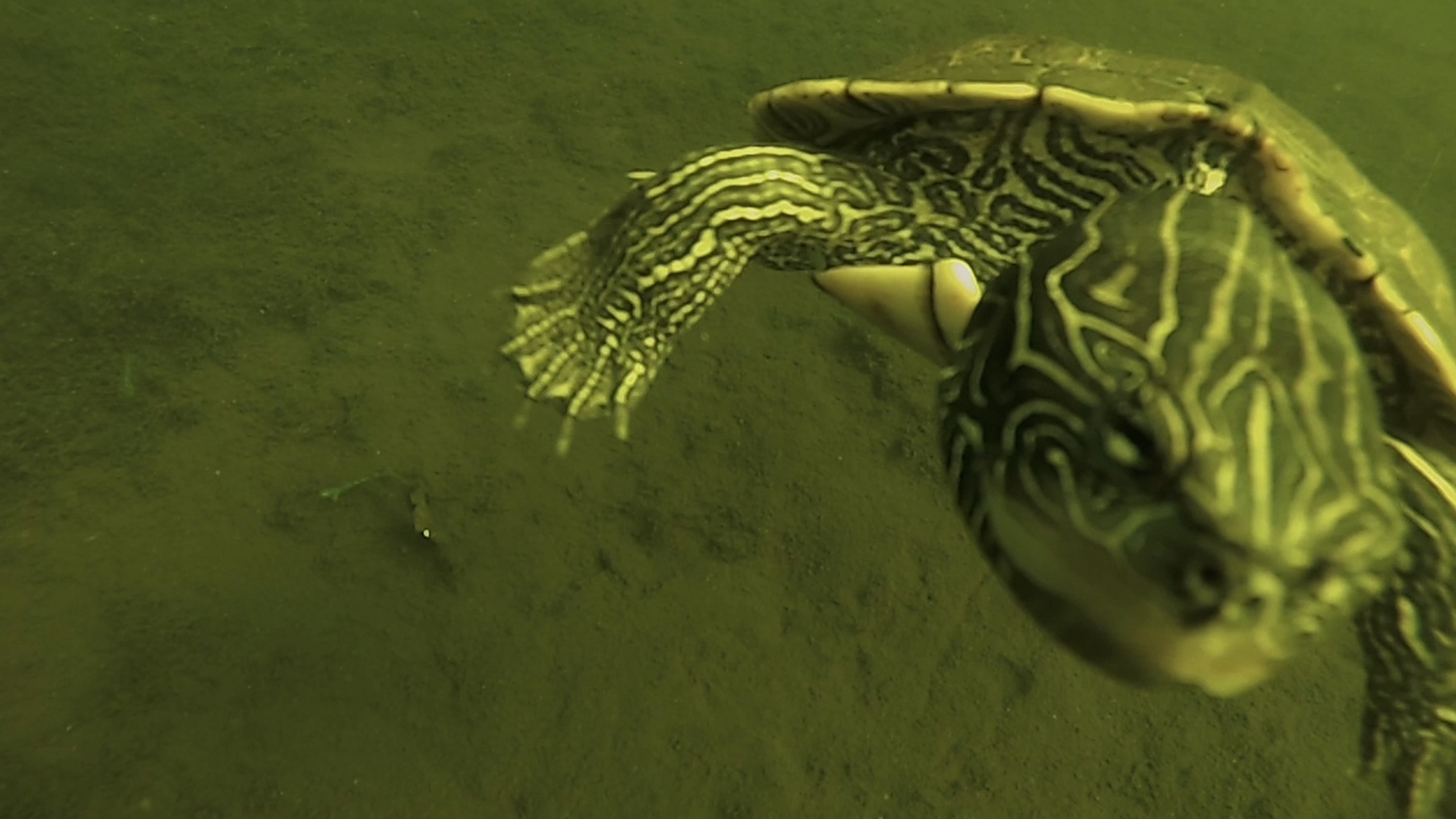
What scientists learned from a mysterious surge in Canadian turtle deaths
Scientists have been closely monitoring a map turtle population after 10 percent died in 2022. They found a surprising culprit, and are left concerned for the future.
Each spring, biologist Grégory Bulté catches turtles that have spent the winter hibernating under the frozen surface of Ontario’s Opinicon Lake. For over 20 years, he’s marked and returned turtles to the water as they wake from their slumber so he can keep an accurate head count.
In April 2022, he spotted something he hadn’t seen before: a dead turtle in the water.
Its shell was smashed, and its limbs were missing. Bulté, an associate professor at Carleton University, went home for his wetsuit and returned to swim in the area. He found another dead turtle, then another. Soon, he was filling bins with them.
"At first I was afraid," he says. "You just keep picking them up, saying 'when is this going to end?'"


This was the first and, so far, the only time Bulté had ever seen a mass mortality event in this population of map turtles, a species found in the midwestern region of North America. In the end, he counted 142 carcasses with broken shells and missing limbs—about 10 percent of the lake’s population.
The only resident powerful enough to crush turtle shells, Bulté says, is the river otter. Normally, hibernating map turtles are protected from predators by a thick sheet of ice. Somehow, holes in the ice had allowed river otters to dive in and make the sleepy turtles their meal.
"It’s like an all you can eat buffet for hungry otters,” says Bulté.
He suspects that warming temperatures will create more opportunity for otters to dive under the ice. Human residents also create holes the ice, something that Bulté fears could put the turtles at greater risk. Together, these factors could spell disaster for the map turtles of Opinicon Lake, which is part of the Rideau Canal. Rideau Canal is a site that is part of Preserving Legacies, a global project supported by the National Geographic Society that works with communities to help adapt cultural heritage sites to the effects of climate change.
Bulté continues to track the population and learn more about what’s happening underwater, but he fears the 2022 deaths were a “warning sign.” Was 2022 just the beginning of the end for Opinicon Lake’s map turtles?

A rare adaptation
When Bulté found the dead turtles, the surface of the lake was just beginning to melt after a long, miserable winter. Snow blows sideways, sharp as needles, and the temperatures drop below freezing. It’s inhospitable, especially for a cold-blooded animal like a map turtle.
Indeed, most reptiles prefer warmer climates, and Ontario's map turtles are a rare exception. From November through April, they hibernate under the ice without coming up for air once, instead absorbing oxygen from the water, their skin acting like gills. They stall their metabolism by reducing their body temperatures to one degree Celsius. Incredibly, they still move under the ice, possibly to access more oxygen-rich water.
Bulté sees the turtles almost everywhere on the lake in the summer. In the winter, they concentrate in a few clusters, with most of them hibernating in groups in the shallow waters around one island in the middle of the lake. This may be a defensive measure — perhaps there is good ice coverage in that part of the lake, he says. The shallow water means the turtles rest closer to the ice, giving them access to colder, oxygen-rich water that can help sustain their hibernation through the winter.
It also makes them more vulnerable. Fully exposed and grouped together in shallow water, the sleepy turtles are too slow to hide or escape. An otter who gets access to this hoard finds a "very, very easy meal," Bulté says.
Bulté speculates that the number of dead turtles he saw in 2022 was actually larger than his official count, as some turtles could not be recovered. Of the 142 turtles, 105 were males, and no adult females were killed. Females are significantly larger than males, so the otters favored the males, Bulté says, rather than try to crush the females' large, thick shells.
"It's probably a slow road to bounce back from that," says Peter Lindeman, a professor of biology at Pennsylvania West University who has studied the northern map turtles of Presque Isle State Park on Lake Erie since 1999.
He cites the case of a three-year-long mortality event in Algonquin Provincial Park, Ontario, when river otters preyed on wintering snapping turtles in the late 1980s. Twenty-three years after the event, a follow-up study found that the population had yet to fully recover.
(After 41 years in captivity, this celebrity sea turtle is finally swimming home)
A changing ecosystem
The map turtles of Opinicon Lake have adapted to an environment that is far from untouched—both by humans and other species.
When the Rideau Canal was formed in 1832, Opinicon's water level rose by a few yards. It's unclear whether map turtles already inhabited the lake before the canal was built, but in the 20 years that Bulté has studied them, most of them have returned to the lake year after year to hibernate. The females' diets consist of zebra mussels and mollusks called banded mystery snails, both invasive species.
And river otters have made a reappearance. Fur trapping caused a decline in river otter populations in the 19th century. They've since bounced back thanks to conservation efforts and are now listed as Least Concern by the International Union for Conservation of Nature.
It used to be rare for Bulté to see otters at Opinicon Lake, but now, he says, "otters are definitely coming back."
Their reintroduction, combined with human activities, may end up having deleterious impacts on the turtles in Opinicon Lake.
"Shoreline development is one of the most urgent challenges that we're dealing with," says Cass Stabler, an ecologist for Ontario Waterways and the Preserving Legacies Site Custodian for the Rideau Canal. Map turtles are found in freshwater bodies, not backwater swamps, says Bulté, and the shift from small cottages to larger suburban developments in the Opinicon area is likely to impact them. He's finding more and more turtles that have been hit by boats, the propellers slicing through their shells.
But at the moment, he's most concerned with de-icing bubblers, which keep water from freezing in areas around boathouses and docks and are becoming increasingly popular in the area. By creating holes in the ice, bubblers add more opportunities for otters to dive in and grab turtles. Bulté has seen otters jumping in, just not within range of the hibernation site. (A warming climate may have a similar effect, melting ice and creating more holes for otters).


The 2022 mortality event was likely not due to bubblers—how the otters gained access to the turtles remains a mystery—though Bulté still worries that bubblers could become a problem, especially since the hibernation site is located just off the shore of a private island. Putting a bubbler near the site would be "catastrophic."
"If [the island] gets sold and somebody decides to keep the water open there, it's just the end of the population," he says.
(We thought we knew turtles. A new discovery raises a mystery.)
The iceberg principle
Bulté hopes to work with Stabler to identify hibernation clusters in other parts of the Rideau Canal. The turtles' faithfulness to particular sites makes them vulnerable to mortality events like the one he witnessed, so protecting these areas is crucial—if only we knew where the turtles cluster in winter, beyond Opinicon Lake.
It's one of many questions that, even after spending two decades with this group of turtles, Bulté still has about them.
"A lot of freshwater turtle work is constrained by the old iceberg principle," Lindeman says. "Seven-eighths of what's happening is happening underwater." Behaviors like hibernation are difficult to study, though new technologies like underwater drones may help fill these knowledge gaps in the coming years, he says.

Some of what Bulté has learned has been through pure chance. When he was having trouble finding females in October 2020, he realized they were burying themselves in the lake's floor to "hide from pesky males" during mating season. The males use coercive tactics like harassment and even biting, so hiding under the mud—sometimes with just their heads sticking out of the ground—reduces the costs of resistance for females.
Bulté hopes to learn more about this behavior using underwater cameras. He will also work with a wildlife statistician to find out more about the Opinicon Lake population's trajectory and determine whether the population is stable, increasing, or decreasing, as well as whether the male-female sex ratio has shifted due to the mass mortality event.
Of course, much depends on what he finds in April 2026. When the lake thaws this coming spring, will Bulté find his beloved turtles stirring from their slumber, shells intact? "I hope so," he says.
