Witness the Uncanny Spectacle of Millions of Mullet Swarming in the Atlantic
Just beyond the shoreline of the southern United States, the annual migration of the resurgent striped fish has become a breathtaking conservation success story.
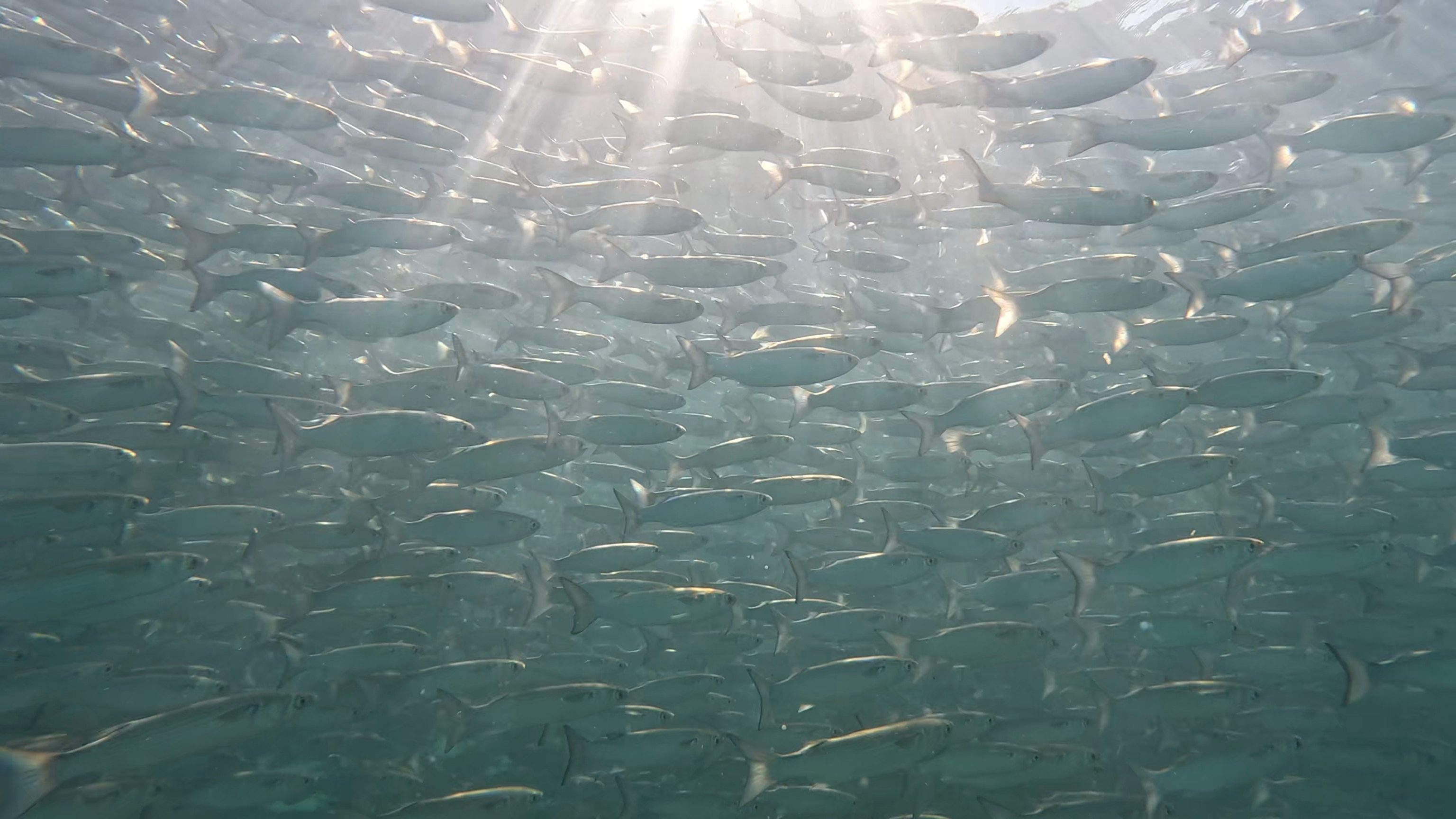
You can see them surging from the shore: a dark band across the water, a stream of silver fish paralleling the beaches along Florida’s Gulf and Atlantic coasts. For several weeks each fall and winter, the schools of migrating mullet can be a million swimmers strong, up to 40 feet across and a half mile long. They look like writhing sea monsters or oil slicks come to life. Approach one in a boat, and you split the school like Moses parting the sea. Behind you, the swarm reassembles effortlessly, the fish unbothered by the interruption. You sit in a bubble of empty water amid the rush of life.
For photographer and National Geographic Explorer Mac Stone, capturing the full majesty of the annual mullet run—one of North America’s largest and most visible marine migrations—meant going even further, dropping into the clear waters south of the Everglades, free diving among the fishy millions. The experience was disorienting. “You can’t see anything, no horizon line, no fixed point that you can focus on,” Stone says. “You just have a wall of fish. My brain broke multiple times.”


Most people, if they know the striped mullet at all, know it as a humble baitfish. Scientists’ descriptions can sound almost contemptuous: The fish are “thick-bodied” and “blunt-snouted,” according to one government report. Typically a foot or so long, they’re bottom-feeders found all over the world, in tropical, subtropical, and temperate waters. And since their massive schools make for easy pickings, mullet have long been a cheap staple of coastal kitchens, although their fatty flesh is too muddy tasting for some palates. Around the southeastern United States, they’re caught mostly as bait and to harvest roe for export to Asia, where it’s a delicacy.
Off Florida’s coast, today’s impressive runs are, in part, a testament to the impact of one forward-thinking policy. Some 30 years since the state banned the use of entangling fishing nets—underwater sieves that once made it easy to haul in staggering numbers of mullet—the population is robust. Florida’s commercial mullet catch has dwindled, and some longtime mullet run observers say the migration has only become more spectacular.
And that abundance has a massive ripple effect for other species. “You can see tarpon, sharks, king mackerel just turning cartwheels,” says Captain Jim Ross, owner of Fineline Fishing Charters on the state’s Space Coast, near Cape Canaveral. For the mullet’s many predators, the annual run prompts feeding frenzies, the little fish leaping out of the water to evade the bigger ones. The resulting churn looks like grenades being detonated. Seabirds hover overhead, waiting for their chance to dine.

The mullet may be humble, but their pursuers are often big-name sport fish, meaning the run creates a business opportunity for captains like Ross. During the migration, he says, the trophy fish are “so focused on their mission … that the fishing becomes extremely easy.” Along the Space Coast, where a long line of beaches gives easy access to the schools, charters book clients months in advance.
When they’re not luring anglers to the coast, mullet spend most of their lives in freshwater rivers and estuaries. But as the days shorten and the water cools, they gather and swim downriver, seeking brackish estuaries that serve as staging areas, before venturing offshore to spawn. Many will travel less than 20 miles, but a hardy few migrate hundreds of miles along the coast.
The epic migration turns the mullet into an ecological bridge, linking profoundly different habitats into one food web. Before the run, the mullet hoover up bits of bacteria and algae from the muck of the river bottoms. The mullet, in turn, are eaten by predators in the ocean or swooping from the sky. Their place in the middle makes mullet what biologists call an indicator species, a way of monitoring the entire system. And the spectacle of their massive runs in Florida is suggestive of healthy habitats, says Stephen Kajiura, a biologist at Florida Atlantic University. “It’s interesting from a visual perspective,” Kajiura says, “but it’s also a good ecological indicator.”
Both impacts, visual and environmental, are what lured Stone to Florida’s Everglades, home to the mainland U.S.’s southernmost mullet run. (North Carolina is also known for impressive runs, but there, where fishing nets are less regulated, officials are seeing fewer older females—a warning sign of overfishing, which the state is working to address.) Stone followed the schools by boat and helicopter. From the latter, he watched for dolphins engaged in a behavior known only in a few places outside Florida, using their flukes to stir up mud rings that surround the schools. When the spooked fish jump from the water, the hungry dolphins are waiting to catch them.


But capturing a close-up of mullet leaping away from predators—what Stone calls the “holy grail” of mullet photo ops—proved tricky. Stone knew he’d have to get wet to do it. Swimming amid the rush of the silver fish, he says, made him feel like a “chicken nugget,” a vulnerable target for sharks—of which he saw several. Getting a mullet’s-eye view had an upside, though. After going a season in the water without photographing a jumping fish, Stone began noticing a telltale behavior. Right before a predator would swim into their midst, a few of the more perceptive mullet would switch direction instants before the whole school took evasive action.
“So I started to just cue into that little change in movement of fish,” he says. “As soon as fish started going the opposite way, I turned my camera back to the way that they came.” And soon enough, he managed to capture the leap, a small but mighty maneuver, a moment of acrobatic drama from a species known for putting on a show.


