These bats make intricate tents out of leaves
A team of National Geographic Explorers is studying how these bats developed their architectural expertise—while cataloguing the various styles of tents they make.
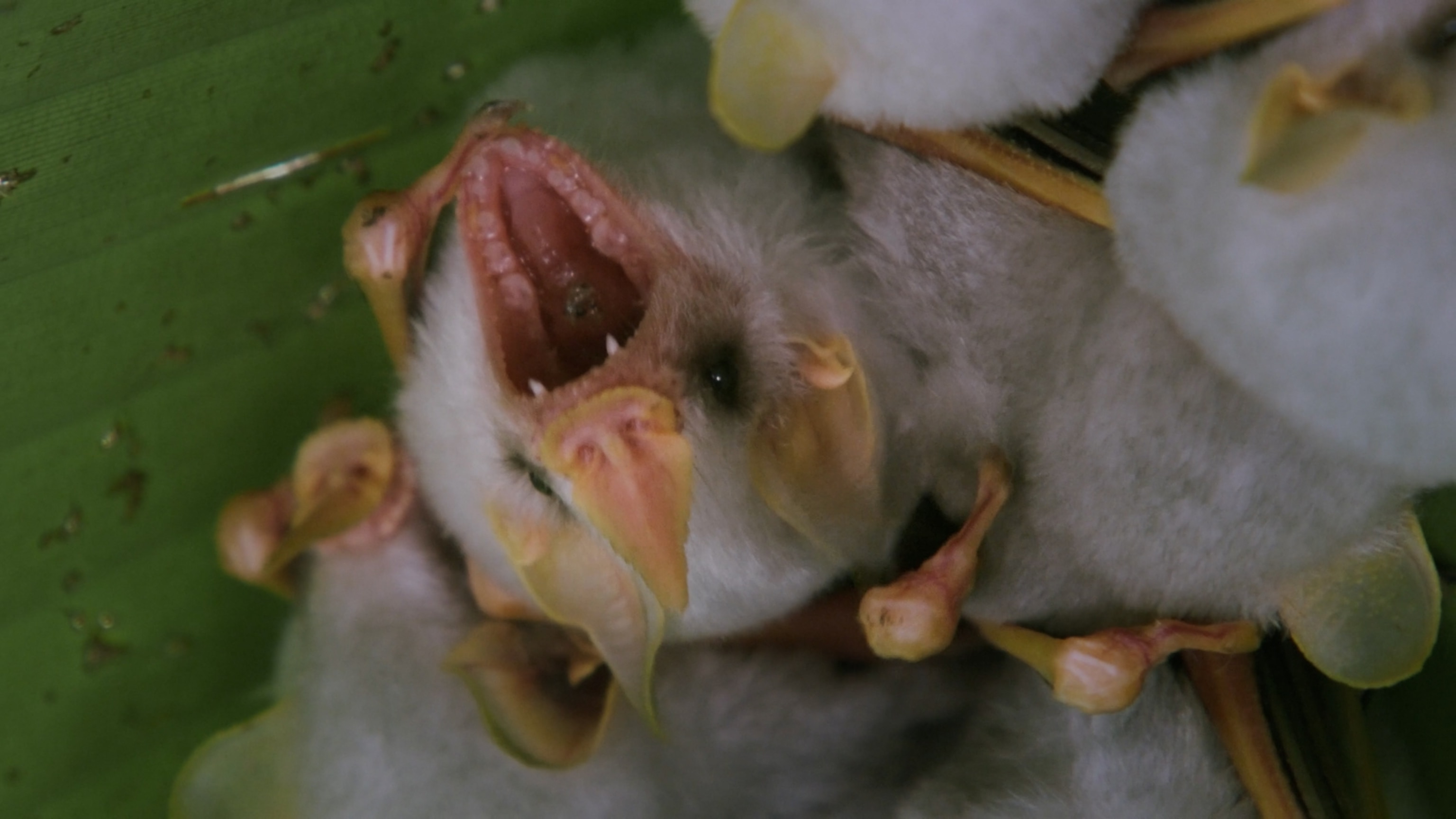
In the tropical forests of Central and South America, skilled architects create intricate structures without the help of blueprints, tools, or even hands. Using only their teeth and claws, certain bats can fashion leaves into cozy tents.
Little is known about these intrepid designers of their own tree houses, but a team of National Geographic Explorers is working to change that. Bernal Rodríguez Herrera, a professor of biology at the University of Costa Rica, leads a team of bat biologists, a photographer, a scientist-illustrator, and two wildlife filmmakers dedicated to exploring the mysteries of these bats. The group of eight travels through Latin America, from Mexico to Brazil, cataloging the bats’ various architectural designs, the types of plants they use, and how they contribute to the health of the forest.
“We are trying to tell stories to help humans think of bats as not so different from us,” says Rodríguez Herrera. These bats “choose a safe place for a neighborhood. They build a home that protects them. They live in family groups. And they help us, performing an important service by dispersing seeds.”

Bats that build
There are at least 22 species of New World leaf-nosed bat (family Phyllostomidae) known to make tents, and they use more than 77 different species of plants as building materials. The bats create tents by making precise cuts around, but not through, major veins on a suitable leaf. This makes the leaf collapse and change position, but maintains the flow of water and nutrients, keeping it alive.
So far, the team has documented eight distinct styles of tent architecture, says Ana Lucía Arévalo, a master's student at the University of Costa Rica and researcher on the project.
“One type looks like an umbrella, another like a camping tent,” she says. “One bat species makes symmetrical cuts to form a shape like the letter J. For other tents, the bats cut the stems of several leaves to form a cone.”
Finding these tents requires dedication, patience, and a trained eye, according to Rodríguez Herrera. These bats have not been well documented in the past partly because few people can recognize their tents in the wild. That’s one reason why the National Geographic team’s goals include training young bat researchers and educating the public, in addition to scientific discovery.
Most of what is known about Neotropical tent-making bats comes from studies of a few locations in countries like Costa Rica and Panama. Last year, Arévalo, Rodríguez Herrera, and colleagues published a first-of-its-kind report on Guatemala’s tent-making bats. Although at least 10 of the 22 tent-making bat species are found in Guatemala, the behavior had never been systematically documented there before.
The researchers surveyed two locations in northern Guatemala’s Maya Biosphere Reserve, the largest tropical lowland forest in Central America. They found umbrella-shaped tents in two types of palm trees, used by two different bat species. What’s more, they described a type of ceiling modification to the umbrella tents in one tree species that had never been reported before.
“This paper really emphasizes that we're still discovering new things about the ecology of tent making,” says Angelo Soto-Centeno, assistant curator in the Department of Mammalogy at the American Museum of Natural History in New York, who was not involved in the research. “There is complexity there that we do not fully understand.”
Habitat heroes
How these bats eat also furthers the part they play in maintaining their home habitat.
In tropical forests, fruit-eating bats disperse small seeds by ingesting them and passing them through their gut. Now, it’s becoming clear that tent-making bats play an underappreciated role in dispersing large seeds (0.3 inches or larger), as well.
Each night, tent-making bats leave their tents to forage for figs and other large fruits. They bring these food items back to their tents to consume them, then drop the seeds on the forest floor below.
“Most bat diets have been studied by catching a bat and sampling its feces when it poops in a bag,” says Soto-Centeno. “But that doesn’t tell you anything about items that are too big for the animals to swallow. These scientists have been able to get around that by looking at the seeds found under tents.”
Rodríguez Herrera has shown that the diet of tent-making bats includes fruits weighing as much as 80% of their own body weight — which, depending on the species, can range from 0.2 ounces (comparable to a grape) up to 2.5 ounces (like a large chicken egg). He compares the feat to a human traveling nearly four miles while carrying a 100-pound sack of potatoes in their mouth.

For two years, the team collected data from 70 study plots in forests throughout Latin America. They found that tent-making bats disperse seeds from over 100 plant species, including trees, shrubs, palms, and vines, some of which are economically valuable to humans. By moving the seeds of these species around, tent-making bats help maintain the health and diversity of the rainforest and fuel reforestation.
And if that’s not reason enough to love these bats, they’re also adorable.
Some tent-making bats sport stripes or mottled markings, while others are pale all over, like the Honduran white bat (Ectophylla alba). Rodríguez Herrera, who has studied this species for over 35 years, thinks it is an especially beautiful bat. “It looks like a pig or a cotton ball,” he says.
The rest of the team is equally smitten. Arévalo says her passion for bats was ignited as an undergraduate, when she had the opportunity to see a bat up close and hold it in her hands. “It was like love at first sight,” she says.

Rodríguez Herrera and colleagues are in the process of publishing more of their discoveries, including new tent architectures, additional plant species used in tent construction, and further details on the role of these bats in seed dispersal and forest health. This year, they are expanding their fieldwork to Colombia and Guyana, as well as planning an expedition to Africa to investigate if tent-making behavior occurs there, too.
The team hopes that sharing their passion for these bats will encourage people to appreciate and protect the animals and their forest homes.
“When it comes to conserving animals, most people think of charismatic, fluffy, iconic species like tigers, pandas, or giraffes,” says Soto-Centeno.
“Projects like this help people see that bats rival all these animals in terms of their cuteness and fluffiness, and they provide ecosystem services that help us directly.”
