The surprising geological wonders hidden in the NYC subway
These mineral "icicles" hanging from the subway ceiling form like stalactites in caves and may contain clues to the city's past.
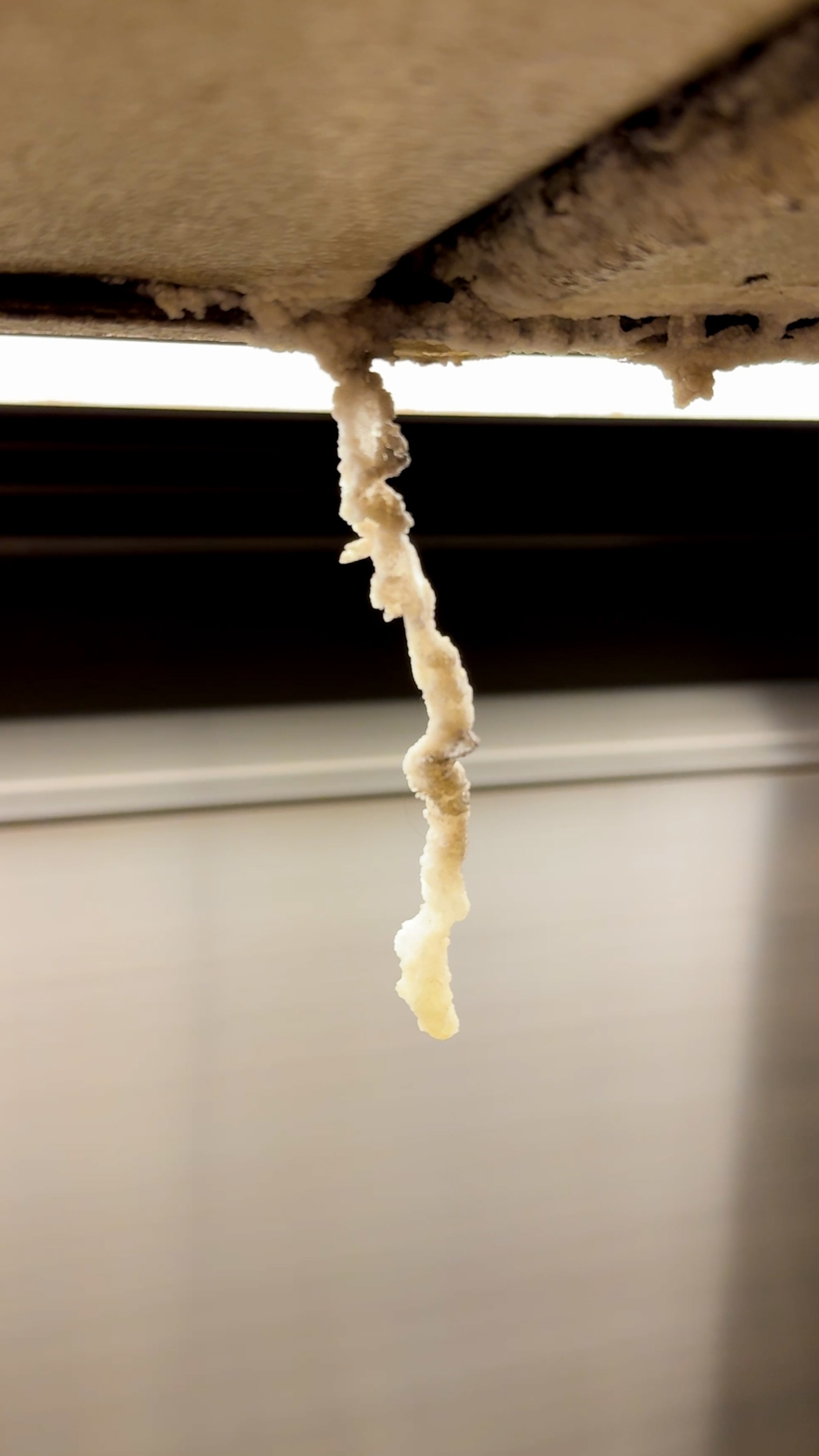
A hard thing about being a high school earth science teacher in a major city is that when I ask a group of students, “Have any of you ever been in a cave before?” they stare at me blankly. “Who remembers the experiment where we dissolved Alka-Seltzer tablets in vinegar?” I might follow up. More stares—but this time with squinted eyes.
Whether my students realize it or not, many of them have spent countless hours traveling to and from school in cave-like environments. New York City has its own cave system, run by the Metropolitan Transportation Authority and occupying an area of nearly 450 miles.

Our built environments are made of the same ingredients that make up the world's greatest natural wonders: mineral-laden rock and water. Given enough time, water can find its way almost anywhere—and in major cities like New York, aging infrastructure makes leaky structures commonplace. Where water seeps through cracks in concrete, hanging formations called calthemites can be found.
(How cities are fighting back against the 'heat island effect')
Anyone who has ever been on a cave tour has probably seen signs that read “Don’t touch the stalactites.” They are the hanging, icicle-like formations that are born from mineral-rich water that drips from the ceilings of caves. These decorations take thousands of years to form and give caves their signature look. If we touch them, the oils from our skin will discolor the formations, stop their growth, and make them unattractive to future visitors. We should probably see the same signs in the New York City subway system, too.
Calthemites are the anthropogenic brethren of the stalactite, and they exist all throughout our tunnel and road systems. The word calthemite is a combination of Latin and Greek origin roughly translating to “lime deposit,” and the ones we see in the subway system are composed of the leached calcium that comes from the mortar, lime, or cement that the water travels through. Once the solution finds an exit, it combines with carbon dioxide in the air to form a calcium carbonate stone. Minerals that the water picked up along its route begin to harden as a precipitate once the water drips away from the rock.
If compared against the largest known natural caves in the world, New York’s subway system would be ranked number one, besting Kentucky’s Mammoth Cave by roughly 20 miles—the NYC subway is 443 miles of track, while Mammoth is 426 miles of underground terrain. What makes New York’s cave system different is that it was carved out by humans for the purpose of mass transit. What they have in common is that they are both dark, damp, home to small organisms, and frequented by tourists.

Calthemites grow up to 300 times faster than cave-born stalactites. This is mainly due to the ease with which water travels through man-made materials compared with the limestone that is naturally found in caves, and subway tunnels generally have more air exchange compared with a sealed-off cavern. This provides them with the carbon dioxide they need to grow, while simultaneously purifying the air by reducing carbon dioxide levels. Their beauty comes in their variations. Their parent material determines their color. Some older deposits are long and thin and take on a straw-like appearance. Younger deposits are often still dripping, and if you look close enough, you can see calcium particles swirling within the suspended droplets before they fall to the floor.
(Henry Hudson faced a brutal mutiny—then disappeared. His fate remains a mystery.)
And there's potential to learn a lot about how our built environments have changed over time by studying these formations. I spoke with Daniel Babin, a marine geologist, climate scientist, and educator who lives in New York City. He suggested that we could study the cross sections of calthemites in a way that’s similar to how we analyze tree rings, ice columns, sediment cores, or cave speleothems to learn about our past climates before temperature records existed.
What makes calthemites unique, he said, is that they are akin to middens—ancient piles of refuse from past civilizations that help archeologists understand the activities and diets of people long gone. “The question is, how old are they really?” he says. “They can grow up to two millimeters each day. That's so fast!”
Using that metric, we could theoretically extrapolate the thickness of one of these structures to find out its age, which has implications for the history of the city’s population and its quality of life. “If a calthemite were old enough, we’d potentially be able to study how our water or air quality in the city has changed over time,” he says. “This could be linked to human health.”
The R train entrance was a three-minute walk away from our school, so I took a small group of my earth science students to see some rare formations. The sample I guided us to was so eroded that you could see the rusted re-bar attempting to reinforce the concrete holding the subway entrance together. I asked the group “Have any of you noticed these before?” as I pointed to a two-inch calthemite dripping next to our heads. They nodded and smiled as we created real-world connections to the cave diagrams we studied in class.


