The hidden ruins of the great Maya Snake Kingdom were almost lost to time
Calakmul remained relatively undisturbed until gum harvesters in Mexico led an American botanist to them in 1931. Here’s what was found in its remnants.

The Snake kingdom (Kaanul dynasty) was among the most powerful within the Maya realm. Lying deep within the Yucatan Peninsula’s jungle, close to Mexico’s current border with Guatemala, the kingdom was named Oxte’Tun, or “three stones place,” by ancient Maya. In Maya cosmology, three stones often refer to the three hearths of creation—a sacred concept associated with the origin of the universe and the founding of cities. The city is known today as Calakmul, a Maya term meaning “two adjacent hills” or “two adjoining mounds,” referring to the twin pyramids at its core: Structure II, the first to be built, is believed to represent the mythical mountain Witz, sacred to the Maya. Over time, the structure was overbuilt by successive Calakmul kings.
Calakmul reached the height of its splendor during the seventh and first half of the eighth century A.D., most notably under the seventh century rulers Yuknoom Cheen II and his successor Yukom Yich’ak K’ak’, known as Jaguar Paw, a name that symbolized royalty and strength.The city established significant political ties with other minor city-states as part of its strategy to counterbalance the power of its rival, Tikal (now northern Guatemala), and control the trade routes that ran north-south and east-west across present-day Mexico and Guatemala.
Calakmul, the great Snake kingdom, won victory after victory in the internecine wars against Tikal. But the power balance shifted in A.D. 695, when Jaguar Paw led his army against King Jasaw Chan K’awiil I of Tikal. The victory is recorded on a wooden lintel in Tikal, which reads that King Jasaw “brought down the flint-and-shield of Yukom Yich’ak K’ak’.”
(Scientists find tomb of a Maya king and his ancient treasures. But who was he?)
Reclaimed by the jungle
In the centuries that followed, the Snake kingdom and other powerful Maya empires declined. Wars broke out among them.Some scientists have proposed that there were also devastating droughts. The legitimacy of political and religious powers waned, and cities were eventually abandoned. Of the monuments known, the last one at Calakmul was constructed in A.D. 909; sometime after that, the once glorious city was reclaimed by the jungle. Calakmul remained hidden for 10 centuries.
Beneath the frieze
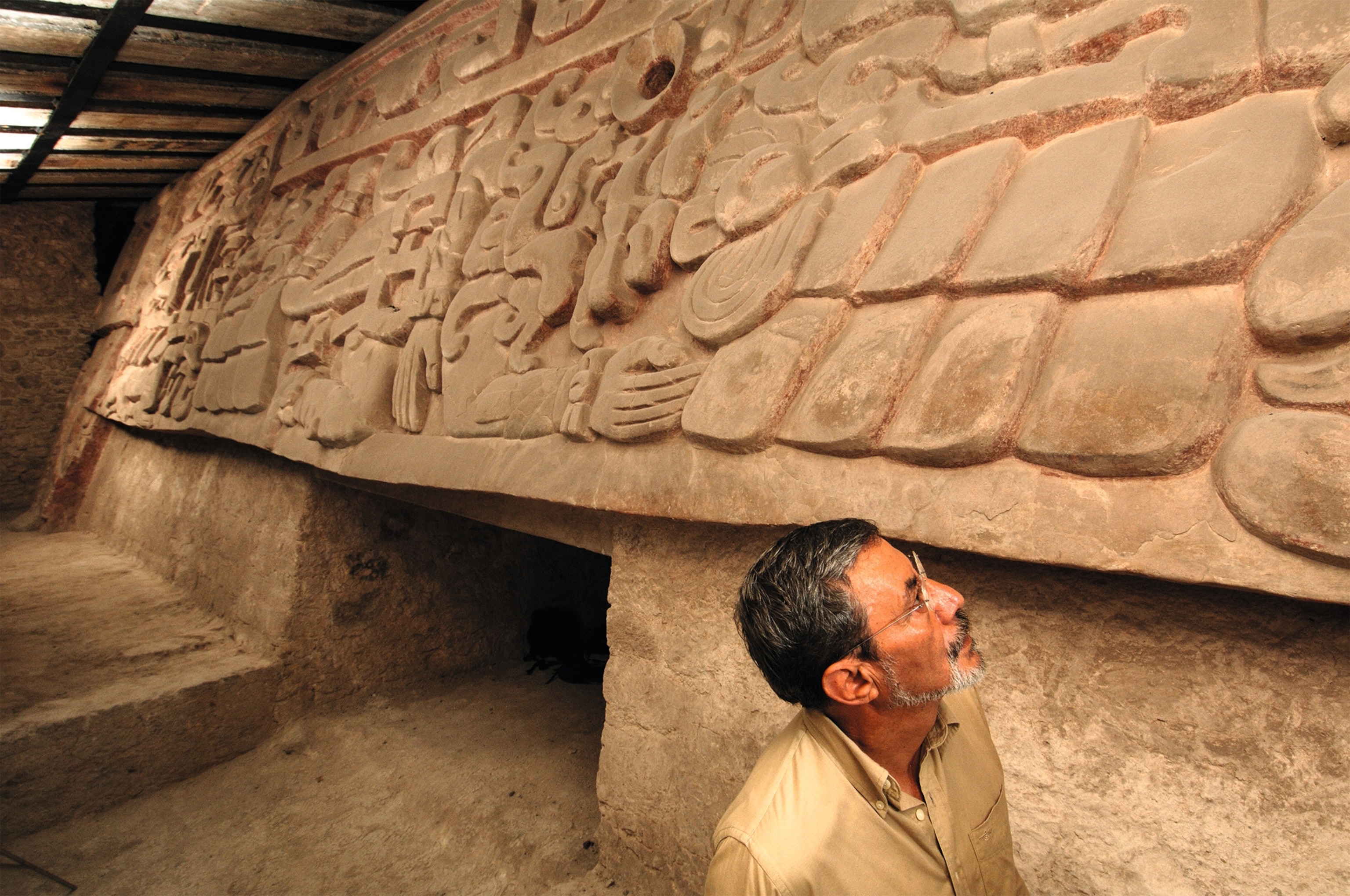
Despite Maya cities sparking interest among European and American explorers during the 18th century and before, Calakmul was brought to the forefront in 1931 thanks to Cyrus Longworth Lundell, an American botanist and archaeologist. Lundell was working for a chicle company in the area. Gum harvesting had boomed in the Mexican state of Campeche since the end of the 19th century. A group of chicleros (chewing gum hunters) took Lundell to see ruins buried in the jungle. Although he was not yet aware, he was looking at what remained of one of the most powerful Maya kingdoms.
Lundell reported his documentation of the site (photos and a map) to Sylvanus G. Morley, director of the Carnegie Institution of Washington’s research project at Chichén Itzá, another important Maya site in the Yucatán Peninsula. Soon after, Morley directed the first expedition to Calakmul and was impressed by the scale of the city and its sculpted monuments. In 1934 another expedition was organized, this time led by Karl Ruppert and John H. Denison, who drew up the first detailed plans of the site.

Despite Calakmul’s initial impact on the explorers and Mexican authorities, it wasn’t investigated further and remained known only to the chicleros. During the 1960s through 1980s, as demand for Maya artifacts soared among collectors and exhibitors, the isolated jungle city suffered significant looting. Many of the better-preserved stelae, depicting Maya royalty dressed in detailed finery on the day of their enthronement, were sawed off. All that was left behind were the blank or less detailed sides of the stelae, which in some cases ended up being defaced by tourists.

Hidden treasures
In 1975 Mayanist and epigraphist Eric von Euw began cataloging the inscriptions and images on the monuments. But systematic excavations didn’t commence until 1982, under the direction of archaeologist William J. Folan.
In 1993 archaeologist Ramón Carrasco Vargas took leadership of the Calakmul Archaeological Project. Under his direction, archaeologists, restorers, and other specialists have been revealing what the city was like in its heyday. They have uncovered a wealth of architecture and art, including a painted pyramid, monumental buildings fitted one inside another, palaces, stelae, and tombs of kings and queens containing impressive goods.
(Who were the Maya? Decoding the ancient civilization’s secrets)
Royal grave goods
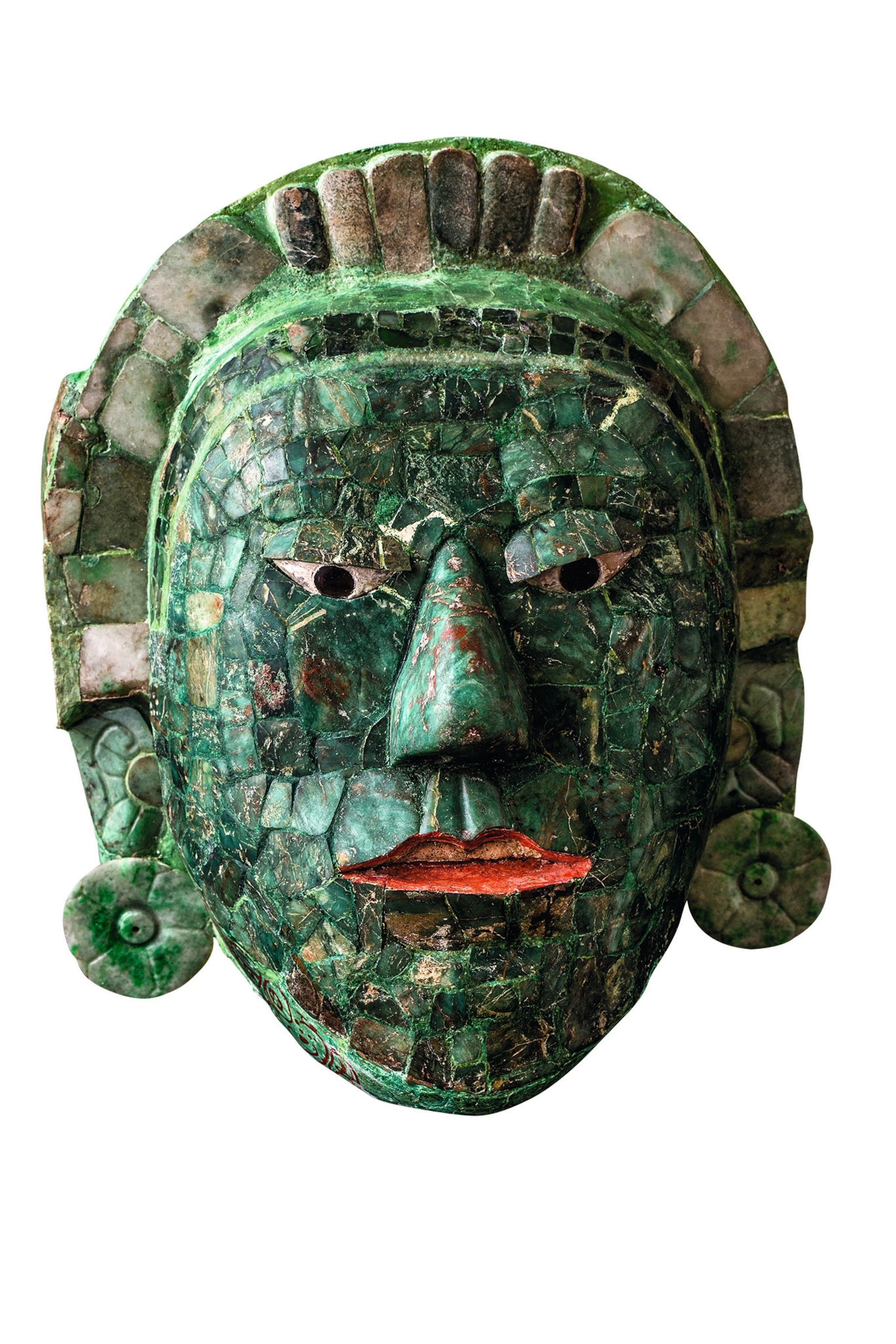


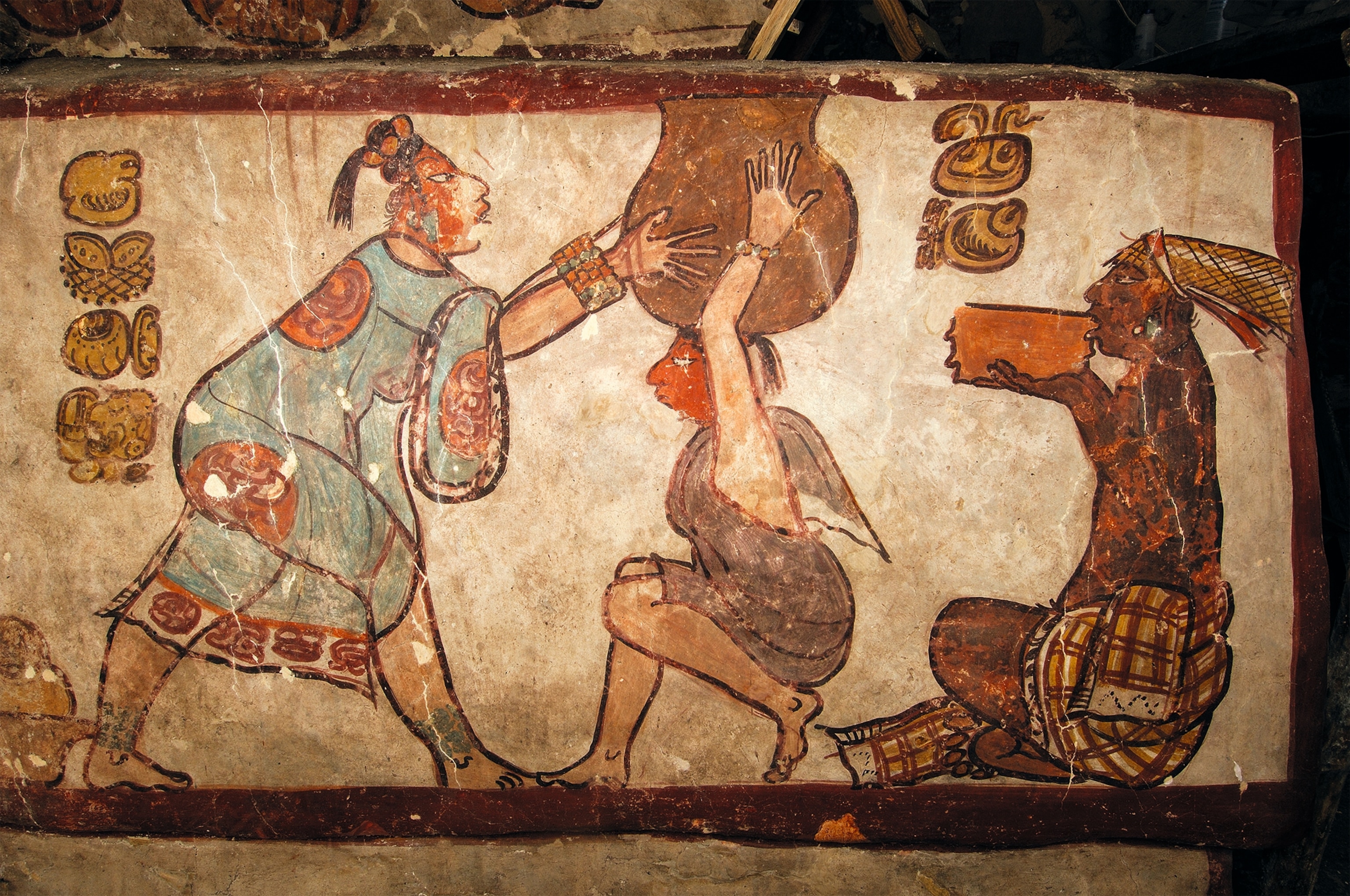
Excavations in recent decades have revealed some unexpected treasures along the way. A set of exceptionally well-preserved murals was discovered in Structure I in a sealed room within its sub-structure, a later addition.
Often referred to as the Calakmul murals, they depict vibrant everyday scenes— women preparing food, people exchanging goods. This subject matter is rare in Maya art, which most commonly represents the elite and ceremonial rites. As the murals were covered up shortly after being painted, they remain beautifully preserved.
Jaguar Paw’s tomb
In 1997 Vargas’s team discovered an unusual tomb inside Structure II. The colorful wooden sarcophagus, inscribed with hieroglyphs, had a vaulted structure reminiscent of the sacred caves of the Great Pyramid, which was believed to be a portal to the afterlife.The skeletal remains of a man lay inside, wrapped in animal skin and various fabrics. Offerings included a jade funerary mask and several luxurious vessels, some of which were made in the codex style, a type of Maya ceramic art that mimics the appearance of bark-paper books covered in hieroglyphs and painted illustrations. The tomb’s occupant was identified by a plate inscribed with the owner’s name: Yukom Yich’ak K’ak’ (Jaguar Paw).
(Archaeologists have discovered a 1,600-year-old Maya altar, surrounded by children's bones)
Paintings uncovered


Calakmul has been designated as a UNESCO World Heritage site since 2014, in recognition of both its cultural and environmental significance. With the help of rangers and surveillance cameras, the Mexican Army and police now keep a close eye on the site to protect it from looters and illegal logging. Calakmul is key to understanding ancient Maya culture. Its architectural ambition and the refinement of its grave goods reveal a society where power, ritual, and the cosmos were inextricably bound.
