See Florida's cowboy history come to life in this 54-mile cattle drive
The Great Florida Cattle Drive pays homage to the state's once-thriving cattle industry—and imagines what it may have looked like a hundred years ago.
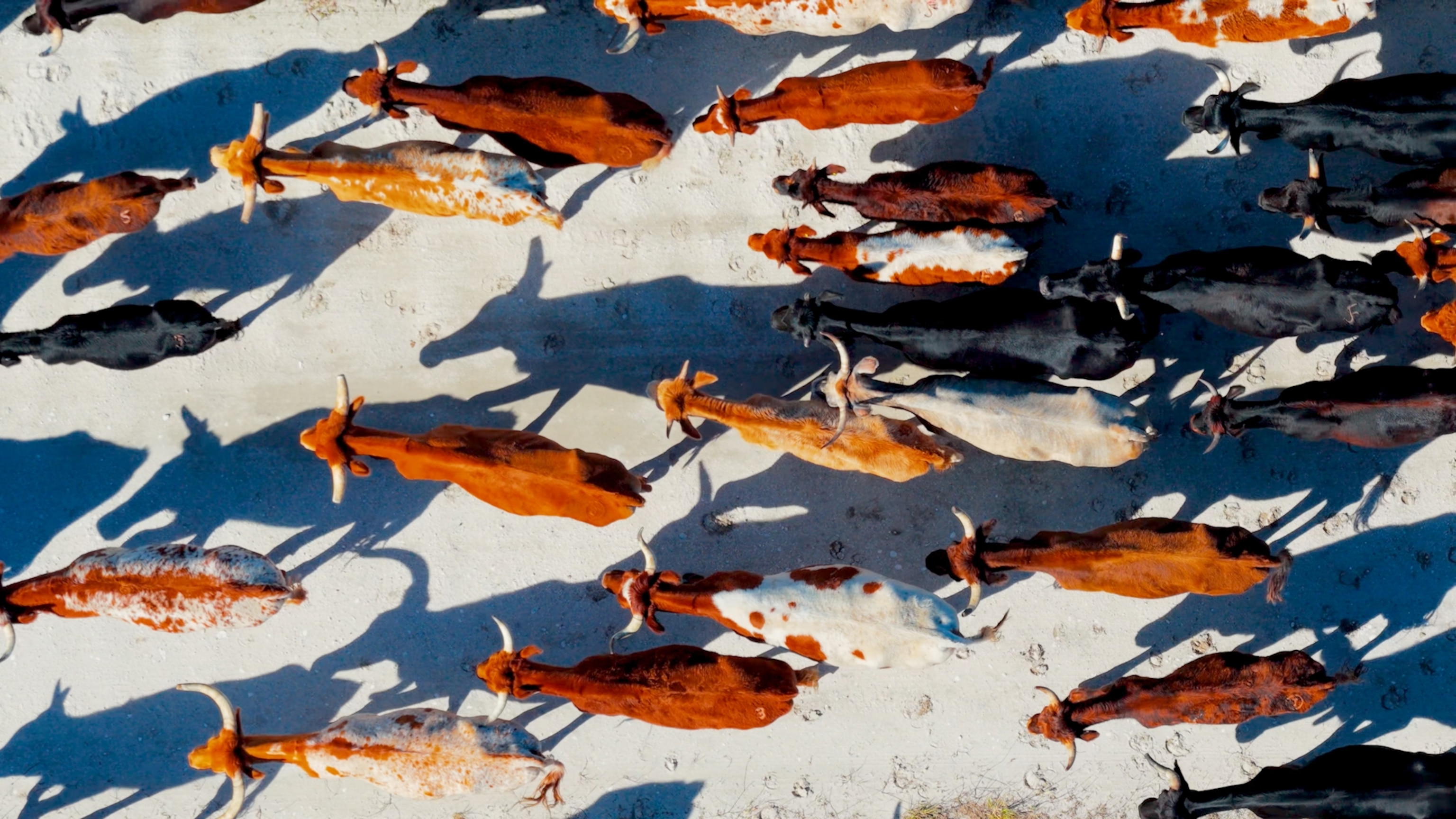
Time travel is real. Except you don’t need some elaborate technological contraption to do it. You just need a horse and Florida wilderness.
This past January, nearly 300 people and 300 head of cattle traveled a century back in time for the 5th iteration of the Great Florida Cattle Drive, a living history reenactment over six days and six nights where hundreds of riders on horseback walk, trot, canter, and gallop through 54 miles of pristine Florida country that is now part of the Florida Wildlife Corridor.
Florida was once the center of the cattle industry in America. The first cows arrived in the New World on the Gulf Coast of Florida near Charlotte Harbor in 1521 when Juan Ponce de León landed with hogs, horses, and a small herd of Andalusian cattle to feed his conquistadors. Though Ponce de Leon was killed by a poisoned arrowed, the animals he left behind adapted and became part of the landscape. By the late 18th century, there were enough wild cattle in the prairies and forests of Florida to bring Scotch-Irish immigrants from Appalachia down into the peninsula to farm and domesticate the livestock they could catch. Florida eventually became the leading exporter of cattle in late 19th-century America, shipping 1.6 million head of cattle to places like the Bahamas and Cuba between 1868 and 1878.


The state’s original cattle drives were months-long journeys that stretched across hundreds of miles of Florida’s diverse ecosystems and ended at ports along the Atlantic. But by the mid-20th century, Florida’s population had increased thirty-fold and the vast wilderness where the cattle and cowboys roamed was fenced in and carved up by roads and developments.
This past January, Florida’s cowboys took back the land—for a week, at least. The 2026 Great Florida Cattle Drive began at the DeLuca Preserve, a 27,000-acre plot of land between the Kissimmee Prairie, north of Lake Okeechobee, and the headwaters of the Everglades. The preserve contains some of the last vestiges of the once-great dry prairie that covered more than 1.9 million acres of the state. Today, only 20 percent remains. This dry prairie is one of the most diverse ecosystems for flora in the state, home to wire grass, toothache grass, blue stems, dwarf oaks, saw palmetto, and pine lily.

That the DeLuca Preserve exists at all is a miracle. Its previous owner, the sandwich franchise Subway co-founder Fred DeLuca, had planned to convert the land into a city called Destiny—a sprawling, 250,000-resident, master-planned community. It would have fragmented the land and cut off the flow of water from the north of the state to the Everglades. Instead, thanks to DeLuca’s widow, Elisabeth DeLuca, the whole of the land was gifted to the University of Florida’s Institute of Food and Agricultural Sciences in 2020, in partnership with Ducks Unlimited. It is now a conservation easement, joining the surrounding 354,000 acres of protected land that is part of the Florida Wildlife Corridor, a statewide network of 18 million acres of connected lands and waters.
It was David Hunt, president of Florida’s Cow Culture Preservation Committee, who insisted on beginning the Great Florida Cattle Drive at the DeLuca Preserve. Past drives were held farther north in the Orlando area. “I had always wanted to go south because that's one of the old routes for cattle to shipping ports like Fort Pierce and Punta Rassa,” says Hunt, a fifth-generation Florida cowboy.


It’s a good thing he insisted. This January was a cold one in Florida. As riders moved their way from the DeLuca Preserve through the Kissimmee Prairie Preserve State Park and over a handful of private ranches, they endured wet, 28-degree weather. Hunt says real cattle drivers let it roll off their shoulders. “Florida weather has a pretty good reputation for not being very predictable,” he says. That probably didn’t appease the mostly inexperienced riders on the cattle drive, who came from around the state and country. They were required to dress like the cowboys of yore. That meant no baseball caps or Gore-Tex; just cowboy hats and a lot of denim. “I don’t think anybody is excited to wake up with frost on their tent,” Hunt says, smiling.
(Once every few years, this Florida "fairyland returns to life.)


But being able to see Florida in its most natural state is worth braving bone-chilling cold in wet denim. It’s a sight most people—even longtime Florida residents—never see. Participants rode through scrub, palmetto, sloughs, and prairie and saw Florida the way it looked centuries before human development altered the land. They traversed through some of the last remaining grasshopper sparrow habitat, passed half-submerged alligators, and entered the remaining territory of the rare and elusive Florida panther.
“You can’t see the true beauty of Florida from the turnpike, or the beach, or Disney World,” says Hunt. “But when you start looking in the weeds and the palmettos and the water, you see a whole world we’ve got a lot to be thankful for.”
