The High-Altitude Wonders of a Ride on the Bernina Express
This gravity-defying rail journey through the Swiss Alps is a portal to the past, which brings you up close to mesolithic and medieval history—and a window onto the rapid changes this dramatic landscape is undergoing right now.
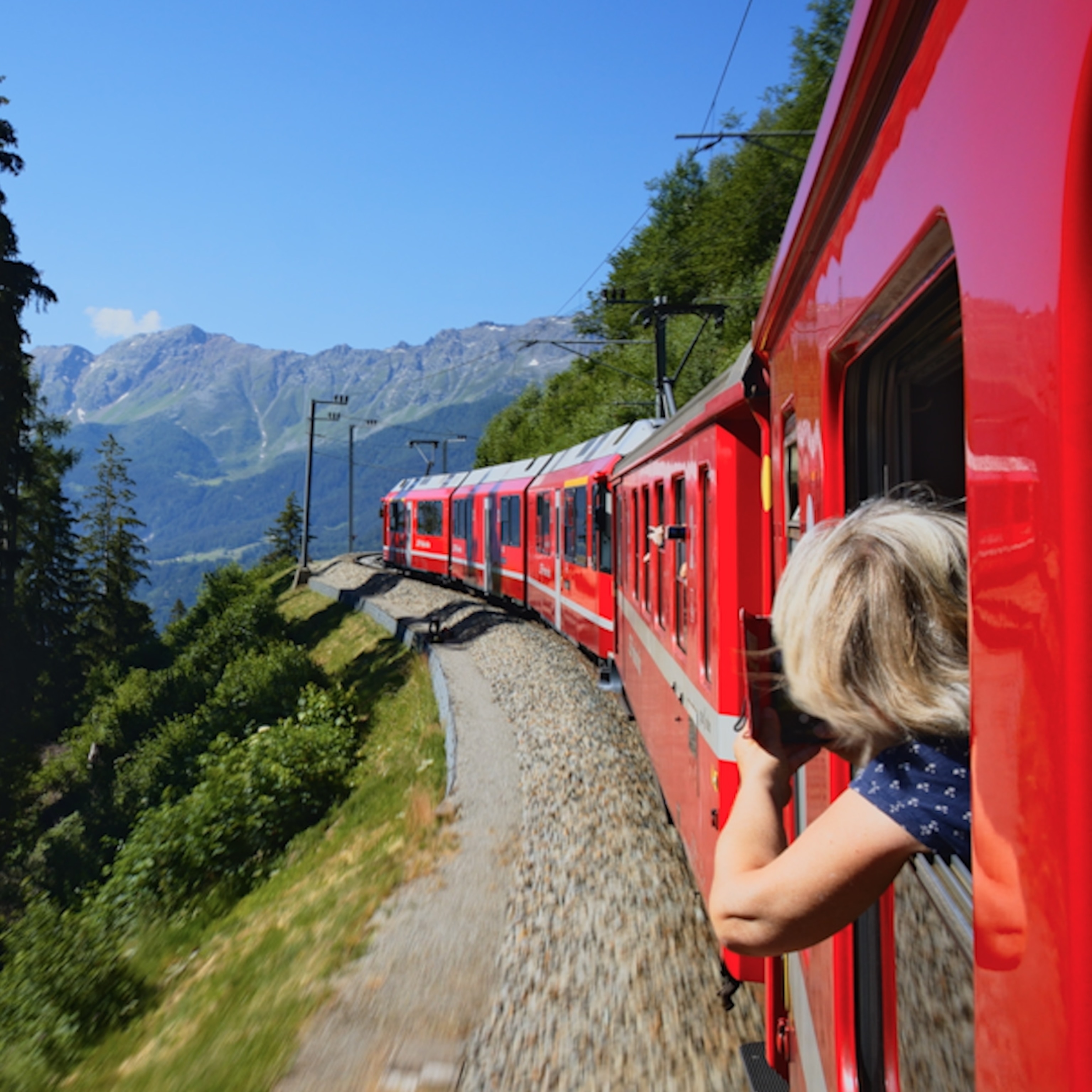
As a longtime resident of Switzerland, I’ve made the spectacular four-hour crawl from the Swiss city of Chur to Tirano, Italy, aboard the Bernina Express several times and I’m always impressed by how the train crosses this major linguistic and cultural threshold so seamlessly. When you board it in the pine-scented peaks of Canton Graubünden, you're surrounded by Rolex-wearing skiers and cow-print caquelons filled with bubbling fondue. But during the 6,000-foot drop from high-alpine Graubünden to Mediterranean Lombardy, vineyards and ringing campaniles replace conifers and timber chalets. Eventually, the train rolls into the streets of Tirano, passing a palm-lined piazza full of ciaos and expressive hand gestures. The border takes only an instant to cross, but the transition is a cinematic slow fade.
The other aspect that always strikes me is the Bernina Pass itself, a primordial landscape chiseled by cosmic forces. When Homo sapiens first arrived in Europe more than 50,000 years ago, this was an impenetrable fortress of snow and ice. But the retreat of the glaciers around 9,000 years ago opened this resource-rich landscape to Mesolithic hunters. No matter how many times I make the crossing, it still feels magical to watch the landscape fly by through a panoramic window in one of today’s crimson, WiFi-enabled cars.
Ancient ways
Completed in 1910, the Bernina Railway is one of only five train networks with UNESCO World Heritage status. Its tracks are laid beside ancient pastoral pathways still used by modern-day dairy farmers, who bring their cows up into the Alps every summer.
Neanderthals occupied the lower flanks of these mountains for two hundred millennia. When the ice thawed around 7,000 BCE, early hunter-gatherers moved in during the warm summer months to chase red deer and chamois above the timber line. Today, Switzerland's retreating glaciers have become an archeological hot spot, regularly spitting out reminders of these past visitors in the form of microliths—small early stone tools—and tiny, razor-sharp segments of flint.
The sculpted agricultural landscapes of the lower valleys in the region known as the Engadine date back to the Roman and medieval eras. They were forged over the centuries, first by Bronze Age traders around 1800 BCE, who hauled copper and salt over the pass, and then by Rhaetian tribes around 500 BCE, whose mountain strongholds laid the foundation or what would eventually become Switzerland.
Subsequent waves of Romans, Alemanni, Carolingians, Swabians, Hapsburgs, and Walsers left their own mark on the terrain. By the 17th century, these valleys had become crucial to the Veltliner wine trade, as horse and mule drivers dragged casks along stone paths up and down steep gorges. When construction of the Rhaetian Railway began, engineers deliberately laid the iron lines alongside—and sometimes directly on top of—these older paths, modernizing a route that stretches back millennia.
A miracle of modern engineering
Operated by the Rhaetian Railway, this narrow-gauge railway line is part of a network contained (aside from the single station in Tirano) within Switzerland’s Canton Graubünden that consists of 239 miles of tracks, 102 stations, 116 tunnels, and more than 600 bridges. The Bernina Express itself is a 76-mile corridor with 55 tunnels and 196 bridges and viaducts, which climbs a brutal seven-percent gradient topping out at Ospizio Bernina at 7,392 feet, making it the highest trans-alpine railway in Europe.
“The engineering is awe-inspiring, even by modern standards,” says Hansruedi Herger, a native Swiss hiking guide from the outfitter The Alps by Joe. “Even in Switzerland, it’s quite unusual to have such a landscape accessible by train, where palm trees, glaciers, and the glorious Alpine beauty of the Engadine come in such short succession."
Arguably the most iconic sight along the Bernina Express—and my personal favorite—is the dramatic, six-arch Landwasser Viaduct, which was constructed in 1901 from local limestone. Traveling southbound, the train leaps across a 213-foot-high viaduct over the jade-colored Landwasser River before plunging into a black maw in the cliff face that leads to the 692-foot long Landwasser Tunnel, which runs straight through the mountain. It’s a blink-and-you'll-miss-it moment, lasting no more than 20 seconds, but it’s a thrilling and unforgettable experience.
Another segment that still impresses engineers and train geeks is the nine-arch Brusio Circular Viaduct, an innovative stone-masonry solution to a seemingly intractable physics problem. Here, the train faces a drop that is far too steep for standard adhesion rails. If it went straight down, gravity would turn it into a rollercoaster. If it tried to climb straight up, the wheels would screech and spin uselessly against the steel tracks. The solution: a snail-shaped granite viaduct that forces the train to coil as it goes from snow-capped peaks to a valley where wildflower-strewn meadows, terraced vineyards, lush chestnut groves, and fruit orchards are a vibrant counterpoint to the austere stone and ice at high altitude.
Biodiversity in motion
In the warmer months, the Rhaetian Railway operates open-air convertible train cars that let travelers take in the smells and sounds of the alps. This is great for naturalists who want to catch a glimpse of what I call Switzerland’s Big Five—ibex, chamois, red deer, and elusive lynx and wolves, all of which can be found at differing altitudes. I always bring a pair of binoculars to spot smaller but no less exciting creatures, including acrobatic yellow-beaked alpine choughs, iridescent alpine tiger beetles, inky blue gentian wildflowers, and rock ptarmigans, each breathtaking in its minuscule detail. If you miss the panoramic car, don’t fret—just board one of the regional trains which run along the same route. I sometimes prefer these, because you can open the windows to fully experience the landscape and take pictures without the reflective glare. These trains also have noticeably fewer tourists.
Morteratsch Station is a superb stop for casual flora and fauna sightings, including neon-pink alpine willow herb, glacial buttercups, and rare lichens that colonize the raw, nutrient-poor glacial soil. Winged inhabitants include alpine blue and dewy ringlet butterflies and elusive wallcreepers and white-winged snow finches.
Serious naturalists should visit the 66-square-mile Swiss National Park, part of a UNESCO biosphere reserve. It’s a strict conservation area that forbids cars, dogs, bikes, and swimming so that wildlife can thrive. To access it, board the Engadine Line at the Pontresina station and disembark at Zernez to take a scenic 20-minute ride on the Swiss Post Auto Bus to the Hotel Parc Naziunal Il Fuorn stop, a gateway to the park. Hike the easy four-mile Alp Trupchun trail, one of 21 routes open from May to December, where you’re likely to spot red deer and whistling marmots among the fragrant stone pines and larch trees. Visitors can sign up for guided walks and rent binoculars and telescopes at the National Park Center.
A land of vanishing ice
Few experiences compare to getting close to Switzerland’s cerulean and turquoise glaciers, which are melting at a heartbreaking pace. A stop at the tiny Alp Grüm station, on the descent from Ospizio Bernina, lets you observe Palü Glacier, a classic hanging slope glacier. On the ascent from St Moritiz to Ospizio Bernina, riders can disembark at Bernina Diavolezza station to access the Diavolezza Gondola, which climbs nearly 10,000 feet. Visitors here can ski, hike a network of trails, and use crampons to access the Pers and Morteratsch Glaciers. From the top, there’s a superb view of the accumulation zone, a three-mile-long stretch of rolling white and blue ice that is cracked, fissured, and—for now—frozen in time.
“The biggest glaciers visible from the train are Morteratsch, Cambrena, and Palü,” says glaciologist Mathias Huss, part of Switzerland’s glacier-monitoring network Glamos. "And all of them—along with all glaciers in the Alps—are in a state of massive retreat, having lost half their volume over the past century.” 2026 had the most extreme glacial melt ever recorded, with even the Matterhorn standing snowless for part of the year.
Recent years have seen the organization of theatrical glacier funerals, with attendees wearing various period costumes, and ongoing activist art projects that capture the sights and sounds of these disappearing giants. At Diavolezza Station, riders can take part in the VR Glacier Experience, an immersive 3D journey through 250 years in the life of the glaciers that explores the reasons they are melting and the consequences of their disappearance.
“The impact of glacier change on humans is manifold,” Huss says. “While the attractiveness for tourism decreases if these icy giants disappear, the bigger threats include destabilized slopes due to permafrost thaw, limited water availability, and loss of hydropower generation.” As dire as this sound, it’s worth remembering that this alpine landscape is always in flux. These mountains have their own rhythms—and we are lucky to get to be a part of them.
How to ride the Bernina Express. The train runs from Chur, Switzerland to Tirano, Italy, with 25 stops along the way. In summer, key stops include Alp Grüm and Ospizio Bernina to see and experience glaciers, and Morteratsch for bird, butterfly, and wildflower sightings. In winter, the Landwasser Viaduct is breathtaking under a dusting of snow. Rates start from about $106.
