The Extraordinary Comeback of Zimbabwe's Endangered Black Rhinos
Decades after commercial poaching killed over 90 percent of the world’s black rhinos, a longshot plan by government officials, conservationists and private landowners is restoring the endangered species to Matusadona National Park.
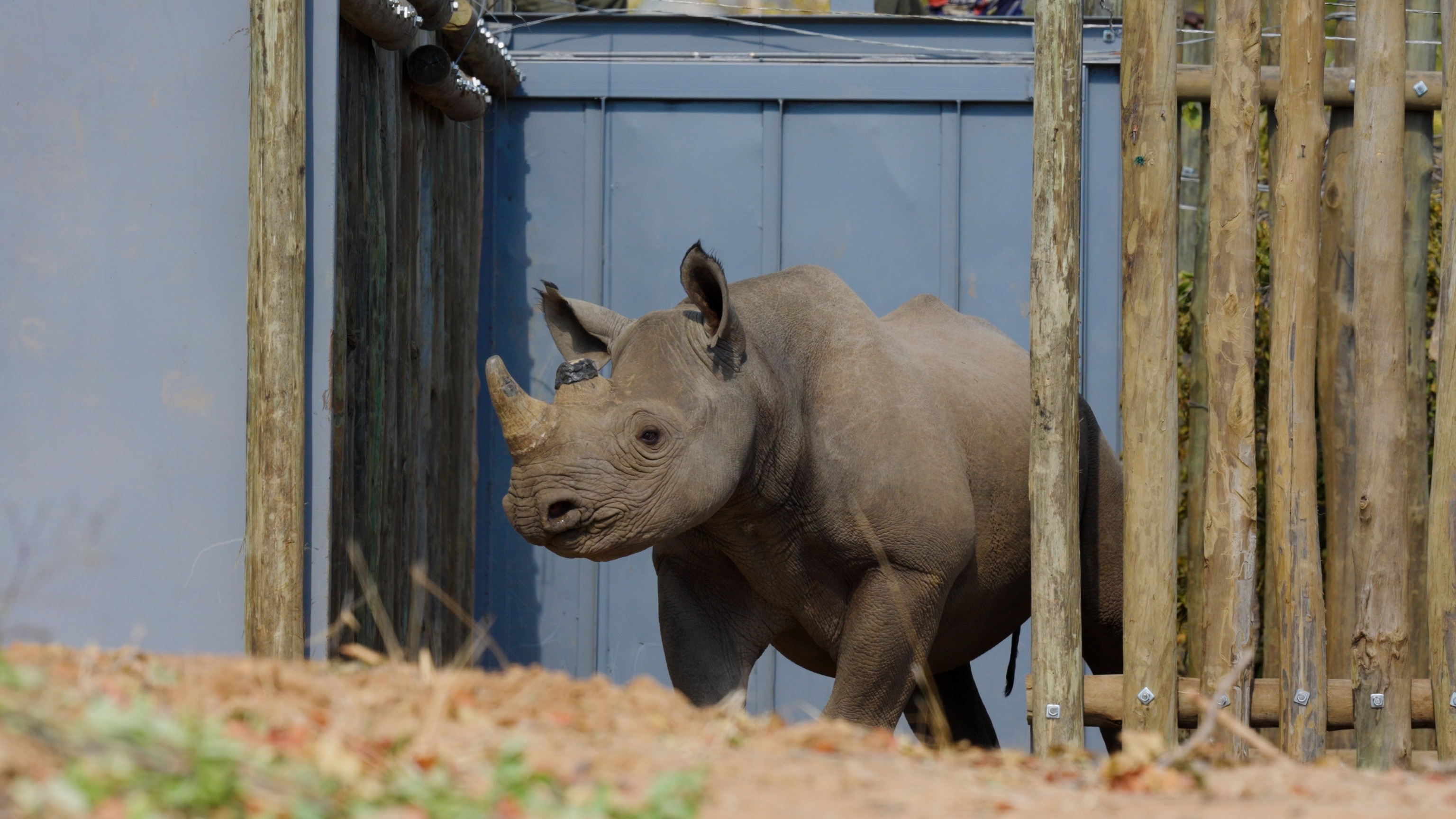
The first evening that black rhinos were back in Matusadona National Park in Zimbabwe this May, park manager Mike Pelham grabbed a bedroll and walked out of his house into the darkness. Under a clear night sky, 17 of the giant animals shuffled within their bomas—protected enclosures where they were acclimatizing before they were released. “The first few days, I slept at the bomas with the animals. I put my bedroll down by the boma walls, just so I could listen to them at night,” he says. “To see them coming back, it’s like a dream come true.”
The return of rhinos to the Zambezi Valley has been anything but certain, after commercial poaching began to intensify in the 1970s and eventually slaughtered over 90 percent of black rhinos in Zimbabwe and the rest of Africa. “Any rhino they found, they just killed it. Even the babies had their small horns taken off them,” says Pelham, who was a safari guide at the park in the early 90s, guiding tourists on rhino treks, when poachers began raiding Matusadona.


To help save the species, Zimbabwe’s Parks and Wildlife Management Authority (known as ZimParks) initiated a massive effort to find and move any remaining rhinos onto private lands and protected zones on public land. Even when rhinos had completely disappeared from Matusadona, determined conservationists and ZimParks officials held onto hope. The promise was stitched into fabric: on every park uniform, the silhouette of a black rhinoceros is embroidered above the words “Matusadona National Park.” This official logo was created in 2020, shortly after the establishment of the Matusadona Conservation Trust—a partnership between the nonprofit African Parks and ZimParks—at a time when the landscape had been void of the iconic megafauna for years.
Others believed in the promise, too. For the last three years, Chief Nebiri, the leader of one of the four local chiefdoms that make up the Nyaminyami Rural District, of which the park is a part, has been saying to Pelham, “Mike, they put rhino on the park logo. We know that our rhinos were lost, but when are you bringing them back here?”
Now, more than 30 years after rescue operations began, descendants of those surviving Zambezi Valley black rhinos have finally returned. “These are Zimbabwean rhino, belonging to the people of the country,” Pelham says. He pauses, a flash of pride crossing his face as a smile, as he recalls his response to Chief Nebiri: “We’re not just bringing any rhinos back here. We are bringing your rhinos back home.”
‘A Killing Zone for Rhinos’
Black rhinos are one of five species of rhinoceros left in the world, and the smaller of the two species in Africa. They are famed for a disposition variously described as “cantankerous” and “grumpy.”
“Black rhinos, unlike white rhinos, can be very, um…moody,” says wildlife photographer Marcus Westberg, who scrambled up a tree to get out of the way of one black rhino recently released at Matusadona. “They are 3,000 pounds of just pure muscle and occasionally bad temperament.”
The two horns of the black rhino are made of keratin, the same fibrous proteins in human hair, and grow continuously through their lives. If left untouched, the front horn can grow up to 1.5 feet into an upwardly curved and remarkably delicate point, as gracefully tapered as a scythe. It is this horn that poachers covet, using chainsaws to carve them off the faces of rhinos that they kill with bullets, insecticides and other means. In some instances, the animals are not yet dead. Although various bans against the trading of rhino horns have been around since 1977, poaching continues to this day. The species has been listed as critically endangered since 1996 and currently numbers around 6,788 individuals across a dozen countries in Africa.
In the 1980s, the largest contiguous population of black rhinos left alive—over 500 animals—was in the Zambezi Valley, an area within a drainage basin twice the size of Texas that’s fed by Africa’s fourth largest river, the Zambezi. As the river enters the valley, its banks become home to hippos and crocodiles that share the inlets and shores with over 90 species of waterbirds. Beyond the river, the valley extends toward broad, flat plains and scrublands, woodlands and thickets known locally as ‘jesse.’ Elephants, cape buffalo, zebra, kudu, eland, and sable antelope, as well as lions, leopards, hyenas, warthogs, baboons, monkeys, and African wild dogs are among the species that find food and shelter in the valley. Matusadona lies at its western edge, along the shores of Lake Kariba, the world’s largest man-made lake by volume, created by the damming of the river in the 1950s.

When a commercial poaching frenzy swept its way across the continent from North Africa in the 1960s, Zimbabwe at first remained untouched—partly due to the presence of armed guerrilla militants fighting the country’s War of Liberation, who inadvertently deterred poachers. But starting in the 1970s, as international demand for rhino horn and ivory soared, heavily armed external syndicates pushed south, leading to an increase in organized poaching that killed tens of thousands of animals.
This violence eventually infiltrated the Zambezi Valley in the ‘80s and ZimParks decided to take drastic action. They organized and carried out a massive effort to track down and relocate pockets of surviving rhinos onto private game ranches and four heavily protected public safe zones called intensive protection zones (IPZs), in the hope that one day the descendants of those rhinos might return more widely to the valley.
Armed teams were trained to fight poachers “along military lines,” in the words of Glenn H. Tatham, a legendary ZimParks figure who named his plan “Operation Stronghold.” Meanwhile, rangers raced to find the valley’s remaining rhinos. “Those were animals that had escaped poaching,” says Pelham, who joined rangers on rescue operations. “They were hiding in very remote areas.”
Once an animal was located, “you had to try and dart them in a location where you could get a truck into them. Sometimes it meant waiting a couple of days until an animal got into an area that you felt you could then cut a road in. You cut a road by hand. Then we would put the animals onto a makeshift sled. You’d get some conveyor belting,” Pelham says, “and then you’d haul it by hand … through the bush until you could get up to a track that a truck could get to.”

For years among that devastation, Matusadona was somehow able to maintain itself as a rhino haven. “We would not struggle to find rhino—on a good morning you’d see nine rhino on a walk,” says Pelham. Exact figures on how many rhinos were lost in the park remain hard to pinpoint, “because they were quite common,” Pelham says. “When we were kids walking around the bush, it was always, ‘Watch out for rhinos!’” No one thought to keep precise records of a species so abundant. Indeed, before the 1990s, a Matusadona without rhinos was simply unimaginable.
But before long, Matusadona’s immunity had reached its end. By the end of 1993, hit hard by poachers, the park’s black rhino population had been reduced to just 16 individuals.
In a desperate bid to stop the destruction, ZimParks designated Matusadona as an IPZ in 1994. At first, “Matusadona had promise as an IPZ when other rhinos were getting wiped out around here” says Raoul du Toit, Director of the Lowveld Rhino Trust, who was instrumental in establishing viable rhino breeding groups. By the 2000s, the park had grown its population to about 45 animals. But during that same decade, an economic crisis in Zimbabwe tipped off another wave of poaching—and Matusadona once again became particularly vulnerable.
“What should have been one of the Intensive Protective Zones here at Matusadona,” du Toit recalls, “essentially turned into a killing zone for rhinos.”
A Last Sighting—and Then Silence
The economic crisis, which caused rampant unemployment and hyperinflation across the country, left Zimbabweans desperate to find any means to make a living, and drained ZimParks of tourism dollars and state funding. “The money needed to look after these animals in the ZimParks state plan just diminished, and that was when the demise of rhinos started again from the early 2000s,” Pelham says. Du Toit recalls an organization in freefall. “National Parks was collapsing,” he says. “There was a lot of anarchy in the parks department at that stage. A lot of staff left because of the collapse. It was like a vicious circle.”


Park rangers recall the 2000s as a difficult time. Ranger Million, who proudly describes himself as a local Tonga man from the Nyaminyami District and who has been a ranger at Matusadona for 22 years, says, “we had no resources, no fuel, no vehicles to use here, we were using the tractor. The manpower was down. Only 20 patrol-going rangers were covering the whole Matusadona.”
At 6:05 am on July 16, 2016, the last sighting of a black rhinoceros was captured in Matusadona—a camera-trap flash illuminating a fleeting silhouette where a thriving population once stood. “I thought that was the end of the wild,” says Million. To him, the disappearance of the rhinos felt final.
Turning a Park’s Fortunes Around
Even at that low point, with no rhinos left in Matusadona, a dedicated few held onto their vision that the species might come back to the valley. Offspring of rhino populations established during the IPZ era, including several initiatives on private land, had been able to survive and ZimParks began to devise a plan to secure funding to help make the return of black rhinos a reality. They also began to move away from ‘fortress mentality’ conservation, the idea that wildlife protection meant keeping communities out rather than bringing them in.
It took years of deliberation before African Parks and ZimParks settled on Matusadona in 2019 as the focus of their partnership—a choice that was far from obvious. At the time, Matusadona had massive challenges. “It had gone off the tourist map, it was losing a lot of money, and had one of the most challenging environments with communities around the whole country,” says Pelham. In selecting Matusadona, both African Parks and ZimParks chose to take on “something that was an operational and financial burden to the government.”

It may have been a gamble, but the bet is now paying off. “Through reinvestment in the park, the effort made has actually turned around what was a black hole for rhinos” says du Toit, who believes Matusadona is now set up for success with the structure and trust necessary to ensure things won’t “simply slip back into the anarchy that was.”
The community is the first line of defense for protecting these rhinos, and support for the Nyaminyami District is written into the foundation of the Matusadona Conservation Trust itself. “Whether it’s employment or procurement of supplies, it's a very specific agenda to benefit the local community first, the national economy second, and last resort is outside,” says Pelham. But earning the community's trust wasn’t straightforward. The Nyaminyami District had watched 40 years of donor cycles arrive with promises and quietly leave when the funding ran out. At the start of the partnership, skepticism ran deep, and Pelham knew it. His priority now is to ensure the community hears and genuinely understands that this time is different. "This is forever,” he says with conviction.
No one embodies that commitment more than Vimbayi Nebiri. As the Community Development Coordinator for the Trust, she leads the team responsible for making sure the community is involved at every stage of the park’s work. She is also the daughter of Chief Nebiri—the same chief who spent three years asking Mike Pelham when the rhinos were coming home. Vimbayi describes a community that is genuinely excited about the rhinos’ return, but one that also has questions—practical, urgent ones rooted in safety and the realities of living alongside large animals. Human-wildlife conflict has always been a concern for the people of the Nyaminyami District. Her role is to make sure those concerns are heard before they become grievances. “What they need from us is constant engagement,” she says. “Because anything that is done without engaging them, they will feel it is not for their benefit.”
Under the management partnership between ZimParks and African Parks, vital community work has included hiring and training staff from four chiefdoms whose people live near the park (across Matusadona, 99 percent of the employees are Zimbabwean, and 84 percent come from the local four Chiefdoms of the Nyaminyami District), providing lunches for over 5,000 local school children during last year’s drought, and improving park infrastructure so that tourists will return and help the park become financially self-sustaining.
For rangers like Million, the difference is tangible—vehicles where there were once tractors, fuel in the tanks, colleagues on patrol. “We have 46 more rangers who are finishing their training,” he says, and he’s eager for them to come and join the ranks, to eventually make up 100 rangers across a park where he once struggled as one of 20. His pride for his home park is what convinced him to push through, and it’s the return of resources that has convinced him to stay. “We lost those rhinos because we had no resources, but now we have resources,” he says. “We must not lose them again, we must not.”
Rhinos, Returned
What makes the rhinoceros reintroduction at Matusadona so scientifically remarkable—beyond its emotional resonance—is what these particular animals represent. These are not rhinos sourced from elsewhere and transplanted into a foreign landscape. They are Zambezi Valley rhinos, a direct genetic lineage protected through decades of crisis and carefully maintained. “What's most significant," says du Toit, “is that this reintroduction has brought back the genetic diversity that they had when they left here. They retained that.”
During a recent visit to the park, in preparation for his involvement in the second release of rhinos happening next year, du Toit ran his hand slowly across the timber of a boma that held some of the first rhinos upon their arrival in May. He photographed the structure methodically, already thinking ahead. He and Natasha Anderson, rhino monitoring coordinator for the Lowveld Rhino Trust, have been planning for phase two: the release of 20 more rhinos into the park. Anderson is already working through genetics, selecting individuals from southern Zimbabwe’s Bubye Valley Conservancy to maximize diversity.


The long-term vision is meta-population: a genetically robust, interconnected network of black rhinoceros populations across Zimbabwe, in which Matusadona eventually becomes not just a recipient of rhinos, but a source—contributing animals to help repopulate landscapes that have lost them entirely. Currently there are only three ‘meta-populations’ of black rhinos in Zimbabwe with more than 100 individuals, all on private lands. “The big agenda now is to start making the next meta-populations on public land,” says Pelham. Matusadona is only the second public site chosen for the start of an eventual meta-population; the first was established in 2021 as 29 black rhinos were gradually released at Zimbabwe’s Gonarezhou National Park, 500 miles away.
“We have the most genetically healthy and diverse population of black rhino in Africa, and I think that’s something where the government needs to take massive credit for,” Pelham says, noting that ZimParks had the foresight to devise a long-term strategy “to preserve these genetics and animals.”
If things go well, black rhinos will repopulate the Zambezi Valley in significant numbers again, and Matusadona will see the fruition of Tatham’s plan and the efforts of hundreds of people who worked to achieve it—from rangers who tracked and rescued the surviving rhinos to private landowners who sheltered the animals and conservationists who worked through years of economic, political and social turmoil.
“This is what the whole plan of Operation Stronghold was, to safeguard these animals, get them out of harm's way until such time that we felt it was safe enough to bring them back home into the Zambezi Valley,” says Pelham. "To be involved in this project now, to see them coming back," he adds, “it's been a giant amount of tears and emotion.”
A Future for Rhinos
When the rhinos first arrived at Matusadona, Admire Mrewa, the park’s biodiversity monitor and now the rhino monitoring coordinator, learned each one’s personality, its patterns, its particular restlessness or calm. Before this role, he’d been tracking pangolins within the park. And as he’s relatively new to Matusadona, these rhinos are the first he’s seeing across the landscape. Every morning since the release, he heads out before the heat rises, drone in hand, to find them.

A sliver of moon, white against a blue sky, provided the backdrop one recent morning as the drone lifted into the air with a steady hum. Mrewa operated the machine with focus—buttons beeping as he zoomed in and out across the thermal screen, searching for the bright white blob that told him what he needed to know. Somewhere out in the mopani woodland of the newly fenced IPZ, he zeroed in on one of the black rhinos, just beginning its morning in its new home.
This is what a promise looks like, day to day. Not a ceremony or a headline, but a person in the early morning light, looking for animals that almost didn’t make it back.
The future of these rhinos now depends entirely on what happens in the years ahead. And everyone here knows it. Through the woodlands of mopane, rangers move through training exercises, preparing for the patrols that will define the daily reality of protecting this population. When asked about the biggest challenges facing Matusadona's rhinos, staff acknowledge that being ahead of the poaching threat is critical. “We know at some point or another, rhino poachers are going to come and have a go at us” says Pelham.
Du Toit, after living through the decimation of rhinos in decades past, is characteristically clear-eyed about the threat the park is training for. “The thing about poaching is that it's like a bush fire,” he says. “If it starts, it will be very hard to stop. Poaching is always something you have to be ready for. When it's not happening, it’s not the biggest challenge. But you have to be ready for when it does.”
Phase two will bring more animals, more complexity, more risk. There will be losses. There may be setbacks that are difficult to explain to the outside world, to donors, to anyone who wants conservation to be a story with a clean ending. “You’ve got to be prepared to take a chance,” says the Lowveldt Rhino Trust’s Natasha Anderson. “If you're going to have a no-risk attitude, you're not going to achieve conservation. This place might lose rhinos—they might even lose them to poaching—and that doesn't mean it's not worth trying.”
And it is worth trying. Over thirty years of evidence says so. The silhouette on the Matusadona uniform is no longer just a promise. But the people who wear it understand something that the moment of release cannot capture: the hardest work is not bringing the rhinos back. It is keeping them here.
