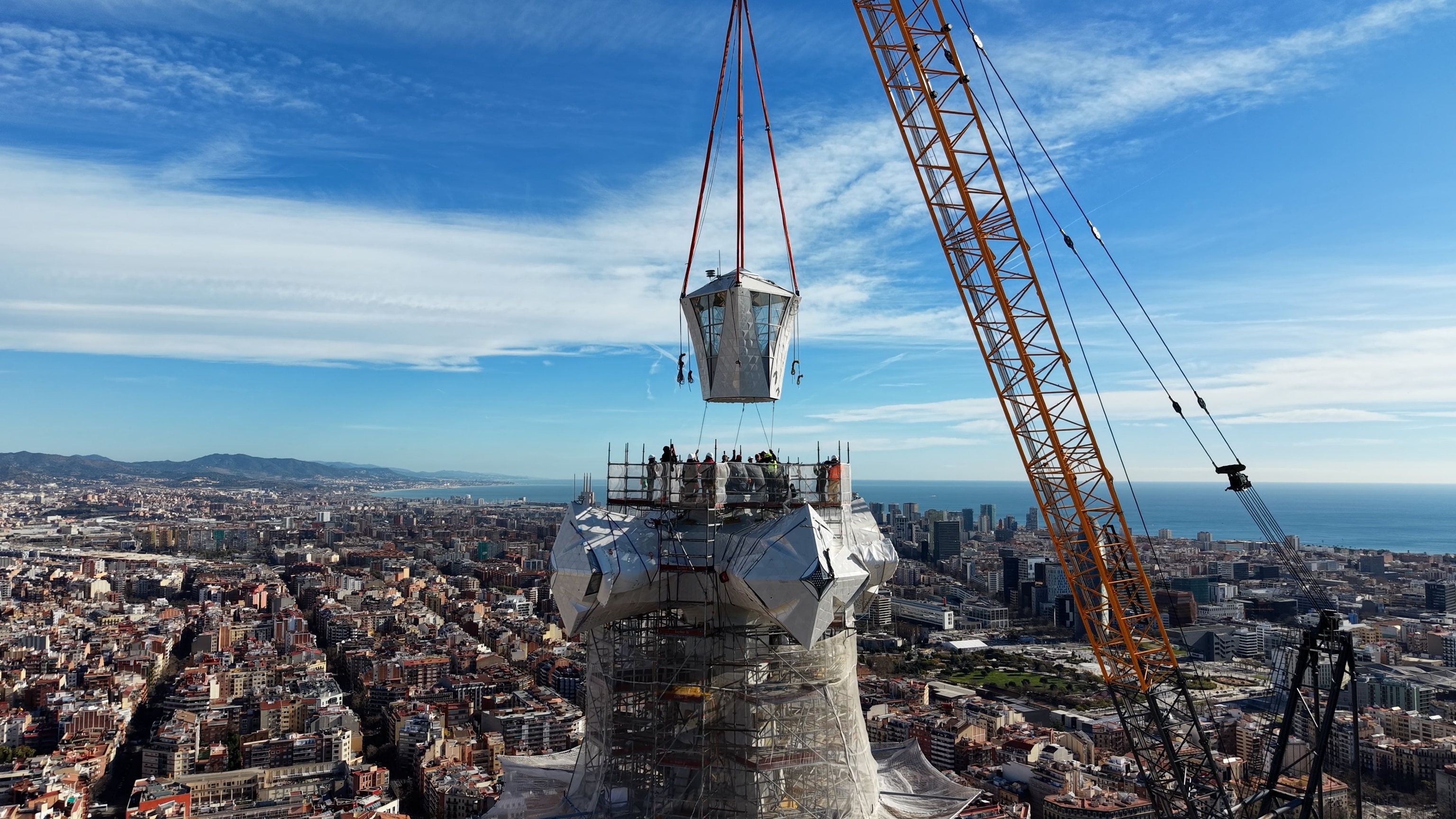
Watch exclusive drone footage of the crowning of the Sagrada Família, the world’s tallest church
After more than a century of work, the Sagrada Família's central tower is in place. Here's how architects executed the 19th-century masterpiece design with 21st-century tools.
For more than 140 years, the Sagrada Família has risen above the streets of Barcelona. Finally, this year—the centenary of architect Antoni Gaudí’s death—the basilica is nearing completion, and church and city officials have planned a year of celebrations to mark the occasion. The central tower, topped with a cross clad in glass and glazed ceramic that stretches more than 500 feet above the port city, makes the Sagrada Família the tallest church in the world (it surpassed Germany’s Ulm Minster for that title during construction in October), giving the monument a satisfying sense of finality.
In medieval and Renaissance Europe, cathedrals took centuries to complete, evolving stylistically as they were built. The Sagrada Família, in this sense, is a continuation of tradition. The whimsical basilica does not pretend that every chisel stroke is Gaudí’s, but instead declares itself a palimpsest, layered with successive interpretations of the architect’s intent.

But what does it mean to complete a building whose design and significance have shifted over a century, from a symbol of religious devotion to a symbol of Barcelona itself? And where does the vision of Gaudí himself fit into a project that has extended so far beyond his own years? Completing Gaudí’s work has been a complicated choreography between his vision and modern materials. The result is the expression of faith through architecture.
Antoni Gaudí’s vision, interrupted
“The basic reason the Sagrada Família wasn’t finished in Gaudí’s lifetime,” explains historian Michael Eaude, author of a recent book about the architect’s life and work, “is that they didn’t have the money.”
The Sagrada Família wasn’t conceived by Gaudí—it was the brainchild of a Barcelona bookseller after an 1872 visit to Rome; he intended for the structure to be financed entirely by private donations rather than by the state or the coffers of the Vatican. The original design was influenced by the flying buttresses and stone figures of neo-Gothic architecture, like St. Patrick’s Cathedral in New York or the late 19th-century reconstruction of the Palace of Westminster. When Gaudí took over the project in the early 1880s, and reshaped the design in his own exuberant style, he imagined completing it within a decade, a wildly optimistic goal.

In late 19th-century Barcelona, industrial magnates were eager to commission flamboyant townhouses, many of which Gaudí designed, but were less enthusiastic about funding a monumental basilica. “They were religious,” Eaude notes, but they weren’t devout enough to consistently provide the capital needed for such an ambitious project, and the flow of donations slowed dramatically.
When Gaudí unexpectedly died in 1926, struck by a tram on his way to confession, the church stood only partially finished. His workshop contained models, drawings, and plaster casts detailing the rest of his vision, but 10 years later, during the opening days of the Spanish Civil War, anarchists set fire to the crypt and destroyed much of his archive. While the architect’s disciples later resurrected what they could salvage of his notes, a clear directive for the finished product remained elusive. Work stopped and started over the next several decades, spearheaded by a mix of artists and architects who tried to balance Gaudí’s unique style with elements of contemporary aesthetics.
Completing the central tower
The central tower was always part of Gaudí’s grand plan for the Sagrada Família. In his symbolic scheme, the basilica would carry a total of 18 towers: 12 dedicated to the Apostles, four to the Evangelists, one to the Virgin Mary, and the tallest of all to Jesus Christ himself. The Jesus tower, whose crown was placed on the basilica in late February, rises from the center of the church like a stone mountain, intentionally higher than the surrounding towers but still slightly lower than Barcelona’s Montjuïc hill—an architectural gesture of humility that Gaudí believed ensured that human work would never surpass God’s creation. Its placement was a technical feat, employing, according to the basilica’s website, a “tensioned-stone building system, combining stone and steel,” a modern building method in which steel cables are inserted through stone panels. The result is a tower that withstands wind while remaining light enough to be supported by Gaudí’s original foundation.
At the Jesus tower’s summit sits the newly installed cross, roughly 43 feet wide from arm to arm and made of glass and glazed white ceramic. The cross was built in Germany but meticulously assembled in the Sagrada Família itself. Embedded lighting allows it to glow after dark, turning the uppermost point of the basilica into a radiant landmark visible across Barcelona. Rather than a solid mass, the cross has a delicate geometry, with glass facets to catch daylight and scatter it across the tower’s pale stone.
The concept, says Eaude, remains faithful to the architect’s original vision, even if the materials are unmistakably modern. Gaudí imagined the basilica as a fusion of nature, light, and faith, and the glass and ceramic cross carries that idea forward using 21st-century engineering. Set atop the tallest tower ever built for the church, it completes a vertical axis Gaudí conceived more than a century ago: a climb from the shadowed nave floor through branching stone columns, upward past the symbolic towers, and finally to the radiant cross suspended high above Barcelona’s skyline.

Work on the Sagrada Família continues
Even as officials herald the completion of Gaudí’s plan in 2026, one entire face of the basilica remains unresolved. Of the Sagrada Família’s three monumental facades, only the Nativity facade was largely finished during Gaudí’s lifetime. It is an explosion of fantastical detail: turtles anchor columns, angels tumble from foliage, and the Holy Family emerges from a thicket of carved flora and fauna. It is also the side most photographed by the millions of visitors who line up daily along Carrer de Mallorca, drawn to Barcelona in part because of countless images depicting Gaudí’s most famous work.
The Passion facade, begun decades after Gaudí’s death and completed in the late 20th century, tells a starkly different story. Its gaunt, angular sculptures were created by the artist Josep Maria Subirachs, and many critics argued that the modernist style clashed with Gaudí’s organic fluidity.
“Lots of people say it’s not what Gaudí would have wanted,” Eaude observes. “But no one knows for sure what he would have wanted.” That includes, perhaps, Gaudí himself. He famously improvised much of his work, carrying pieces of design in his head rather than on the page, tweaking and refining forms through hanging models with weights on ropes to discover ideal curves and shapes.

The third facade, Glory, remains unfinished, and may remain so for years. Gaudí envisioned a grand processional ramp extending outward from the church, symbolizing humanity’s ascent toward God. Realizing that plan would require demolishing an entire city block, and with many of the nearly 3,000 residents living there expressing strong opposition, Barcelona’s city council has so far declined to authorize the work.
If early progress on the basilica stalled for lack of funds, today’s construction is fueled by abundance. Entry tickets generate hundreds of millions of euros annually, and before the COVID-19 pandemic, visitor numbers surpassed 4.5 million per year, making it Spain’s most visited monument. That revenue has allowed the foundation overseeing the basilica to accelerate work dramatically in the 21st century, aided by computer modeling and digital fabrication techniques that translate Gaudí’s complex geometries into buildable components.

(In 2015, the cathedral entered the final stage of construction.)
As Spain prepares for a series of events this year celebrating Gaudí’s life and work, the Catholic Church is also considering whether the architect could be elevated to sainthood. The Vatican began the formal process of sainthood for the artist in 2003. Advocates point to Gaudí’s deep commitment to his faith, to reported miracles attributed to his intercession including restoring sight in a woman’s eye, and to the Sagrada Família itself as a monumental catechism in stone.
The estimated completion date for the entire Sagrada Família is 2034, but that remains in flux. When asked about the push to declare the basilica complete, Eaude recalls one of Gaudí’s most famous quotes: “My client,” the architect once said, referring to God himself, “is not in a hurry.”
