Idris and Sabrina Elba are on a mission to transform an entire West African island
Off the coast of Sierra Leone, the actor and model are fighting against tourists traps with their own vision: a tropical “eco-city” of the future.
Sherbro Island, a tropical outpost of farmers and fishermen nestled in the crook of Sierra Leone’s arcing Atlantic coastline, is about the size of Chicago, but its population of 40,000 wouldn’t even fill Wrigley Field. Electrical power and wireless internet are scarce. Fishermen can’t refrigerate their catches long enough to sell them on the mainland, and farmers often lack the expertise and equipment to harvest much more than they need to survive. But Sherbro Island has some enviable resources, including miles of unblemished beaches and lagoons, as well as an abundance of replenishable fresh water.

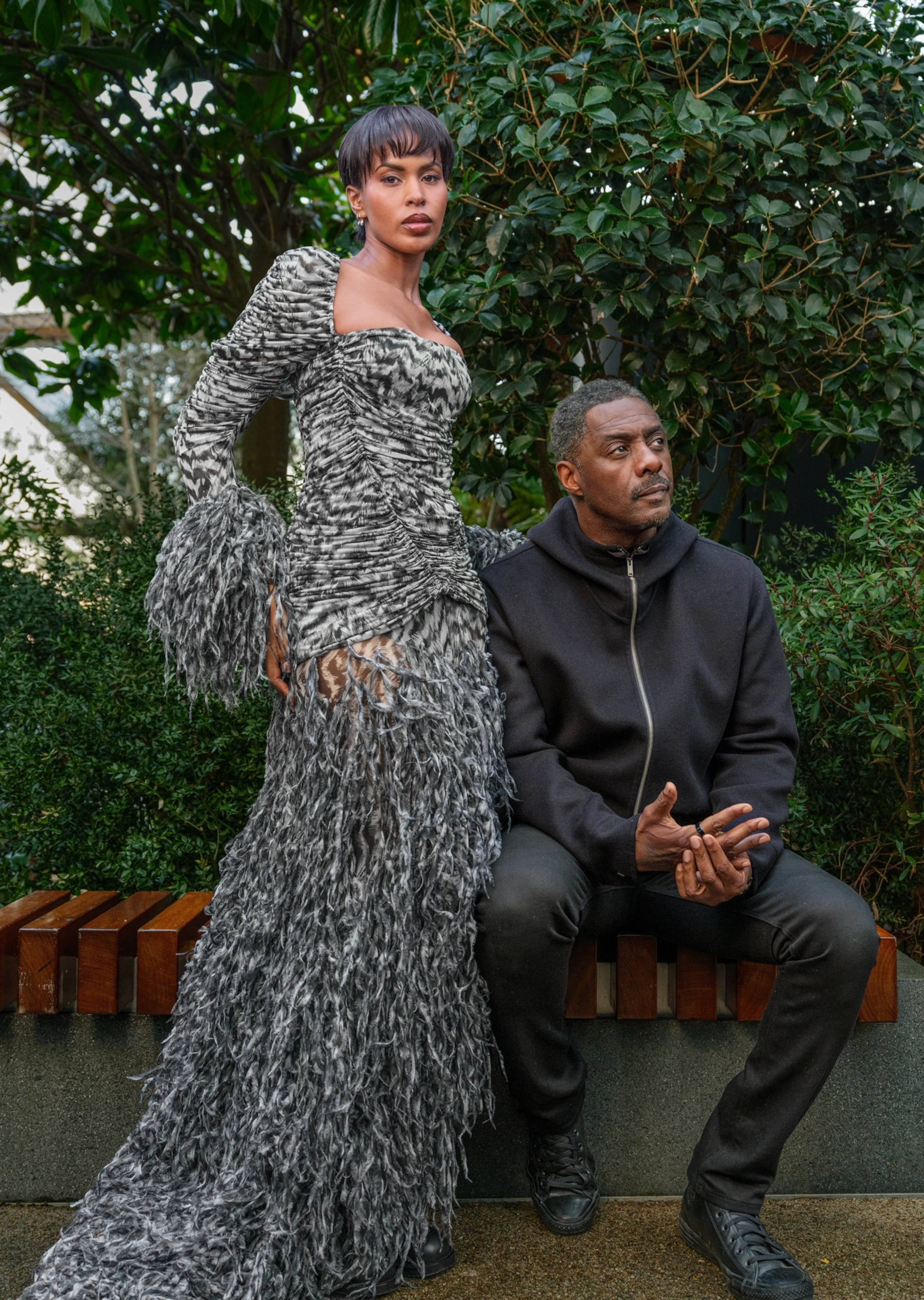
One other invaluable asset: the support of Golden Globe–winning British actor Idris Elba and his wife, Canadian model Sabrina Elba. The couple see an opportunity there to marry ecological sustainability with economic growth in a way they hope can be a template for development projects across Africa—and perhaps help rewrite a whole continent’s narrative. Idris’s father is from Sierra Leone, Sabrina’s mother is from Somalia, and growing up, Sabrina says, “there were particular stigmas attached with being African.” She remembers seeing ads that seemed to show abject people waiting for a handout. “We wanted to see Africa represented the way that we knew it to be,” she says. “We wanted to change the storytelling.”
Her husband—known for the baritone potency he brings to prestige TV dramas like Luther and The Wire, along with films like last year’s critically acclaimed thriller A House of Dynamite—first heard about Sherbro Island years ago. A close family friend had tried to convince him it could become a world-class holiday destination. “At that juncture, I was just like, Oh, OK, that sounds interesting,” says Idris, 53, who co-owns a wine bar in London’s King’s Cross neighborhood. “Like, maybe I’ll build a nightclub, maybe build some tourism.” He made a mental note to visit someday.
He got the opportunity in 2019, while he and Sabrina, now 37, were in Sierra Leone touring small family farms as part of their ambassadorial roles with the International Fund for Agricultural Development (IFAD). It was during that trip, Idris says, that he had something of an epiphany. He’d been venturing into philanthropy as his celebrity grew: supporting childhood education and hunger-relief programs in Africa, as well as campaigning on behalf of at-risk youths in the United Kingdom (work for which he was recently knighted). But on that trip, the Elbas saw an opportunity to build something more enduring and meaningful than a fancy vacation spot—and “to reframe the conversation,” Sabrina says, “[from] one of aid to one of investment.”

Soon after, the couple launched the Elba Hope Foundation, a way of bringing all of their philanthropic endeavors under one umbrella, including an initiative to help empower small-scale farmers on Sherbro and across Sierra Leone. Among other things, the program involved guidance on sustainable farming methods and resources to help cocoa and cashew farmers form cooperatives and access credit. Building that kind of capacity isn’t a matter of cutting checks, says Marsha Reid, the foundation’s executive director, but of “time and training and education and investment.”
That early focus on agriculture was a natural extension of the Elbas’ work with IFAD, which had given them “a master class,” Sabrina says, in how to support “farming that doesn’t damage the planet, that protects rural people, that allows them to have a means and a way to economically support themselves.” But the scope of their ambitions for Sherbro Island has only continued to grow.
Last year, the Elbas’ commitment to the island took a huge step forward with the launch of a three-year initiative, called the Hope Power Project, to electrify and wirelessly connect the entire island. They’re doing it by joining up with some deep-pocketed corporate partners—brands that Idris says gave the right answers when he asked, “Do you want me to just wave a flag and get some likes? Or are you interested in our ideas?”
Octopus Energy, for instance, one of the U.K.’s largest energy providers, is building a wind and solar farm, including five wind turbines—and training Sherbro islanders how to operate them. ServiceNow, an AI workflow company for which Idris is a spokesperson, is helping finance solar and clean-water infrastructure.
The Hope Power Project will change lives on the island, and the Elbas see it as laying the groundwork for further green development in the years to come, eventually transforming Sherbro into a self-supporting, renewably powered “eco-city.”
“Do we want to continue throwing concrete [up] and putting calluses on our world, or do we want to build structures and cities that actually nourish our world?” Idris asks. “What are we going to teach the next generation about how to build and develop? And can Sherbro be a blueprint for that?” He knows how ambitious it sounds—but with ambition, focus, and commitment, he says, “you become more than just this celebrity putting their name to something—you become a member of a working engine.” An engine powerful enough, maybe, to help a small rural island tell a whole new African story.
A version of this story appears in the April 2026 issue of National Geographic magazine.
