Phil Gordon's House Will One Day Slide Off an Alaska Cliff. So He's Moving It Inch by Inch.
"Twenty-five years ago, when I first looked over the edge... I thought I was the kind of fool that should live here.”
Phil Gordon sits atop a pile of old fishing nets on a tiny wooden platform suspended over a sheer cliff outside of Homer, Alaska. My stomach lurches as I peer over the edge. Some 247 feet below, the Pacific Ocean hurls itself against rocks. Clearly unaffected, Gordon offers wheat crackers dipped in peanut butter and a bottle of bourbon balanced at his feet: “Help yourself. We’re living abundantly.” He smiles as a bald eagle comes in for a landing on a post, then he wanders into the garden to cut a peony for his wife, Kyra Wagner, who is lounging on a cracked white plastic chair.
Just a few feet behind the platform stands his 12-by-16-foot wood-sided cabin with a red metal roof, hoisted comically above the ground on jacks and wooden blocks. “Where I live is a foolish place to live, on the edge of a crumbling cliff,” he says. Which is why his house is currently lifted mid-air, green door opening several feet off the ground. It’s a first step in an attempt to save his home.
If Gordon does nothing, his cabin will eventually fall into the sea. Waves constantly eat away at the cliff edge from below. But, perhaps more concerning: It’s possible the entire bluff, made of weak sedimentary bedrock and oversteepened glacial sediment, could slowly slide into the bay. The bedrock holding it in place, undercut by the sea, is unstable.

Deep-seated landslides are a problem facing communities all over Alaska. Changing rainfall patterns, retreating glaciers, and thawing permafrost increasingly conspire to collapse topography and transform the landscape. These giant masses of unstable bedrock, like the one Gordon lives on, can creep along slowly for decades or collapse catastrophically without warning, sometimes generating tsunamis when they fall into water. This emerging geohazard draws scientists from around the world to the natural laboratory of Alaska. Across the state, communities are partnering with geologists to install monitoring instruments, stockpiling food, holding community meetings about insurance concerns, and deploying early-warning systems to prepare.
Gordon knows it would be more reasonable to find a sturdier plot of land to live on. Houses all around his have already tipped off the bluff, falling to the beach roof-first. Gordon often hears big booming thumps as railroad car–size chunks of rock and trees go over the edge at night. But he’s not going anywhere. “Twenty-five years ago, when I first looked over the edge of that arm of the Pacific Ocean at the mountains beyond the bay, the volcanoes across the inlet, I thought I was the kind of fool that should live here,” he says.
In his battle against the shifting earth, it seems Gordon is as close as one can get to winning. Instead of letting his house fall down a cliff, Gordon is moving it back to a safer distance … largely doing the work himself.
‘Ironic for a Guy who Hates Erosion’
Gordon, a 77-year-old retired schoolteacher and librarian with a white beard and a mischievous glint in his eye, knew what he was getting into when he bought this tiny sliver of coastal real estate in 1999. He knows erosion better than most. His father watched the family farm blow away during the Dust Bowl in the Texas Panhandle and fled to Oregon, where Gordon grew up learning to care for the soil. “Ironic for a guy who hates erosion to house himself permanently at a site where it is most active,” he says.
In the past, he’s tried to fortify the cliffside itself against being eaten away by the sea. He once rented an excavator (with zero experience operating one—he tipped it over twice) to rearrange boulders into a seawall down on the beach. Another effort to prop up the cliff had him burying more than 300 feet of drainage pipes across his property to carry away excess water. On a summer day, hikers on the beach below might have seen Gordon dangling off the cliff to pound in reinforcing beams.

Largely, it’s worked. Gordon says his neighbors lose one to two feet of land to erosion each year. His property loses one to two inches. Gordon is proud to say he’s slowing the “progress of the Pacific Ocean as it gobbles up the North American continent, which it has been doing for billions of years. I’m standing in the way. Me and the Pacific, mano –a mano. It’s pathetic and it’s wonderful.”
Given his efforts, Gordon’s confident that, at the current rate of decay, there is “plenty of time for me to be comfortably dead” before his entire 170-foot-deep property is eroded by the sea. But that rate might not stay steady. While Gordon can theoretically manage the erosion from the seaside, climate change is raising the possibility his entire bluff is sliding oceanward.
Much of coastal Alaska is made up of ancient landslide deposits. For millennia, the North American and Pacific tectonic plates have smashed together here, uplifting loose glacial sediment into mountains that collapse back into the sea as massive landslides when large earthquakes strike. In Homer many homes, including Gordon’s, were built around the remains of one of these slides that collapsed more than 2,250 years ago, leaving behind an oversteepened slope made of poorly consolidated sandy rock and coal. That geological makeup is prone to retaining water, a recipe for instability.
In 2024, independent geologist Bretwood Higman, known as Hig, a longtime friend of Wagner’s, asked Gordon to help him test an instrument on Gordon’s property to measure the bluff’s movement. Previously, Hig had seen tension cracks and failures throughout the area, evidence that landslides around Homer may be starting to move.
That December, the duo donned head lamps and took axes to the frozen ground, trenching in a 100-foot carbon fiber rod attached to a cable wrapped around a spindle on one end. As the bluff compresses and stretches, the rod pulls on the cable. An instrument brain, called an extensometer, attached to the cable and housed in a sealed glass mason jar above ground, records every tiny movement of Gordon’s property, down to a fraction of a width of a human hair.
On the July day I visit Gordon, Hig sits on a log and plugs his MacBook into the instrument’s control box, downloading data. “There’s not been much total motion, but these poppy bits where all of a sudden it changes, that’s a little scary,” Hig says, pointing to squiggles on the screen. Hig determines Gordon’s entire property expands and retracts “like Jell-o” with each major rainfall. Hig’s hypothesis is a larger landslide inland from Gordon’s property could be moving downslope, compressing his land in the process. “There’s only one way a landslide like this can evolve,” says Barrett Salisbury, a geologist with the Alaska Division of Geological & Geophysical Surveys on another visit to Homer to survey landslides, “which is to progressively fail.”
In all, Hig estimates that Gordon’s cliff has moved about two-fifths of an inch in the past year. That doesn’t sound like much. But the hazard potential is still high. “It could go from ‘The house is fine’ to ‘It’s been torn in half and it’s on the beach,’ in one moment,” Hig says.

How to Move a House Away From a Cliff
Around the time Gordon and Hig installed the extensometer, Wagner “quit enjoying sleeping at my cabin, coincidentally,” Gordon said. (Wagner has another house east of Homer.) He’s not totally convinced the landslide will take down his home—erosion remains his biggest concern—but even the possibility is reason enough to move the entire structure away from the cliff. Of course, he could hire a crane operator to do the job. But a crane could crush his raspberry and currant bushes, chives, mint, lupines, and some 200 trees of all varieties Gordon has planted over the past two-plus decades on the property to hold the crumbling bluff together.
It’s actually not the first time Gordon’s done this. Thirteen years ago, he was living on a subsistence farm in Hawai‘i with a friend while his daughter maintained the Alaska cabin. During a winter blizzard, on the way back from the outhouse, she nearly slipped off the cliff. Action had to be taken. Gordon winched his cabin 13 feet back. That project took two months. This time, with his age and after a few delays from injuries, “it’s looking more like a two-year operation,” he says.
The challenge is that he needs to move the house vertically and then horizontally, as the final resting place is three feet higher than the cabin’s current location.
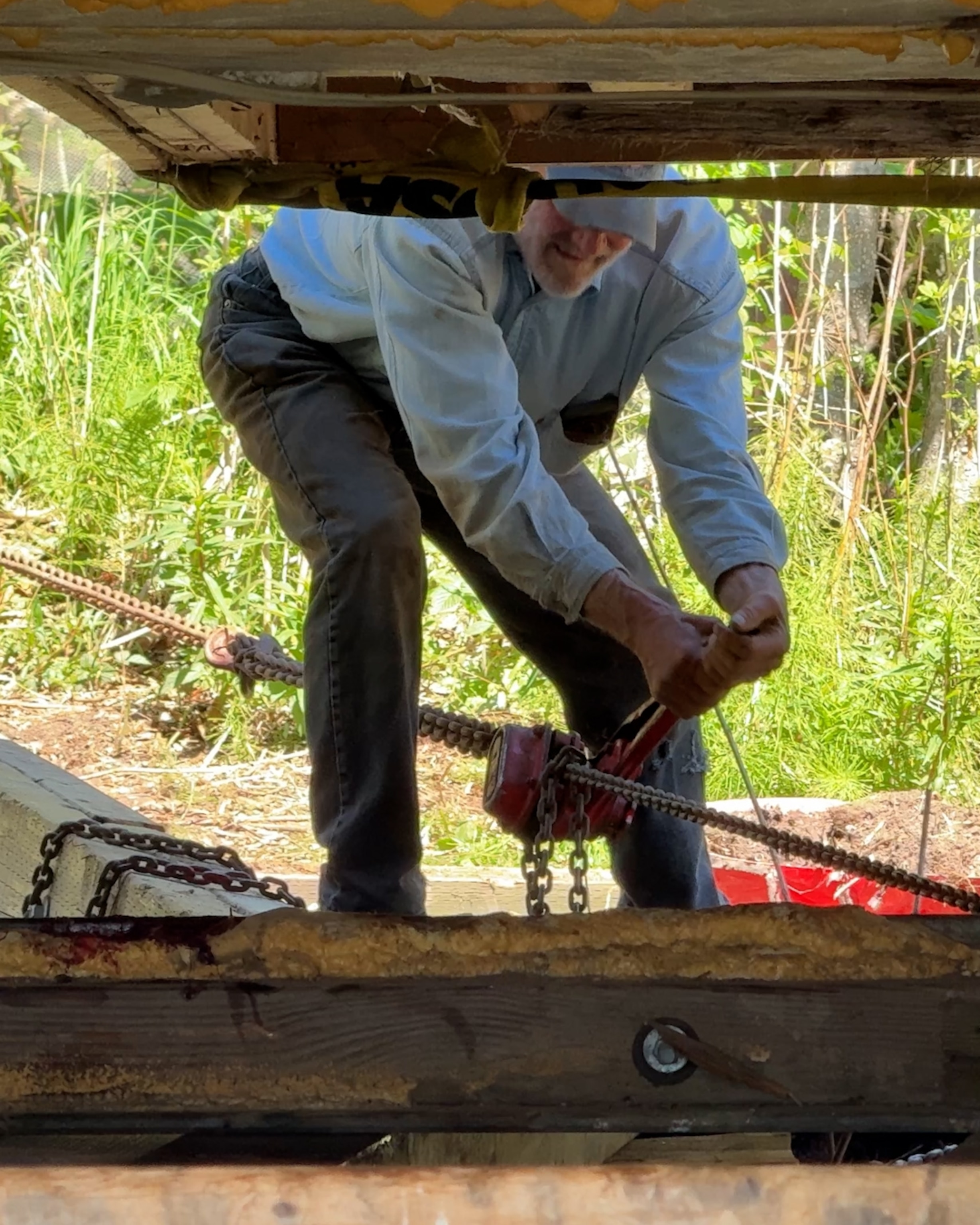
The process he’s settled on involves four hydraulic jacks to lift the cabin into the air bit by bit, and sliding another dunnage block under it for support. The materials are all scavenged, and the work is done whenever he has the time and energy to make some progress. A lot of the effort has been in making sure the main building and its tacked-on additional rooms—what Gordon likes to call “more-on” construction, pronounced like the insult—holds together as it is moved.

Hig eyes the suspended cabin.
“Well, none of the windows are broken,” he observes.
“Not yet,” Wagner quips.
‘The cabin stayed supported on blocks until this past April, when, pelted by spring sleet, Wagner, Gordon, and some friends (including Gordon’s daughter’s assistant peony farmer) attached a chain to the cabin and winched it, at an inch per hour, 30 feet to the west, away from the neighbor’s property. Gordon looked on apprehensively, hoping the cabin wouldn’t slide off the salvaged oil drill stem pipes it was rolling on atop greased metal rails. Checking the underside, he ended up with enough grease in his hair that he “didn’t need to comb it for a few days.”
Next they added a second set of rails in the frozen mud and started to winch the cabin another 30 feet north, away from the cliff edge. “Every crank of his little winch” makes him a bit safer, Hig says.
Never one to make a simple plan when a complex one will do, Gordon also decided to make the cabin do a “do-si-do,” rotating it in place to optimize the sun’s angle on the metal roof, where he’d like to add solar panels.
The Bluff Is on Borrowed Time
In Homer, the shifting earth threatens more than individual homes. West of Gordon’s property, small landslides above an area called Bluff Point, which is the site of yet another slow-moving landslide, could collapse and sever the Sterling Highway, the only road in and out of town, cut off the natural gas supply, and destroy a number of homes and businesses. Slow slope deformation is already making roads bumpy. Properties are slumping or flooding as hydrology shifts. There’s also fierce ongoing debate over the construction of new structures on the bluff, including a recently approved rental complex. Anything on the bluff is on borrowed time, Hig says.

Here in Alaska, where many communities lack building codes and there’s no one agency responsible for monitoring landslides, it’s up to communities like Homer to decide how to handle the increasingly unstable ground they’re built on. Eventually, Homer will have to move the highway, Salisbury, the state geologist says. Gordon’s cabin is already uninsurable. That doesn’t seem to bother him. But he does have a safety net of sorts: Hig calls Gordon when heavy rains are in the forecast and suggests he spend the night at Wagner’s house. And the extensometer sensor the pair installed now automatically sends updates to a web portal for Hig to monitor.
“Eventually, the places we live will all be resurfaced geologically,” says Hig. “The question is how soon, and what do we do in the meantime?” Gordon, on his cliff edge, is facing the reality of climate change, which is forcing tough decisions on communities all over the world. “What’s unique about Phil’s situation and thought process is he’s really confronting this in a way most of us would rather leave to a wonky insurance actuary or government agency,” Hig says.
For Gordon, his situation is a bit simpler: “If we’re going to live lives, we might just as well live interesting lives, you know. The greatest American disease besides dollars and bad politics, I think, is comfort.” He could be resting in a hammock on a safer property. But Gordon has better ways to spend his time.
