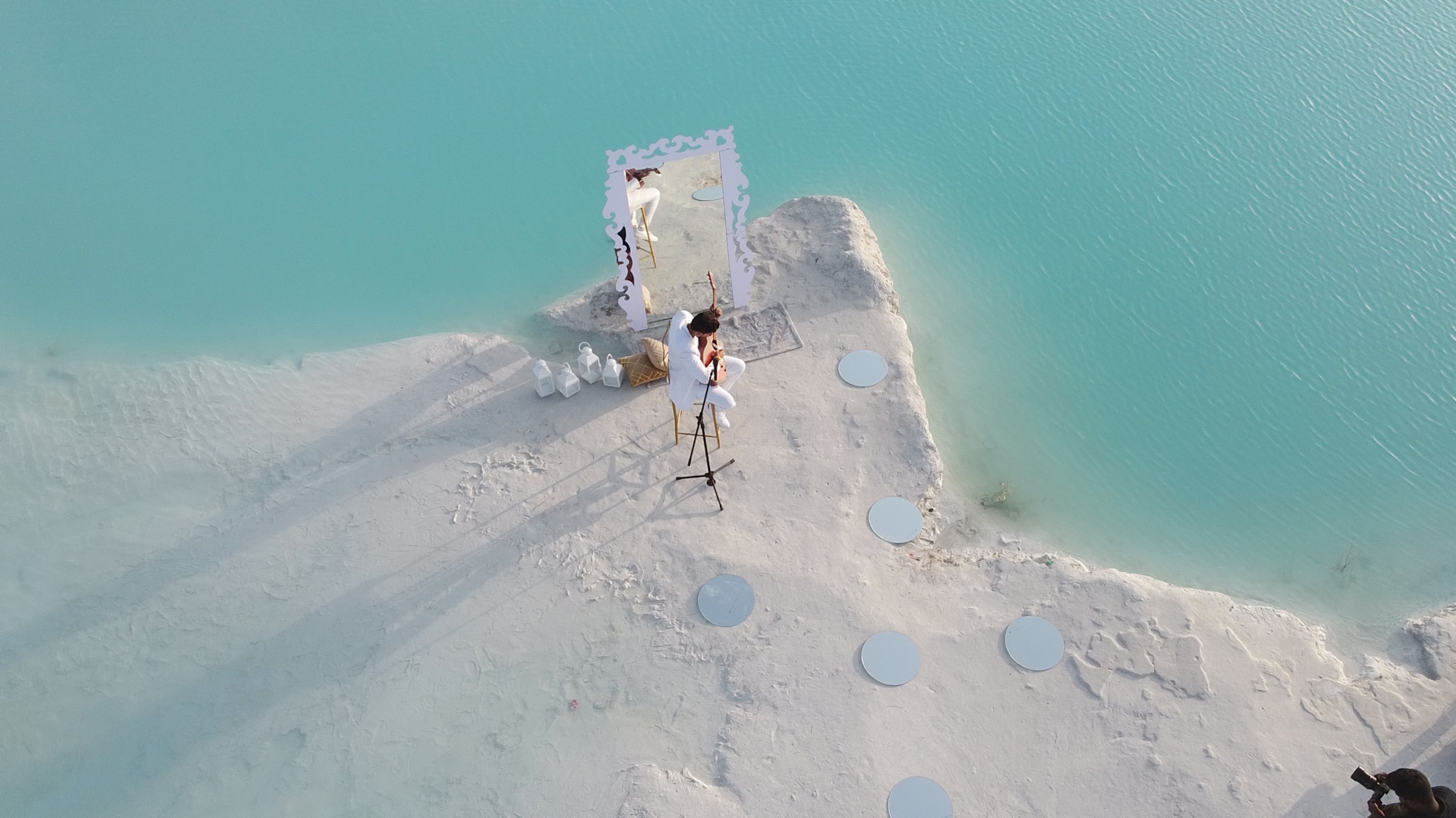
The industrial waste site that glitters like a glacier
In northwest India, a field full of marble debris has an otherworldly allure.
As a travel content creator, Atul Chaurasiya is always on the lookout for unique and offbeat locations. When he came across videos of the Kishangarh Dumping Yard on YouTube, he decided to visit the site.
Located about 62 miles south of Rajasthan’s capital city Jaipur, Kishangarh is Asia’s largest marble market. At the city’s outskirts lies this marble industry’s dumpsite, a “genuinely beautiful” place, according to Chaurasiya—white mountains that resemble snow-covered peaks and a contrast to Rajasthan's otherwise arid landscape. The influencer created a reel about the location in September 2023, and the Instagram post garnered over 250,000 likes.

“My video about the Kishangarh Dumping Yard was viewed by approximately six million people, and after that, thousands of people visited the location. The feedback from visitors was overwhelmingly positive; they truly enjoyed the experience,” says Delhi-based Chaurasiya.
However, the sprawling white landscape, spread across 31 miles, is a landfill—a waste disposal site for the 1,200 marble cutting facilities in the Kishangarh region, which dump the slurry produced from cutting and processing marble blocks at the site, says Sampat Rai Sharma, CEO of the Kishangarh Marble Association (KMA), which represents these marble units. With time, the white dust particles started resembling snow, attracting thousands of tourists every year.
(A guide to Jaipur's craft scene, from Rajasthani block printing to marble carving.)
“The slurry, when first produced, is wet. Then the tankers empty it on to the ground, and it dries up as the water evaporates in the sunlight," says Sharma.
The dumping ground continues to remain a tourist hotspot, even as multiple studies have highlighted the environmental and public health hazards posed by the type of marble slurry found at Kishangargh, from the minute dust particles that inflame respiratory diseases like bronchitis to the slurry that destroys soil cover, contaminates groundwater, and prevents vegetation from growing. Because the landfill has only become a tourist destination relatively recently, more research is needed to determine its precise risk to visitors.
Early investigations show cause for concern.
In 2022, Laxmi Kant Sharma, an ecologist who heads the department of environmental science at the Central University of Rajasthan, conducted the first comprehensive study of the site’s environmental and health issues. Initial findings suggest over 200,000 nearby residents and industry workers are exposed to the slurry through direct contact or indirect exposure via the contamination of air, water, and crops.
The results are currently undergoing peer review, and Sharma says these conclusive findings are urgently needed to warn both residents and tourists of their exact risk.


“If left unchecked, Kishangarh risks becoming a toxic, unlivable zone, with irreversible damage to its environment, economy, and public health,” says Sharma. “Urgent policy enforcement, waste management infrastructure, and industrial accountability are critical to avoid long-term catastrophe.”
A social media sensation
Described as the “Moon Land of Rajasthan”, the Kishangarh Dumping Yard is a “hot location” for filming Bollywood movies, TV series, and music videos. Social media platforms are flooded with tourists and influencers posting pictures and videos against the backdrop of its white plateaus and mountains. But the dump yard is especially popular among couples, says Gaurav Jain, manager of Snow Moments, a company that offers decorations for celebratory photos shoots like marriage proposals and birthdays.
“We started working here two years ago and we now provide decoration for at least 30 to 35 photoshoots of couples every month,” says Jain, a resident of Kishangarh, “The demand is increasing day by day.”
According to Sharma of the marble association, the Kishangarh Dumping Yard gained popularity as a tourist site in 2015 after Kapil Sharma, an Indian actor and comedian, shot a sequence for one of his films at the site.
As more tourists began visiting the yard, the Association, in 2018, made the landfill more hospitable to tourists by building a garden, an access road, water facilities, and a changing room. “We saw that people were coming here, so we added these things for their convenience,” says Sharma, adding that the KMA does not charge a fee to tourists. The Association does, however, charge a fee of INR 5,100 (approximately $60) for theme-based photography at the site.
Considering the “unparalleled uniqueness” of this snow yard, Instagram influencer Chaurasiya thinks that the site should be further developed, and better transportation facilities should be provided to reach it.
“This won't only boost tourism but also contribute to the overall development of the region,” he says, adding, “Of course, being a dumping yard, there are some environmental and health concerns that need to be addressed.”

The unknown risks
In April and May 2022, environmental scientist Sharma led a research team that conducted a study over a nine-mile radius of the Kishangarh Dumping Yard. It found the air quality to be “extremely poor” in the region. The levels of fine particulate matter in the vicinity ranged between 280.46 µg/m³ and 744.32 µg/m³, vastly exceeding the 15 µg/m³ limit set by the World Health Organization.
Similarly, soil samples showed high salinity and heavy metal contamination, says Sharma, especially in areas within a mile of the dumping yard. Researchers also discovered significant groundwater pollution with water samples exceeding safe limits for several contaminants, including chloride, fluoride, zinc, and iron.
To understand the health impacts of the landfill, Sharma’s team surveyed nearby communities, farmers, and industrial workers; all aged 20 to 70 years. Among the local community, researchers found that more than half the populace experienced breathing issues and throat problems, while nearly 40 percent reported skin problems, and at least a quarter suffered from lung-related diseases. The health impact was more pronounced among marble industry workers, 84 percent of whom reported throat problems, 70 percent reported breathing difficulties, 46 percent experienced lung diseases, and approximately half suffered from skin issues, in addition to other ailments such as hearing issues and visual impairments.


Sharma’s findings were consistent with existing research on the health threats related to marble slurry. One study published in February found marble dump yards in the same Indian state contained naturally-occurring asbestos, a known carcinogen.
Earlier this year, Saumya Kapil, an expert in sustainable tourism at Christ University in Bangalore authored a review of published research on the health and environmental impacts of marble slurry dumped at Kishangarh. She noted several studies documenting a die off in vegetation surrounding the landfill and an increase in health issues that may be related.
“The findings indicate an urgent need for sustainable waste management in the face of growing marble industry outputs,” Kapil said in an email.
Local industry leaders haven’t indicated concern about these findings. When asked about the studies that expose the health and environmental impact of the dumping yard, Sharma, the CEO of KMA, accused them of being fake.
He added that the organization hasn’t received any health-related complaints and claimed that the dump site hasn’t affected agricultural land. According to Sharma, the government-owned enterprise, Rajasthan State Industrial Development and Investment Corporation Limited (RIICO), allocated the Kishangarh plot to the Association for dumping marble waste three decades ago. RIICO did not respond to National Geographic’s email for comment.
Meanwhile, some social media influencers now feel that the dump yard should not be promoted as a tourist destination. One Instagram content creator named Sunil Singh shared a video about this white desert for his 112,000 followers last year. He says that the place is “quite surreal”, but “it is, at the end of the day, industrial waste—not designed or maintained for safe tourism. Romanticizing it without acknowledging the environmental damage could set a harmful precedent.”
Another Instagram creator who goes by the name Vibhor agrees. He says the place feels like “a mini Switzerland” but is hot, dusty, and uncomfortable. “I don’t think it should be promoted as a tourist destination. Despite its beauty, the health hazards are too severe,” says the influencer, whose 2023 post about the landfill garnered nearly 830,000 likes.


Puja Changoiwala is an award-winning journalist and author based in Mumbai.
