Explore the elaborate tomb of Nefertari—and see how ancient Egyptians buried their royals
Nefertari was the beloved wife of Rameses II, and her extravagant tomb proves it. Its restored paintings tell an interesting story of her ascent from the realm of death toward the light of Re.

Queen Nefertari, “beloved of Mut,” lived during the 19th dynasty (13th century B.C.) and was a Great Royal Wife of Pharaoh Ramses II. She was most likely his favorite and the most powerful of them. Nefertari was showered with numerous honorific titles, including Great Royal Wife, Wife of God, Mother of Pharaoh, Hereditary Noblewoman, and Mistress of Upper and Lower Egypt. However, one title, She for Whom the Sun Shines, points to Ramses’ special love for Nefertari. He built a magnificent tomb for her in the necropolis at the Valley of the Queens, or Ta Set Neferu (“the place of the beauties”) as the ancient Egyptians called it. The site is south of the Valley of the Kings, and the layout is characteristic of tombs from the time of the New Kingdom. It was excavated out of the rocky mountainside and is organized in a series of descending corridors and chambers leading to the deepest chamber, where her sarcophagus was placed.

Lavish decoration
Nefertari’s tomb was looted in antiquity, but the few remaining goods hint at how luxurious the trousseau once was. The pieces of fabric, sandals, jewelry, fragments of statuettes, and boxes are of the highest quality. However, the real treasure is the beautifully executed and magnificently preserved painting on the tomb walls. Some 5,200 square feet of painted surface are still in good condition around 3,300 years after their creation. Ernesto Schiaparelli, the Italian Egyptologist who discovered the tomb in 1904, immediately recognized the extraordinary value of the wall paintings. He wrote in his account of the excavation:
The magnificence of the style recalls the most beautiful of the Egyptian art produced in the first period of the nineteenth dynasty. It makes this tomb one of the most notable monuments of the necropolis of Thebes, which, if not for its size, certainly for the harmony of its parts, and the exquisiteness of the art, even competes with the most beautiful tombs of the Valley of the Kings.
Analysis of the paintings inside the tomb suggests that two teams of artists carried out the work.The most skilled one worked on the left side of the tomb, and the other worked on the right. First, the rock walls were covered with plaster, and onto this outlines of the figures were traced with red paint and then corrected with black paint.Next came the artisans, who carved reliefs into the plaster following the painted outlines. Finally, the painters brought to life the walls and ceilings through the use of color. Over time, some layers of stucco that had been applied too thickly began to peel and fall off under their own weight. Remarkably, the damage was relatively minor and the paintings, now restored, provide a unique artistic insight into how the inhabitants of pharaonic Egypt understood death and the afterlife.
(How a single battle—and one young pharaoh—turned Egypt into a superpower)
Nefertari’s journey to the afterlife
The artistic conventions of the day are reflected in how the tomb was painted. Royal tombs were conceived as a microcosm, a world in themselves. The ceilings symbolized the sky, and the floor was the earth the deceased would become a part of. The burial chamber where the sarcophagus of the deceased king or queen was placed represented the kingdom of Osiris, the god of the underworld. It was believed Osiris presided over the tribunal that judged the soul, determining whether the person had been righteous enough to pass into immortality.

If the judgment was favorable, the deceased began their ascent to rebirth with the sun god, Re. This transition involved a challenging journey during which the soul had to demonstrate certain knowledge and make offerings to the divine beings. The phases of this passage were detailed in the Book of the Dead. Nefertari’s tomb was decorated and designed to help her on this journey, guiding the queen toward a full and happy life beyond death.
The underground world of Osiris
Nefertari’s funeral ends with the transfer of her mummy to the burial chamber. This is symbolically the domain of Osiris, the god who embodies royal figures after death while simultaneously judging whether or not they are fit to enjoy immortality. Images of Osiris decorate the four pillars that support the room: On each pillar, he appears in human form and in symbolic form as the djed symbol. The mummy of Nefertari is put inside a large pink granite sarcophagus of which the lid, although broken, has been preserved. This sarcophagus is placed in the lower area of the room, which symbolizes the primordial earth, the origin of the world, and all that is in it.


To undertake the journey that led to her rebirth and eternal life, Nefertari needed the protection of various divinities also represented in the pillars of the chamber: the canid god Anubis and other protective goddesses, such as Isis, who offers her an ankh symbol. Images representing the first phase of the queen’s journey to the afterlife appear on the side walls of the chamber. They depict the portals and caverns she had to navigate. To be allowed through, she has had to demonstrate that she knows the names of the portals’ guardians. The names are written out to help her.
(Archaeologists found another Egyptian royal tomb—but who does it belong to?)

Journeying toward day
After completing her underworld tour, Nefertari ascended to the upper level via a stairway. It is a double staircase, with one side for the descent and the other for the ascent of the dead queen’s spirit. She proceeds to the final stages of her regeneration in the rooms closest to the entrance. The decoration on the walls of the stairway reflects the journey from beyond the grave.

At the bottom appears the sister of Osiris, Nephthys, kneeling over the hieroglyphic sign for gold, symbolizing the unalterable metal with which divine flesh, now including that of the deceased queen, was made. Above appears the canid god Anubis, guarding the tomb. Above Anubis is the cartouche on which the queen’s name is inscribed. It is protected by a great winged cobra and, to the right of this, by the goddess Maat, who also has her wings spread out. Next are the goddesses Nephthys and Isis, seated on thrones. Standing before them is a depiction of Nefertari making offerings to Nephthys, Isis, and Maat as she requests their help in her ongoing journey.


Triumph over death
The stairway leads to a vestibule that Nefertari passes through to reach the adjoining room beyond the west wall. To do this, she crosses the portal protected by the vulture goddess Nekhbet, patroness of Upper Egypt (in the south), a divinity closely linked to the queen who is also present in Nefertari’s protective headdress that she wears in all the scenes of the tomb. It is in the vestibule that the nocturnal journey transitions to the diurnal journey. Nefertari passes in front of Selket and Neith, depicted on the side walls. In the company of the goddess Isis, Nefertari approaches the scarab-headed god Khepri, an allegory of the sun in its daily birth at dawn, and also linked to her journey toward rebirth. To the right of the doorway are Hathor, in her form of mistress or goddess of the west (the area containing the royal tombs on the west bank of the Nile), and Re-Horakhty, the morning sun, with the head of a falcon.
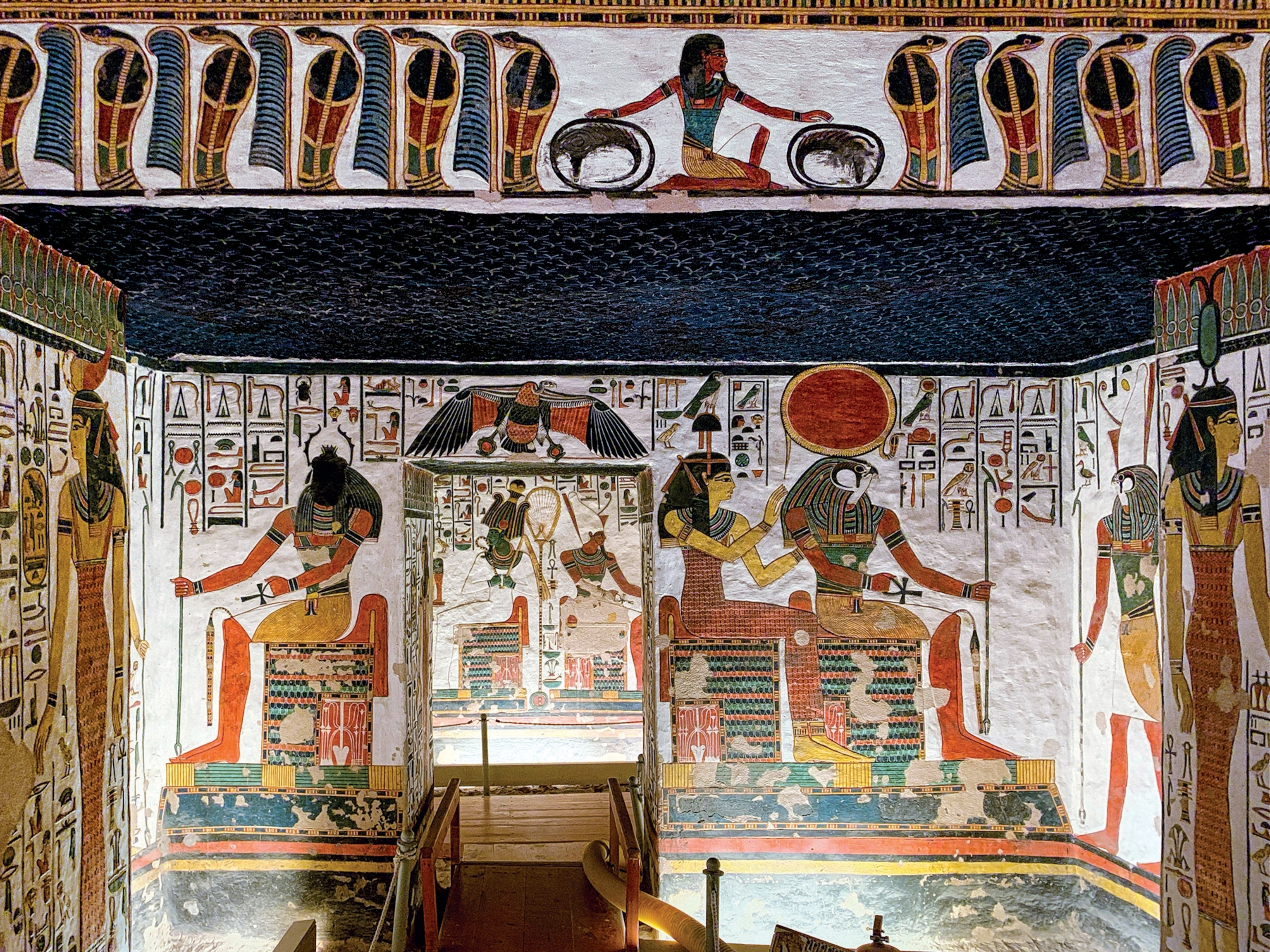
The entire space is protected by a frieze of cobras and ostrich feathers (symbol of Maat). An unnamed genie, kneeling on the first lintel, stops evil from entering and holds two circles incorporating the udjat (eye) of Horus, son of Osiris, a protective symbol believed to impart good health.
VULTURE
The vulture depicted on the other lintel embodies the goddess Nekhbet, with outspread wings. It holds in each of its claws the shen symbol, a knotted ring with no beginning or end. The shen was seen as a powerful amulet believed to offer eternal protection.
WATER AND SKY
The black stripe at the base of the walls symbolizes the black earth of Egypt that emerged from the primordial waters. This stripe contrasts dramatically with the stars on a blue background that cover the entire ceiling of Nefertari’s tomb and evoke the dome of the sky.
Osiris joins Re, the sun god
From the vestibule, the queen passes to the adjoining room, unaccompanied by any god. The most critical stages of the rebirth process occur in this room; once complete, she exits through the same door to enter the antechamber. This annex is also divided into two zones: the northwest half (the domain of Osiris) and the southeast half (the domain of the sun).

The division is determined by the back-to-back figures of Osiris, with green skin, and Atum, the setting sun. In this room, the queen makes offerings to various gods: Ptah, to whom she offers textiles so that she will be provided with the clothes she’ll need in her afterlife; Thoth, who will give her the knowledge contained in speech and writing; and Atum. Perhaps the most vital panel of the whole sequence depicts a single green-skinned ram god in the form of a mummy. The figure combines the two divinities involved in the queen’s rebirth: Osiris (expressed through the green skin) and Re (represented by the solar disk on its head). A hieroglyphic text confirms this identification: “Osiris rests in Re” and “It is Re who rests in Osiris.”
(Nubian kings ruled Egypt for less than 100 years. Their influence lasted centuries.)


Nefertari returns to life
By the end of her ascent, Nefertari is almost ready to merge with Re. She arrives in the antechamber and prepares to “go forth by day.” The significance of this moment is explained in spell 17 of the Book of the Dead, inscribed in the chamber. It includes the line: “Beginning of the praises and invocations to leave the glorious necropolis and to enter it, and in the beautiful west, to go out into the light of day.” The paintings show the queen already reborn, playing senet (a board game linked to death) and transfigured in the form of ba, one of the immaterial elements that form the soul. Her bird form with a human head enables the ba to fly out of the tomb during the day and return to rest and feed inside at night. The queen in mummified form lies on a bed. She is flanked by Isis at her feet and Nephthys at her head, both in the form of kites. Nefertari also worships the bird Bennu, a solar emblem of death and rebirth. With the stages of her nocturnal journey complete, Nefertari exits through the tomb door to appear the same as her father, Re.


