Inside the Sacred Valley of the Inca
Known for their impressive fortifications, terraces, and royal residences—including Machu Picchu—the Inca Empire dominated the Urubamba River Basin in the 15th century until its untimely demise.

The year is 1438, and Cusco is celebrating. The Inca have defeated their great enemies, the Chanca, and a new Sapa Inca (king or absolute ruler), Pachacuti Inca Yupanqui, wears the mascaypacha—a red tassel signifying both sovereignty and divinity—over his forehead. The music of flutes and drums echoes throughout the valley, dancing fills the air with movement, and bright costumes flood the scene with color.
By contrast, less than 10 miles from the city, there is no noise at all except for that of the natural world: the raging water of the Urubamba River winding its way between the steep slopes of the Andes; birdsong; and the occasional sounds of a passing animal. The extensive valley offers a lush landscape of vegetation with little to no human presence. However, all that is about to change. With Pachacuti’s rise to power, the Sacred Valley, as the area would be called, will be transformed, along with the entire Andean world.

On becoming ruler, Pachacuti began an ambitious territorial expansion. In just three decades, the Inca Empire, known as Tawantinsuyu, grew to vast proportions, stretching from what is now Quito, Ecuador, in the north down to Santiago, Chile, in the south. To sustain this lengthy empire, it was vital to cultivate new lands that would serve to support a steadily increasing population. One of the first areas to be used was the Urubamba River Valley, putting an end to its relative isolation. The valley is remarkably fertile, thanks to its rich soil; mild, jungle climate; and steep, extensive slopes able to harbor a wide variety of crops. The Inca rulers were well aware of this potential and implemented an ambitious plan of agricultural development. Soon, the dizzying heights of this Andean valley were stacked with terraces, the highest perched hundreds of feet above the lowest.
(Inside the search for the lost citadel of the Inca)
A Monumental Valley
The Inca had a mandatory labor tribute system, or mita, a societal obligation for communal work, which was also used as a punishment. When a community rebelled, the Inca state forced it to move to Urubamba Basin’s coca fields to cultivate them. The work was exhausting, the atmosphere suffocatingly hot and humid. After the Spanish conquest, a colonial judge, Juan de Matienzo, wrote that six out of every 10 workers on the coca plantations died due to an affliction of “what is called the sickness of the Andes, which is like leprosy though not contagious . . .caused by the dew that falls from some trees.” This punishment served as a warning to the rest of the population, while simultaneously providing continual labor.


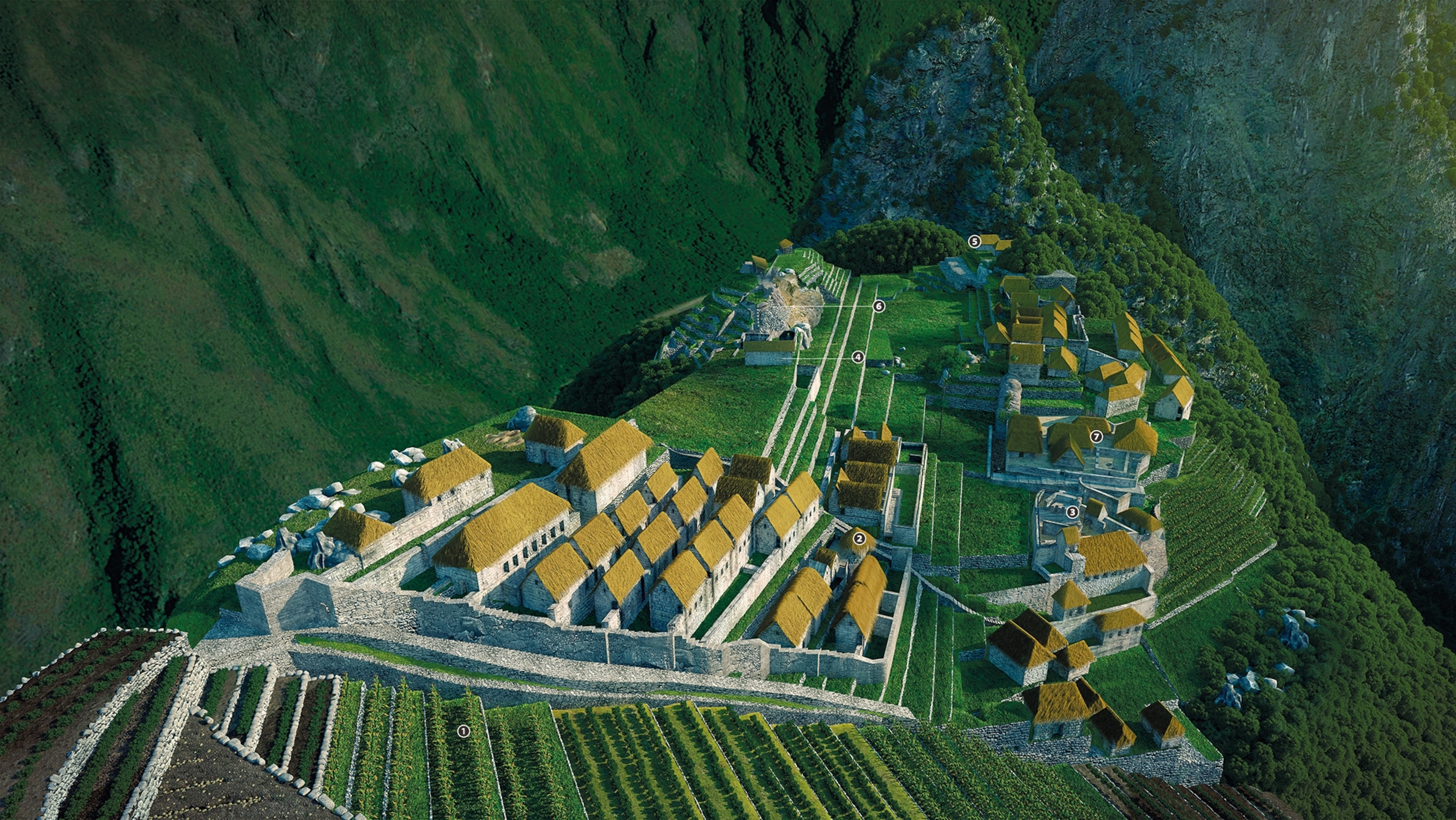
In the mid-15th century, among the terraces that now snaked their way around the valley’s mountain slopes, Pachacuti and his son, the heir Topa Inca Yupanqui, ordered the construction of palaces, temples, fortresses, and tombs. The pair were the driving force behind an enormous construction program that soon filled the Urubamba Valley with ceremonial, administrative, and political complexes. And it was at the heart of this privileged space that Pachacuti ordered the building of a complex that would showcase his empire’s magnificence: Machu Picchu.
Inside the remains of the large and beautifully designed royal residence, archaeologists have discovered remnants related to astronomical observation. As such, it seems that a select elite of religious specialists, astronomers, and engineers were based at Machu Picchu, from where they directed the agricultural tasks and controlled the production in the valley below.
Colossal Constructions
Machu Picchu was the proverbial jewel in the crown, but Pachacuti and his successors commissioned many important buildings. The way these structures integrate seamlessly into the topography of the area demonstrates the Incas’ high level of architectural and artistic knowledge. One example is the palace that Topa Inca Yupanqui had built in Chinchero, whose walls are still visible today despite a church (today called Nuestra Señora de la Natividad) having been built over its foundations during the colonial period. The walls’ original fine stonework and series of niches are clear testimony to the richness of this massive building.

Each of the sites built in the Sacred Valley has its own character. The settlement of Choquequirao, for example, features a set of remarkable terraces. Integrated into the gray stonework are some white stones which, when viewed from a distance, show a herd of llamas (some with their young) being led by a shepherd, diagonally crossing the entire complex. Above Pisac, one of the most important architectural settlements in the valley, hundreds of Inca tombs carved into the rocks have been preserved. The fortress of Ollantaytambo boasts a wall of cyclopean stones at its highest point, demonstrating the Inca leaders’ ability to mobilize labor on a massive scale. Building Ollantaytambo would have required hundreds of workers, dedicated to not only the erection of buildings but also the procurement of raw materials and the difficult transport of granite blocks weighing up to 80 tons. Due to the Spanish conquest, the site was abandoned while still under construction, which has allowed experts to study how the stonework was executed.
(These remote Inca ruins rival Machu Picchu)
Temples and Magical Mountains
The Urubamba Basin was also an area of great religious importance. The Inca saw the winding river as an earthly representation of the Milky Way and called the upper stretch Wilcamayu (“sacred river”). The apus (mountain peaks) were also considered sacred, and believed to be either female, such as Veronica Peak, or male, such as Mount Salcantay. At Machu Picchu, stones were carved to echo the silhouette of the mountains visible on the horizon beyond and were used in rituals to bring rain.
There were also myths and legends explaining the varied topography of the environment. In Pisac, there’s the Ñustayoc hill, or “hill of the enchanted princess.” According to local legend, there lived a princess named Inquill, whose beloved suitor was challenged to build a bridge in a single night in order to win her hand in marriage. As he was about to finish, Inquill turned to look at him (which had been forbidden) and was turned to stone, while he was swept away by the waters. In the Andes, earthly and supernatural life seemed to coexist in a single reality. The name “Sacred Valley” was an apt one.
Machu Picchu, Jewel of the Sacred Valley
The Conquest
In 1533, conquistador Francisco Pizarro took Cusco after defeating and executing the Sapa Inca Atahualpa. He then installed Atahualpa’s brother, Manco Inca, as the new ruler over Tawantinsuyu in a bid to maintain a sense of continuity but, for all intents and purposes, installing a puppet ruler under Spanish control. However, the new Sapa Inca soon recognized Pizarro’s strategy for what it was, fled the capital, and settled in Ollantaytambo.

After a failed attempt to regain Cusco, Manco Inca escaped through the Sacred Valley and into the jungle, eventually reaching the rugged and remote region of Vilcabamba. It was here that he founded the Neo-Inca state, the last bastion of resistance against the Spanish. In a cruel twist of fate, Manco Inca was following the footsteps of his putative ancestors from the mythical origin of Inca history, moving north and establishing a new empire—but not by choice. The residents of the Sacred Valley followed Manco Inca, leaving their former settlements uninhabited. Some even destroyed them, as in the case of Topa Inca Yupanqui’s palace in Chinchero, which was set on fire by Manco Inca himself. The Neo-Inca outpost would last only until 1572; and the final Inca monarch, Tupac Amaru, was beheaded in Cusco. The conquistadors never set up colonies in the Sacred Valley, and nature soon reclaimed the land. Vegetation covered all vestiges of the Incas’ presence.
(How Spain’s lust for gold doomed the Inca Empire)
The past would remain hidden until, in the 19th and 20th centuries, the curiosity of explorers and archaeologists brought the Sacred Valley to the fore once again. Today, it is a leading tourist destination with over 1.5 million visitors each year. Despite the crowds, the remains of these magnificent Inca settlements still give a sense of the immense material and spiritual wealth that once gave shape and meaning to the Urubamba Valley.


