These Italian villages still make the world’s rarest pastas
From remote mountain villages to tiny island kitchens, these disappearing pasta traditions offer travelers a taste of Italy few ever experience.
In Italy, there’s more to pasta than flour, salt, and water. Traditional pasta making is primarily an oral history passed down for centuries in rural villages from one generation to the next.
Italian cuisine was recently acknowledged as the first UNESCO-recognized national cuisine. And on a road trip through Sardinia and Tuscany, food connoisseurs can taste some of the world’s rarest handmade or fatta a mano pastas. In Italy, where food is integral to everyday life, handmade pasta-making is a dying art that regional communities are trying to preserve as young people leave villages.
With help from a translator and knowledgeable guides, you may be lucky enough to have Italian grandmothers (nonnas) invite you into their kitchens to learn their secret traditions and listen to their stories—about the bandit who inspired a pasta pilgrimage, doves released by the bishop and now honored in chicken broth, and how peasant food became a staple of one of Tuscany’s most elegant medieval walled villages.
Su filindeu of Nuoro, Sardinia
Raffaella Marongiu opens a window shade, allowing the sunshine to flood into her apartment kitchen and over a ball of dough on the countertop. Her apartment is located at the right vantage point to get a view of the Sardinian neoclassical city of Nuoro, also called the “Athens of Sardinia.”
“Sardinians are simple and generous people and work very hard. They are proud and reserved, but once they open up, they welcome you like family,” says Simonetta Bazzu, a cultural and culinary preservationist who teaches traditional pasta making at her school, Vittoria Arimani. She’s also Marongiu’s protégé.
Making one of the rarest pastas in the world—su filindeu (“threads of God”)—with them is more than mixing semolina, water, and salt. It’s deeper than stretching delicate dough between your hands—eight times in one motion without breaking it. This handmade pasta method takes a lot of patience to lay 256 ultra-thin strands (in three layers) over a large basket, made from the asphodel plant that covers the Supramonte Mountains in Sardinia. It takes hours for su filindeu to dry under the window into an intricate lattice before it’s blessed, broken up, and served in mutton broth and fresh pecorino. Celebrity and self-proclaimed chefs may have tried, but to really understand how to make su filindeu, you have to be from Nuoro and know the whole story.
Nuoro’s su filindeu dates back to the 17th-century bandit Francesco Tolu, who, after being wrongly accused of murder, prayed to St. Francis for protection. When his innocence was proven, he kept his promise to build a church, where he remained for the rest of his life.
Centuries later, su filindeu is now served only on May 1 and October 4 to faithful villagers in Nuoro. They carry the pasta on foot (some not wearing shoes by spiritual choice) and horseback for eight hours on an overnight 20-mile pilgrimage from Nuoro to the Sanctuary of St. Francesco in Lula, also known as the bandit’s hilltop church. Marongiu and her aunt spend months making su filindeu for them.
“Everyone in the village used to help make su filindeu, but only a handful of women still know how,” says Marongiu. She opens a book to a black-and-white photo of herself as a young girl standing next to her father, who was chosen 60 years ago to organize the pilgrimage as an honorary prior or person responsible for keeping the su filindeu tradition alive.
At the Sanctuary of St. Francesco, visitors can witness the current honorary prior cutting firewood to slow-cook the sheep and to prepare the vestry basins, where the pilgrims wash their feet upon arrival. The honorary prior hands out a bag of su filindeu and a wooden cross to villagers and visitors, in honor of St. Francesco.
At the final stop in Nuoro, on the floor next to a tomb inside the Church of the Madonna della Solitudine, a vase is filled with white-flowering tuberous asphodel used to make the flat basket where su filindeu is laid out to dry in the sun.
“It’s where Nuoro’s beloved 1926 Nobel Laureate Grazia Deledda is buried,” explains Francesca Ruiu, a tour guide. “They left the tubers so she will have food to live on forever.” Deledda’s book, Elias Portolu, celebrates the devotion of villagers on the grueling pilgrimage to eat the nearly obsolete hand-stretched pasta.
“As a custodian of this tradition that has been passed down from mother to daughter ... I remain hopeful that one of them will one day take it on,” she writes. “But if they can't, then I will be sad. So many things in this world that once were no longer are.”
Where to stay: Exoria Luxury Rooms & Spa is located a short walk from Deledda's childhood home, which has been turned into a museum and the Museum of Costumes and Ceramics, showcasing traditional dresses worn during the pilgrimage.
Lorighittas of Morgongiori, Sardinia
Morgongiori is home to 800 people, who live on the slopes of the inactive Mount Arci volcano. Chiara Massa is the daughter of pasta makers. She was barely old enough to ride her bike when she helped paint a giant mural depicting Morgongiori’s famous hand-braided lorighittas pasta morphing into the yarn of the village’s famous hand-woven rugs. She was warned that the fabled “Maria Pungi Pungi” witch would use a pitchfork to stab the bellies of children who ate too much lorighittas. And as she got older, Massa wasn’t like the other young women in the village who hoped that making lorighittas—the wedding ring-shaped pasta—would bless them with a marriage proposal.

Today, 28-year-old Massa, in a white apron, demonstrates how to loop and twist lorighittas in a small commercial kitchen at her parents’ house. It’s a technique developed to resemble the iron rings or “lorigas” that King Ferdinand II of Aragon used to tie up his horses when he ruled Sardinia in the 1500s.
With two of her aunts, she runs Il Grano D’oro, a lorighittas company her parents started in 2000. Women, fewer in numbers now, still gather in the kitchen to loop and twist dough—made of semolina, warm water, and salt—around three fingers into thousands of little lasso-shaped rings. They are lined up to slow-dry in a basket. Lorighittas are still served in chicken broth at the annual Festival of Lorighittas on the first Sunday of August, and on November 1, All Saints’ Day.
The difference now is that Massa realizes it’s up to her to preserve her heritage. Her company is the only one still making this pasta, which is listed as near-extinct in the Slow Food Foundation’s Ark of Taste endangered product catalog. “Thanks to the company, now more people know that lorighittas exist. I want to keep the tradition of Morgongiori alive,” says Massa.
Where to stay: Soak in hot spring-fed pools at the Sardegna Termale Hotel & Spa after hiking in Monte Arci Regional Natural Park and visiting the Living Museum of Textile Art to see hand-spun wool tapestries made in Morgongiori during the 18th century.
(The essential guide to visiting Italy’s Sardinia region.)
Crogoristas and Caombus of Masullas, Sardinia
From the doorway of his home and former restaurant, Giorgio Grussu waved goodbye, tearing up and putting his arm around his wife. It was hard to believe this gentle, sweet-natured 86-year-old man was the same person who said he’d take his ancient pasta recipe to the grave before sharing it. “This pasta almost disappeared, and he is the only one who has kept its memory alive,” Bazzu explains.
Grussu takes on the unique honor of being the only man among the many Sardinian women preserving ancient pasta. He wasn’t always protective of his crogoristas, a rooster-shaped pasta. When his restaurant closed, he tried to teach the entire village—starting with a neighbor—how to carefully shape and season crogoristas with saffron and tomatoes, dried in a bag for 10 days.
“The person folded the crogoristas the wrong way, so I refused to continue this process of sharing the recipe,” he says from across his dining room table. “People are always in a hurry. They don’t have the patience to carry out these traditions.”
Food connoisseurs visiting Masullas should consider a once-in-a-lifetime experience of having Grussu carry over a bowl of his handmade pasta in front of them, while describing the fertile soil in the “village of roosters” and churches—six for 1,000 residents living within seven square miles.
Dating back to 1700 B.C., Masullas, a village renowned for its rare traditional handmade pastas, is home to the remains of a dozen prehistoric stone nuraghe tower-fortresses in the UNESCO-recognized Geomining Park. Monte Arci’s smooth obsidian glass—the Mediterranean's main source of this “black gold,” used to make weapons, jewelry, and tools—has attracted religious leaders and aristocrats since the Middle Ages.

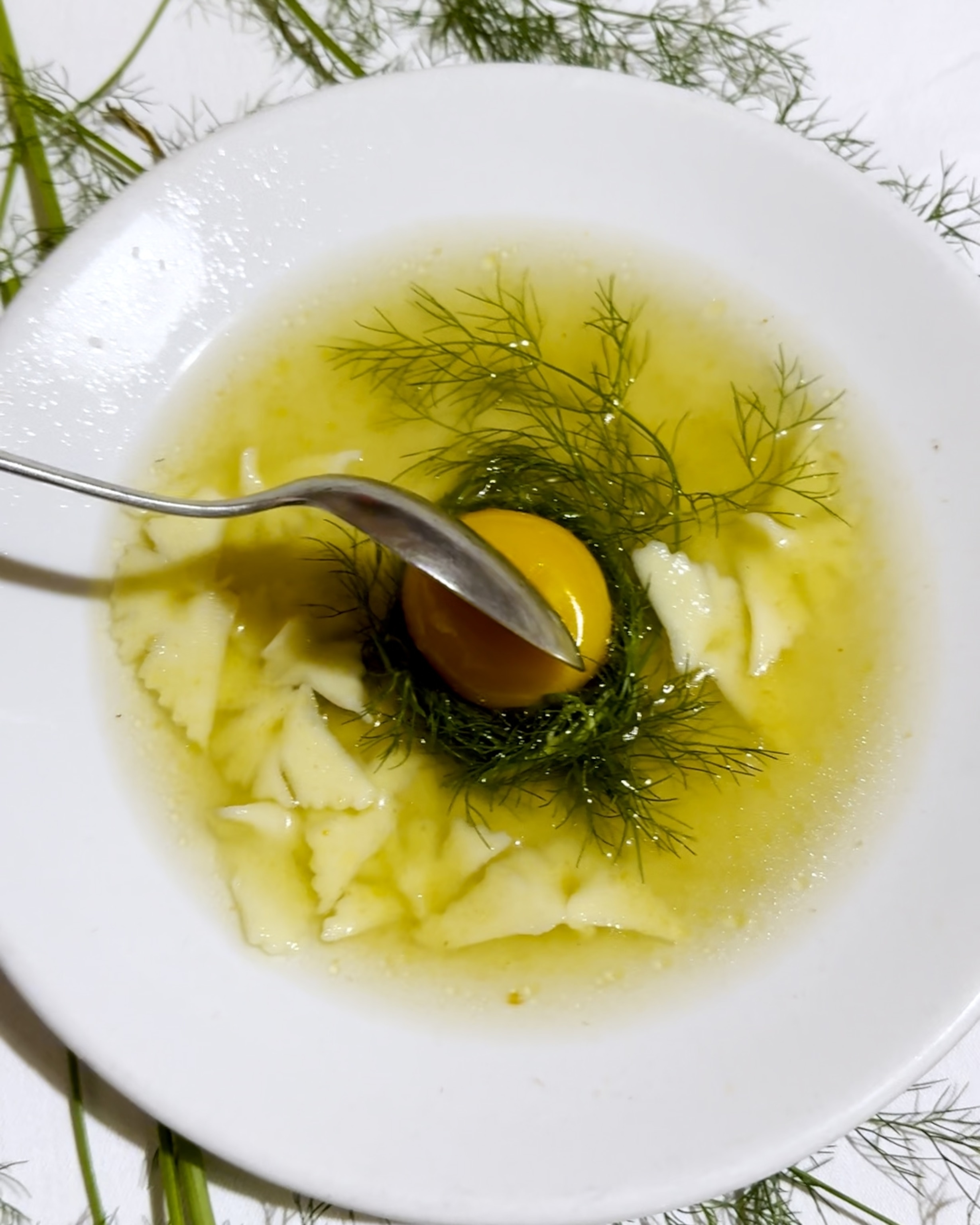
In the 1760s, the Bishop of Ales-Terralba, Monsignor Giuseppe Maria Pilo, made pastoral visits to the 44 villages of his diocese, including Masullas. According to oral history passed down through generations in Masullas, he released doves, which Grussu suspects inspired a noble family to invent, among the town's other famous pastas, floating in the bowl on the dining room table. Around an egg yolk nested in dill, the dove-shaped pasta is a gesture of divine protection.
Grussu, who for now won’t share the secrets of how exactly to mix, pinch, shape, and fold his doves and rooster-shaped pastas, still hopes one day he will be able to trust someone else to carry on his prize-winning recipes, but only in Masullas.
Where to stay: Hotel Villa Fanny, owned by Sardinia’s famous Cellino pasta-making family, offers respite in the beautifully restored boutique hotel near the center of Cagliari. The hotel is a 50-minute drive from Mauallas, where you should consider visiting the Monti Arci Geomuseum and UNESCO-recognized Historical and Environmental Geo-Mining Park.
Pici of San Quirico d'Orcia, Tuscany
A few years ago, Emanuele Micheli drove his nonna Annunziata “Tina” Micheli from San Quirico d'Orcia, Tuscany, to a kitchen in the Dolomites’ Val Gardena, where she rolled up her sleeves and got to work showing the chefs at Michelin-star Suinsom in her family’s Tyrol Hotel how to handroll her fat spaghetti, called pici. Italy is home to over 350 types of pasta, so it’s not uncommon for people living in different regions to have never heard of another region’s pasta.
At 87, Tina’s memory may not be what it was, but the second she starts kneading dough, Emanuele says, “Everything comes back.” She’s been making pici for as long as she can remember. This labor-intensive, difficult-to-mass-produce process also requires grit to roll every single strand between your palms. “You can make the middle fatter, they’re not supposed to be even,” she instructs.
As a child, Tina made Tuscan pici when there was nothing else to eat. San d’Orcia was a poor village before its stone walls, cypress-lined streets, and intact medieval fortifications were perfectly restored.
“This is not just cooking; it’s history. Our pici is her heritage,” says Emanuele, adding that if you want to buy pici from the village markets to take home, just don’t tell Tina it wasn’t served fresh.
Where to stay: Sleep inside medieval walls under exposed beams and lounge in a courtyard fit for royalty at Palazzo del Capitano. Sip Sangiovese at Poggio Grande in the Tuscan countryside, followed by a dish of handmade pici down the block at Al Vecchio Forno.
(Where to eat in Florence, according to a local chef.)
Testaroli, Lunigiana, Tuscany
Travelers heading to Lunigiana, Tuscany, won’t be eating pancakes, but drive into the ancient chestnut woods of Tuscany’s highest peak and you’ll see one of the world’s oldest—flattest—pastas cooking over piping hot coal.
On a blustery day at Tuscan-Emilian National Apennine Park, a robust nonna wrapped in a woven shawl named Graziella Ravera ladles a flour-water-salt mix into an old 15-pound cast-iron “testi” pan. For 33 years, Ravera has made this artisanal testaroli in the Massa-Carrara and neighboring La Spezia provinces.
Outside the remote, award-winning Ristorante La Torre, she cuts the tasty, supersized spongy crepe into two-inch squares. But not until it’s boiled for 30 seconds does this 2,500-year-old Etruscan testaroli become pasta—always topped with the region's famous bright-green basil pesto.
Where to stay: Agriturismo Montagna Verde in Apella, a 13th-century restored fortress and abbey on the Tuscan-Emilian Apennine ridge built around a historic watchtower above marble quarries and castles. Eat testeroli and pesto at Ristorante La Torre and stop by Pontremoli’s Piagnaro Castle on your way out.
