Where to eat bunny chow, Durban's beloved curry-in-a-loaf dish
South Africa’s distinctive curry-in-a-loaf dish began life as a portable meal for Indian labourers and has since put its sunny seaside home city on the food map.
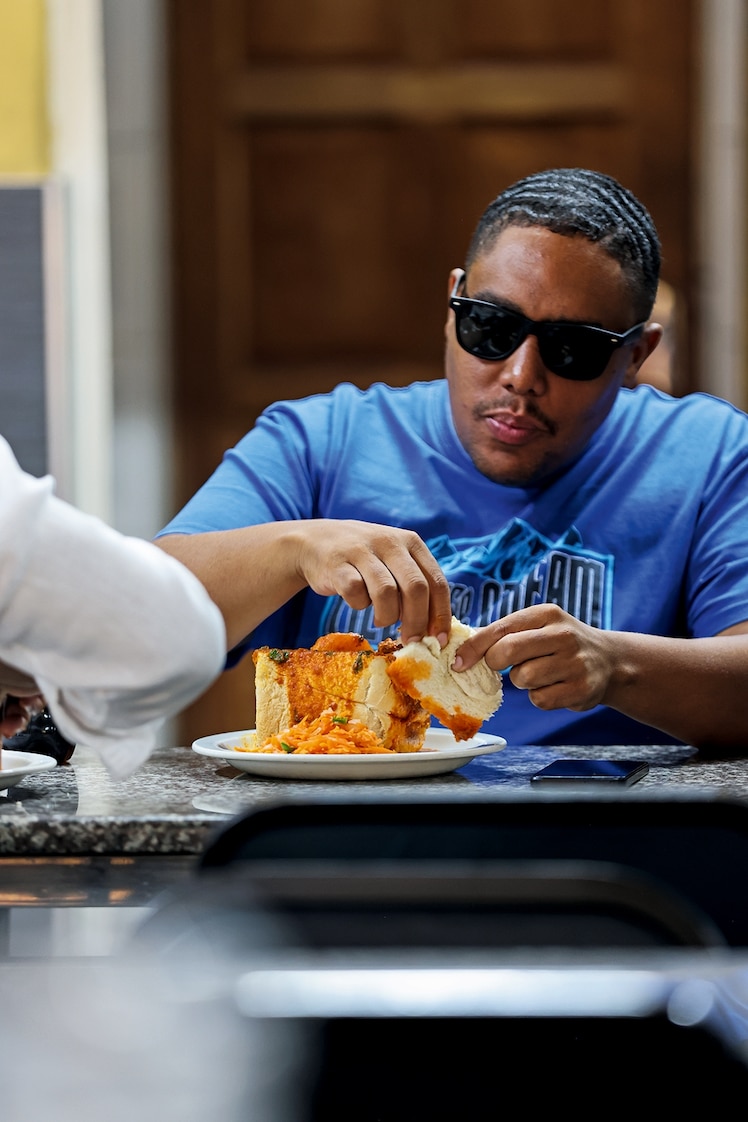
It’s not yet 11am, but the queue at Gounden’s is already three-wide and six-deep. The family-run joint on Umbilo Road, just west of Durban’s cargo port, is sandwiched between workshops and factories — a no-frills restaurant-takeaway that’s been a revered name for 40 years. Front of house, Devan Gounden is the one-man crowd marshal, in constant motion, taking money and cards, relaying orders through the open kitchen door and dispensing the finished dishes. His mother, Mahalutchmi, presides inside, unseen. The clientele is almost entirely male, mainly labourers alongside a few office workers. They’re all here for a meal that combines crockery, cutlery and comestibles all in one: bunny chow. The Durban-born curry is served in a hollowed-out half or quarter loaf of white bread and eaten with the hands.
The British colonial 1860s are most often cited as the origin date of the city’s most famous dish, when Hindu merchants — ‘bhania’, from where ‘bunny’ likely derives — are said to have first served curries in disposable containers. Today, descendants of these indentured workers from the south of the subcontinent are still debating the culinary copyright of this national treasure — a staple in a city that represents one of the largest Indian communities outside of India. Regardless of its provenance, the bunny — the full name is rarely used by locals — quickly became Durban’s working men’s lunch, often dispensed through takeaway hatches and consumed on the go.

By lunchtime, the queue at Gounden’s stretches down the street. So what’s the secret? A tall, middle-aged Indian customer in the queue offers an answer. “I grew up next door to the family. I could smell the spices,” he says. “They’re still the same. The curry here is old-style. Very close to homemade.” Sniffing the air, I detect a mixed-masala aroma, with top notes of turmeric, ginger and cumin.
Cooked with oil rather than butter, a Durban curry is more red and fiery than its sub-continental forebears, with extra fresh chillies and curry leaves, and many more tomatoes, one of its signature ingredients. And whether it’s with vegetables or meat — traditionally mutton, the dish’s defining ingredient — a bunny is always bolstered by potatoes.
The double-doors to the right of the queue burst open and a blast of cool air-con welcomes us to Gounden’s large, bright canteen-style dining room where lino floors, easy-wipe tables and an open washroom represent the essential fittings of a sit-down bunny den. This messy meal requires cleaning up both during and after eating. The room is half full, the clientele overlooked by a couple of very old Manchester United posters flanking screens showing sports channels. Two big guys, hands deep into their mutton bunnies, are happy to be interrupted mid-mop. Gounden’s, they say, is a favourite because of its “very tender meat and very good heat”.
A bunny’s spicy warmth is built in, so asking for extra chilli would offend, but little bowls of grated carrot, cucumber and tomato are served as essential accompaniments, offering contrast and a cool down. My signature mutton chow arrives, topped with the bread ‘plug’ from the excavated loaf — the ideal spoon/mop to reduce the ‘gravy’. It’s savoury-rich and wickedly oily. Once a less spillable level has been achieved,
I can start on the sides of the bread, carefully tearing away strips with which to continue the deconstruct-and-devour process. It’s messy, as convention dictates, even undignified — and it’s worth it. Fragrant with just the right amount of star anise and ginger and richly red, there’s a reason why this is rated one of the best mutton bunnies in town.

Bunny, beans and burfee
Durban’s earliest bunnies centred around beans, particularly sugar (red-speckled) beans and broad or fava beans. And beans bunnies remain the specialities of long-lived spots on Dr Yusuf Dadoo Street, including Patel’s Vegetarian Refreshment Room, a fixture at the heart of Durban’s busy CBD shopping district since 1932. The city’s meat bunnies arrived here around a decade later, popularised by restaurants like Kapitan’s (now closed) and Victory Lounge.
A former city centre spot, Victory Lounge has moved to the predominantly Indian suburb of Chatsworth and also north to the business, shopping and beach development of uMhlanga. And it’s in the latter, in a super-modern mall setting, that I find a new favourite bunny den.
Outside, bright umbrella-shaded tables overlook leafy Park Square. Inside, it’s light and airy, with the obligatory wash basin part of the set-up. On one counter, I survey a multitude of sweet burfee treats, Indian confections made with everything from almonds to spiced chickpeas. A contrasting temptation of savouries is displayed on another: vadde (lentil) fritters, puri patha (tangy spiced spinach patties) and more.
Owner Thivagaran Moodley, whose distinguished demeanour suggests his natural habitat should be a boardroom rather than a kitchen, is a direct descendant of Victory’s founders, whose portraits hang behind the counter. He comes in long before opening time to cut the loaves of bread for the day’s bunnies. Hundreds of them. “It’s all in the hands,” he says.
I’ve opted for a beans bunny. This is perhaps the most easily homemade of all Durban curries, so commercial versions need to be extra-dimensional to shine — and Victory’s is a feted dine-out star. Of course, Thivagaran won’t give away his secrets, yet I’m sure my superbly fragrant beans bunny features more than the usual fresh ingredients: more ripe red tomatoes, young green chillies, curry and bay leaves, which haven’t travelled far from the trees.


Secret spices
The original clientele of the Britannia Hotel would have been pink-gin colonials. Today, its sundowner terrace on the Umgeni River’s south bank is a slice of history that’s almost been swallowed up by Durban’s busiest road. Inside, I don’t find the botanical cocktail favoured in the 19th century, and am instead met with cheers from the Thirsty Horse sports bar.
Linkey Moodley’s family has owned the Britannia Hotel since 1983. It was his mother, Logambal, whose dishes made the place famous, the bespectacled, studious-looking Linkey tells me. She used recipes learnt from her own mother, who was “an exquisite cook”, he says. Today, Britannia’s menu takes in a whopping 14 varieties of bunny including ‘chops chutney’, which features bone-on mutton chops smeared with masala, ginger and garlic, slow-cooked with twice the standard amount of tomatoes.
In the old-fashioned, wallpapered and chandeliered hotel restaurant, distinct from a bunny den’s usual lino and laminate, I find uninitiated guests using cutlery to tackle their meals. That is, until they spot the locals and realise this dish is a strictly hands-on affair.
The masala mixes that anchor most of the curries are still made to Mrs Moodley’s recipe. “And that’s a secret!” says Linkey, before I can press him. However, a waft of fennel seeds and fresh chillies hangs in the air as a beans bunny comes out of the kitchen, followed by the enticing scents of my boti bunny. For adventurous eaters the Britannia’s boti (‘chunk-chopped meat’) is a triumph — one of its ‘exotic’ offerings made with trotters or tripe. Teeming with chickpeas, deeply tomatoey and the tripe spiced with Mrs Moodley’s masala, it’s a worthy rival to any Italian trippa (tripe) or French tripe dish. Offal done with inimitable, Durban style.
How to do it
The Oyster Box is on the KwaZulu-Natal coast just north of Durban CBD. The pool is flanked by cheery red and white umbrellas that colour-match the nearby lighthouse crowning Umhlanga Beach, and the curry buffet is a must-try.
What to see
A 10-minute drive from the hotel, Durban’s Sharks Board is a research institute and museum dedicated to protecting the region’s beach bathers while studying the animals and their relationship with humans.
More info:
visitdurban.travel
To subscribe to National Geographic Traveller (UK) magazine click here (available in select countries only).
