Where to Find the Best Hot Dogs in New York City
Traditionally found at street carts and dive bars, this New York staple is being reimagined with fusion flavours and elevated takes that reflect the city’s ever-evolving food scene.

Around the halfway mark of my New York City hot dog crawl, I begin to wonder whether the human body is really designed to consume this many wieners in buns. But it’s a skill my tour guide Erica Chambre has nailed. Ahead of me, she darts deftly through the Times Square crowds, no sign of sluggishness despite our full stomachs. Steam billows up from manholes, yellow-cab drivers press impatiently on their horns, and nearly every street corner is marked by the colourful umbrella of a hot dog cart, the scent of grilled meat hanging heavy in the warm afternoon air.
Erica, looking sharp in a blue trilby, waves off the surrounding vendors with seasoned dismissal. “The flavour really isn’t worth the gamble for your stomach,” she tells me, flicking her hand casually towards the shiny chrome carts. “What we’re eating today is on a completely different level.”
To prove the point, we head to nearby Hell’s Kitchen and duck through the doorway of Rudy’s Bar and Grill, a dive bar so dingy it takes a few seconds for my eyes to adjust. Once they do, a vision of pure Americana appears: guys hunched over the bar watching sports on TV screens, Bruce Springsteen rocking through the speakers, and a bartender sliding a hot dog in my direction. The edges of the juicy sausage curl upwards like a mouth breaking into a coy smile. All at once, my appetite returns with a vengeance.


I’ve come to New York to sample the city’s finest hot dogs, beginning with the classics before setting off on my own search for the Big Apple’s most extravagant and inventive takes on the sausage staple. The humble sandwich arrived here in the mid-19th century via waves of German-speaking immigrants. They introduced New Yorkers to the likes of frankfurters, weisswurst and wieners — pork, beef or sometimes veal. In places like Coney Island, enterprising immigrant vendors popularised the sausage in a bread roll and sold it as New York street food: cheap, tasty and good-to-go. A handheld dish tailored for a city that never stopped moving.
(How to Explore New York City's Immigrant Past Through its Food.)
“New Yorkers don’t really sit down for lunch,” Erica says at our next stop, Schaller & Weber, on Manhattan’s Upper East Side. She’s brought me here in search of the old country — the wursts from Germany that laid the groundwork for the modern hot dog. “The Germans and Austrians arrived here with the idea of a little sausage in a sandwich roll. They took their food and culture and adapted it to the US.”
Inside the vintage delicatessen, established in 1937, time appears to have stalled. A faded photograph of a moustachioed accordion-player hangs near the entrance, while pale, weisswurst veal sausages are piled like pyramids behind the glass counter. Through a hole-in-the-wall hatch, we order a couple of pork-and-veal bratwursts. They come in warm pretzel buns and buried beneath tangles of sauerkraut, the sharp hit of vinegar strong enough to clear both the sinuses and the mind.
At the final tour stop on the Upper East Side, we tuck in to our seventh, possibly eighth hot dog of the day. Erica explains that for her there’s a rock-steady formula for the perfect hot dog. “This is my favourite,” she says of the no-frills version served at Papaya King: the instantly recognisable all-beef frankfurter. The fast-food institution opened in 1932 selling tropical drinks before adapting to its German clientele. “It’s very simple: just a bun, sausage, mustard and ketchup. A couple of bites and it’s gone. It’s fast-paced food for a fast-paced city,” she says, as I savour the rich, grilled beefy snack.


The High-Low
The following day in Midtown Manhattan, it’s a different scene altogether. I’m at The Modern, a sleek two-Michelin-starred restaurant cocooned inside the MoMA art gallery. My table looks out onto a sculpture garden lined with large-scale works by the likes of Pablo Picasso and Joan Miró, while the muffled sound of polite conversation drifts across a sea of white-clothed tables. Chef Sarah Hsieh pulls up a chair and presents me with the restaurant’s masterpiece: caviar hot dogs. Two dinky buns each cradle a finger-length sausage topped with loops of pickled shallots, dill and a heaped spoonful of caviar.
“Most people don’t expect caviar and hot dogs to make sense together, but somehow they do,” the Canadian chef says with a grin, her long black hair tied back and her name embroidered onto her crisp white jacket. Since debuting on the menu three years ago, the unlikely pairing has developed a cult following, and the kitchen now sends out roughly 100 of the luxe little dogs each day. On the plate, it’s a work of art that could rival the canvases just visible through the gallery’s windows. But Sarah explains that creating the restaurant’s signature indulgence is actually more like a science.
“There were many iterations to get to this point,” she recalls. “We started with a potato roll, then migrated to brioche. And the sausage is made especially for us by a secret supplier, to an exacting length so it just peeks out the end of the bun.” I finish mine in two delicious mouthfuls, the all-beef sausage tender after being poached and then kissed by the grill, mingling with tiny, salty pearls of caviar that explode in the mouth. The dish’s success comes down to taking the old-school nostalgia of a New York hot dog, its smell evoking backyard cookouts and Independence Day feasts, and elevating it to fine-dining standards, Sarah says. “There’s something really fun about caviar hot dogs,” she concludes. “It’s a bit of high-low culture.”


Top Dog
For my ultimate stop, I head through Brooklyn’s tree-lined brownstone streets to the Time Out Market on Water Street. It’s here that the South Asian-American hot dog company Chaat Dog can be found slinging wieners. Behind the bar, a couple of foot-long sausages sizzle loudly on the griddle before owner Pervaiz Shallwani, sporting black-rimmed glasses and a clipped salt-and-pepper beard. His South Asian-American street food concept was born in 2017, when the classically trained chef decided to mix the flavours of his life — the Chicago-style hot dogs he’d eaten as a child in Illinois, married with the spices of his family’s Pakistani heritage. The chaat element comes from the sweet, savoury and spicy street food snacks often found in South Asia, used as toppings.
“There’s really nothing new in this culinary mashup,” he says, popping a Vienna beef sausage into a ghee-toasted bun and adding mint and coriander chutney. “All American food is immigrant food,” he adds, scattering tiny balls of dough dusted with masala chaat powder onto my smoking hot dog. People have long come to America with their recipes from home, then blended them with what they found on arrival, creating something entirely new. “The hot dog is the perfect example of this because every immigrant group that comes to America tries to make it their own. It’s a blank canvas.”
I bite into my chaat dog, and it instantly claims the crown of top dog in New York for me. Not just for the addictive crunch of the chaat topping, which I could happily eat by the handful. Or even the way sweet, salty and spicy play out with chef’s-kiss precision. But because, tucked into a toasted bun, this fusion hot dog somehow tastes like the very experience of wandering New York’s streets: inventive and joyfully diverse. It’s proof that in New York City, you can always teach an old dog new tricks.
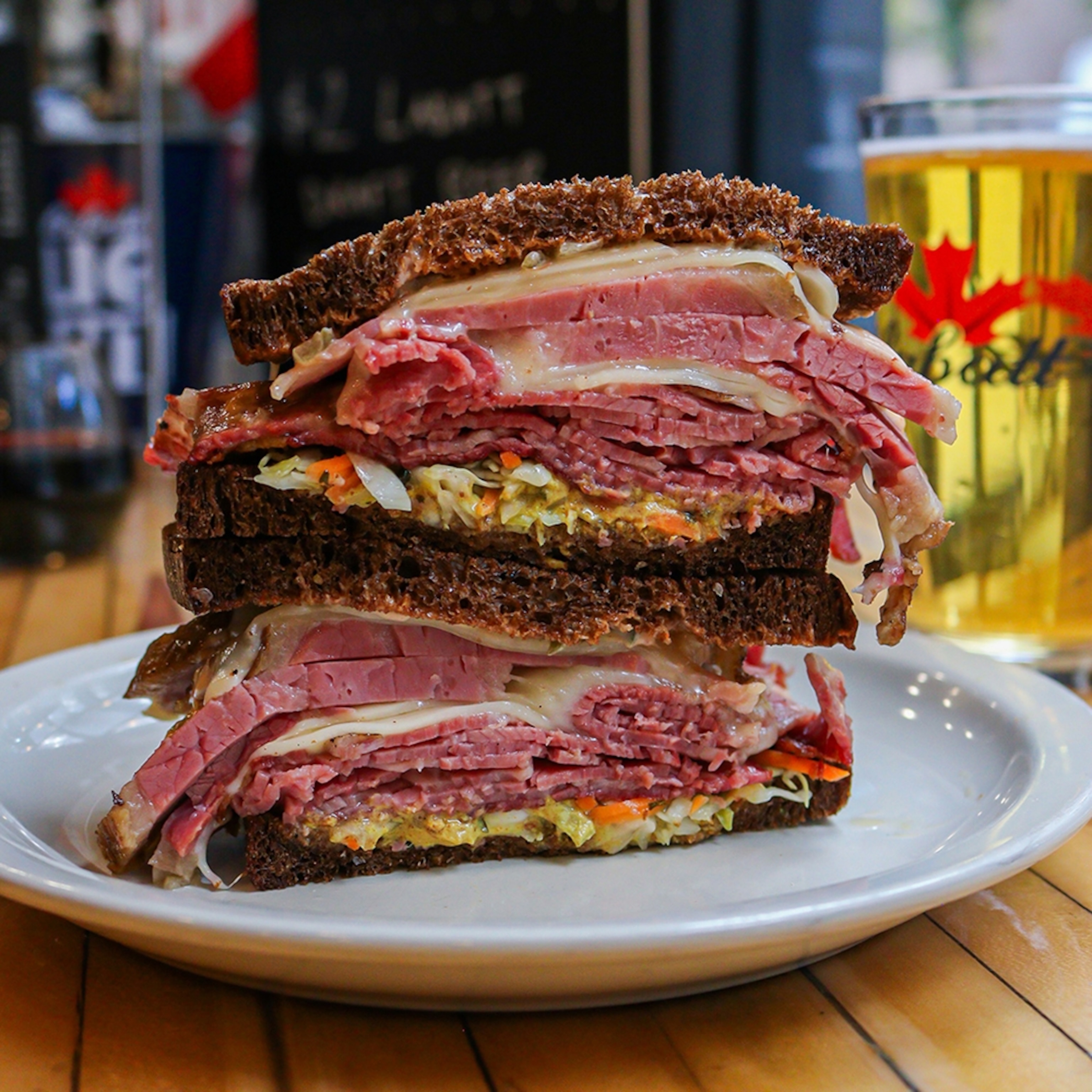
Related: Discover the Story Behind the Reuben Sandwich
Read more here.
How To Do It
How To Get There:
Airlines including British Airways, Virgin Atlantic and Delta fly to New York from UK cities.
Where To Stay:
TWA Hotel at JFK International Airport is set in a former terminal, complete with a concession stand serving classic Feltman’s of Coney Island hot dogs. Rooms from $257 (£192).
More Info:
nyctourism.com
To subscribe to National Geographic Traveller (UK) magazine click here (available in select countries only).
