An ancient city was left in ruins—but this remarkable statue was saved
When two British explorers excavated the remnants of the ancient Greek city of Cyrene in 1861, many tombs had already been looted. But the Sanctuary of Apollo still held their greatest find yet.

In the spring of 1860, Robert Murdoch Smith, an engineer and young lieutenant in the British Army serving in Malta, hatched a plan for an archaeological exploration in North Africa. He convinced a colleague from the Royal Navy, amateur artist Edwin Augustus Porcher, to join him on the adventure. Both men had already witnessed fabulous archaeological discoveries made by colleagues that had caused a major stir back home in Great Britain. Now they wished to mount their own excavation and hoped to discover some splendid treasures from antiquity for themselves.
Smith and Porcher chose as their destination the coast of Libya, a territory home to relatively unexplored ancient sites. In the seventh century B.C., Greek colonists founded the city of Cyrene there, which became one of the most important urban centers in the region. But after major earthquakes in A.D. 262 and 365, the city was left in ruins, visited only by nomads and a few local inhabitants. The remains of its monumental necropolises and ancient temples stood undocumented by historians until the early 19th century, when various European travelers visited Cyrene. Some recorded their impressions in evocative chronicles and engravings. Among them were brothers Frederick and Henry Beechey (1821) and James Hamilton (1851). Colonel Herman, British consul in Libya, visited Cyrene in 1849 and wrote a detailed description of the city. It was these tantalizing accounts that had piqued Smith and Porcher’s curiosity.
(This missing Wonder of the World inspired countless modern imitations)
The expedition begins
After obtaining the necessary permits from the Turkish authorities (Libya was then part of the Ottoman Empire), Smith and Porcher left Malta and arrived in Cyrene on December 23, 1860. As they made their way through the necropolis on the edge of the city, they found that many of the tombs had been looted. They decided to use these burial chambers as places to camp and focused their attention on the ruins of the city. They found columns, the remnants of imposing walls and a theater, fountains, and podiums. Cyrene, half swallowed up by the surrounding landscape, still showed the vestiges of a glorious past.
Plundered tombs
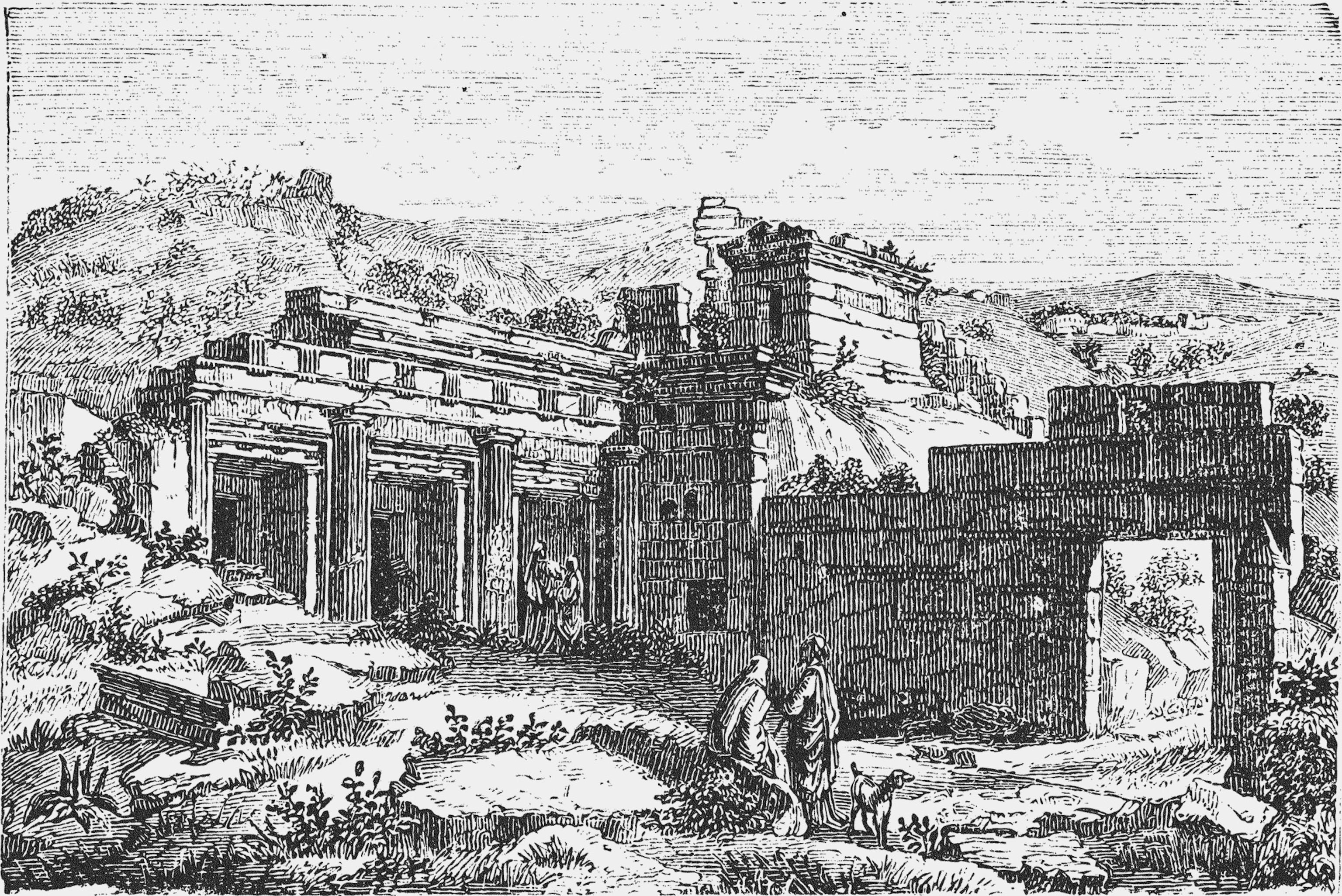
After surveys were made across the site, excavation work began in an area now known as the Sanctuary of Apollo. There, Smith and Porcher located a monumental fountain and the remains of a once vast building. Two inscriptions dedicated to Apollo found nearby led them to identify this building as a temple of the god. The ruins were surrounded by farmland that the local population wanted to maintain, and this initially prevented a complete excavation of the site. So the work was carried out in stages; when earth was removed from one area, it was replaced in another that had already been excavated. As they dug, Smith and Porcher found walls and floors superimposed on each other, which indicated that the site had been reused throughout antiquity. In the oldest layer, they located part of the original paving, columns, and remains of materials that had served as the temple’s roof.


As Smith and Porcher excavated within the confines of the ruined temple, there, in the cella (inner part of the temple, where the image of a deity would have been placed), they began to uncover the kind of artifacts they’d been hoping for. The first find was a female figure about three feet six inches high and wearing fine drapery. Later, in no particular order, they found a statue they identified as the emperor Hadrian, as well as a head of the goddess Minerva and another of Gnaeus Cornelius Lentulus Marcellinus, the first Roman praetor of Cyrene. There were also representations of Jupiter, Amon, the nymph Cyrene with a lion, and a huntress— perhaps the goddess Diana—among others. The pieces must have adorned the temple in ancient times and lain buried since the earthquake whose estimated magnitude of 8.0-8.5 had devastated Cyrene in 365.
Aesculapius or Apollo?
One find in the cella particularly excited Smith and Porcher. Lying on the ground, near a large pedestal on which it had once been displayed, was a colossal marble statue. The head had broken off and the body was cleanly fragmented into three large pieces and more than 100 pieces of smaller ones. It seemed to depict an ancient deity with hints of draped garments, a cithara (lyre), a snake, and the trunk of a tree. Initially, Smith and Porcher assumed that the statue lying in what they believed to be the Temple of Apollo must be a statue of Apollo himself. But then, in March 1861, Smith wrote a letter explaining that he had reconsidered this attribution and now believed the figure to depict the god of medicine, Aesculapius (Asclepius): “There is no inscription, but the statue is shown to be one of Aesculapius by the presence of a serpent wound round the trunk of a tree and entwining a rod.” This new theory led him to change his mind about the temple too: “This, instead of being as I supposed the Temple of Apollo, is no doubt the Temple of Asculapius.”
Apollo and the nymph Cyrene
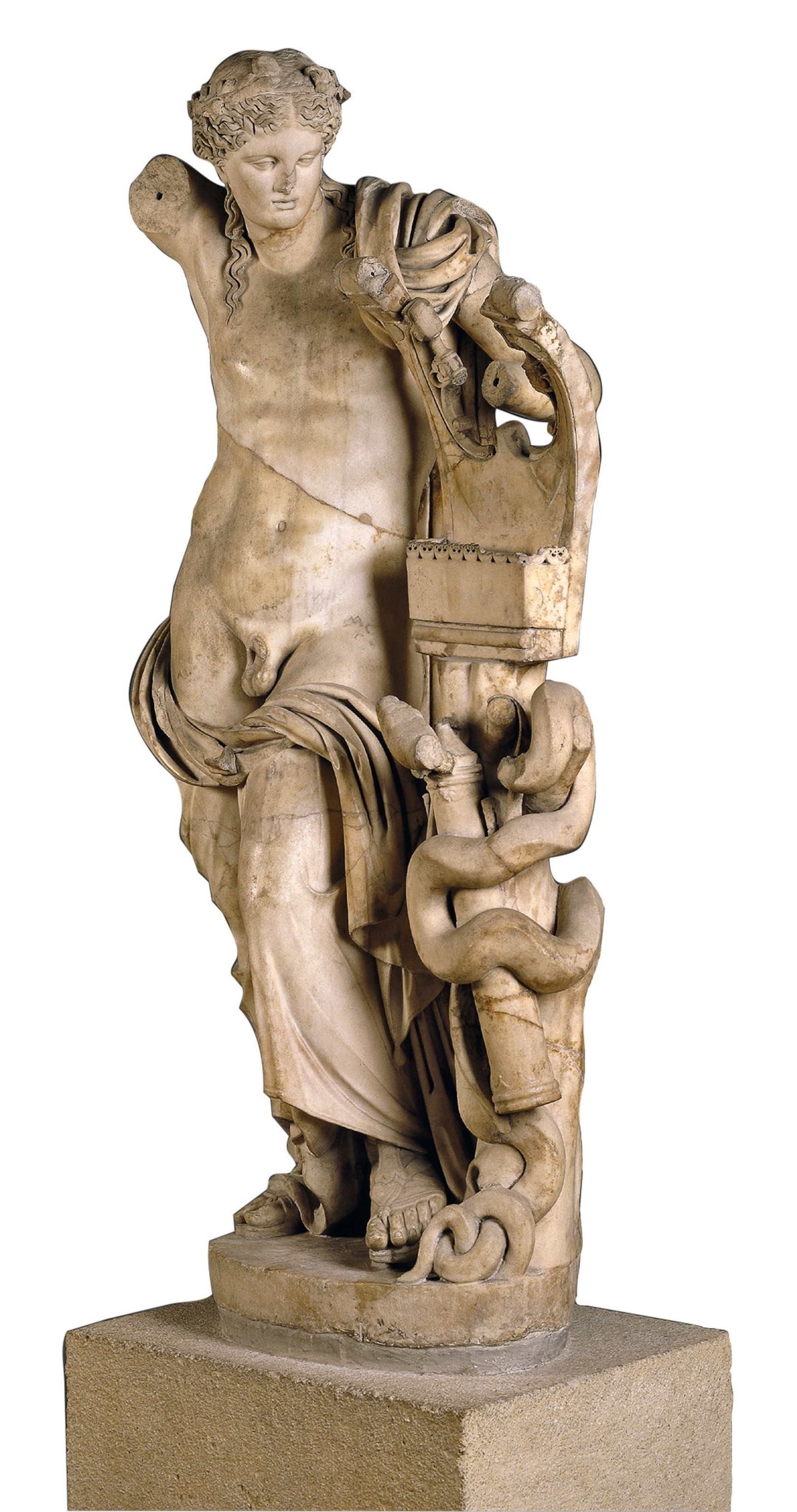
THE APOLLO OF CYRENE
GOD
Apollo’s face shows great serenity and beauty. His long, curly hair, wreathed in laurel, cascades over his shoulders. The god appears half naked, barely covered by a himation (wrap) around his thighs.
MUSICIAN
Apollo is depicted as the god of music (Apollo Citharoedus) holding a cithara (ancient lyre) in his left hand.
AVENGER
The cithara rests on the trunk of a tree, from whose branches hangs a quiver, an attribute of Apollo in his role as a god who dispenses justice.
SAVIOR
A great serpent coils itself around the tree trunk by Apollo’s left foot. This is Python, the monster that sought to destroy the Earth and terrorize its inhabitants. Apollo killed it and, in memory of his feat, founded the Pythian Games, which were held in Delphi.
A conflict with the workers over their pay forced the remains of the statue to be reburied temporarily until new workers arrived. Then, with the help of a camel and three other men, the pieces of the broken statue were transferred to the same tomb in the necropolis where Smith and Porcher had set up camp. The explorers had been using the tombs as a kind of warehouse, storing fragments of the sculpture there for safety.
The excavation was completed on April 20, when the local workers left to tend to the harvest in their fields. The time had come to pack up the finds for transportation to England. Their sheer number forced Smith and Porcher to make a selection; some statues had to remain in situ due to their weight. One such piece was that of the emperor Hadrian. Among the objects shipped to London were the pieces of the colossal statue found in the cella of the temple. There, after a thorough study, scholars would conclude that it was in fact a representation of Apollo, as Smith and Porcher had initially supposed.
Moving the marbles
The transportation of the artifacts to London was a feat in itself. On May 29, a procession of camels and two wagons carried the precious cargo to the port where the British ship Assurance was waiting. Upon its arrival in London, the broken statue underwent meticulous restoration work at the British Museum and was successfully reassembled from three main fragments and 118 smaller ones.
(What really happened to the Library of Alexandria? These are the theories.)
Italians in Cyrene
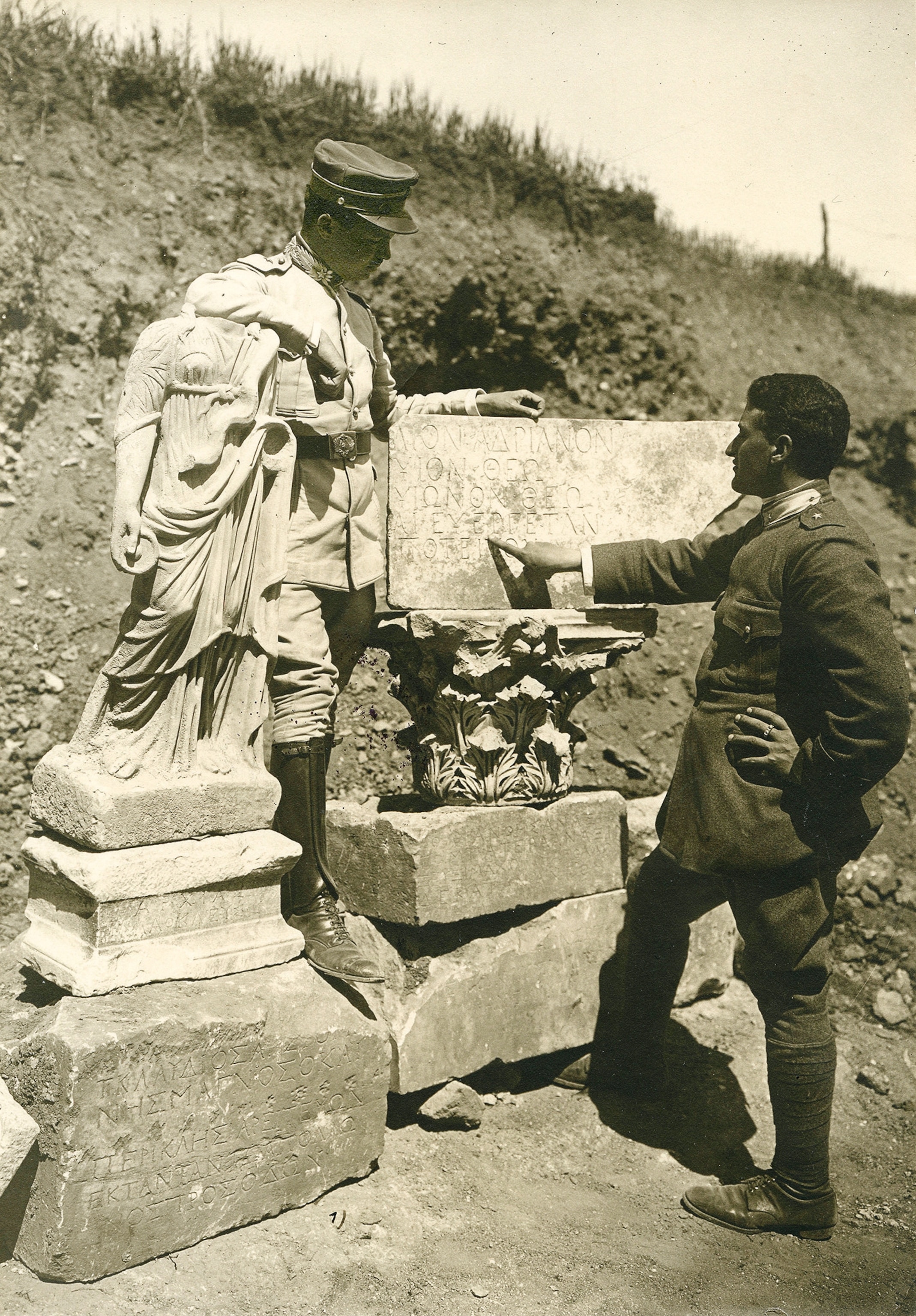
Scholars believe the statue was not destroyed by looters but shattered after falling from its pedestal, probably during the earthquake of 365. Research shows that it was made in the second century A.D, and was copied from a Hellenistic original dating to between 200 and 150 B.C. The statue depicts Apollo as the god of music (Apollo Citharoedus) supporting a cithara that rests on the trunk of a tree, but the figure is simultaneously Apollo Pythios, poised to slay the monstrous serpent, Python.
The Apollo of Cyrene still rests in the British Museum, where it is visited to this day.
