Vesuvius buried these scrolls. AI is bringing them back.
Once thought to be unreadable, 2,000-year-old papyrus scrolls from one of antiquity’s only surviving libraries are finally spilling their secrets—and National Geographic got a first look at what they say.
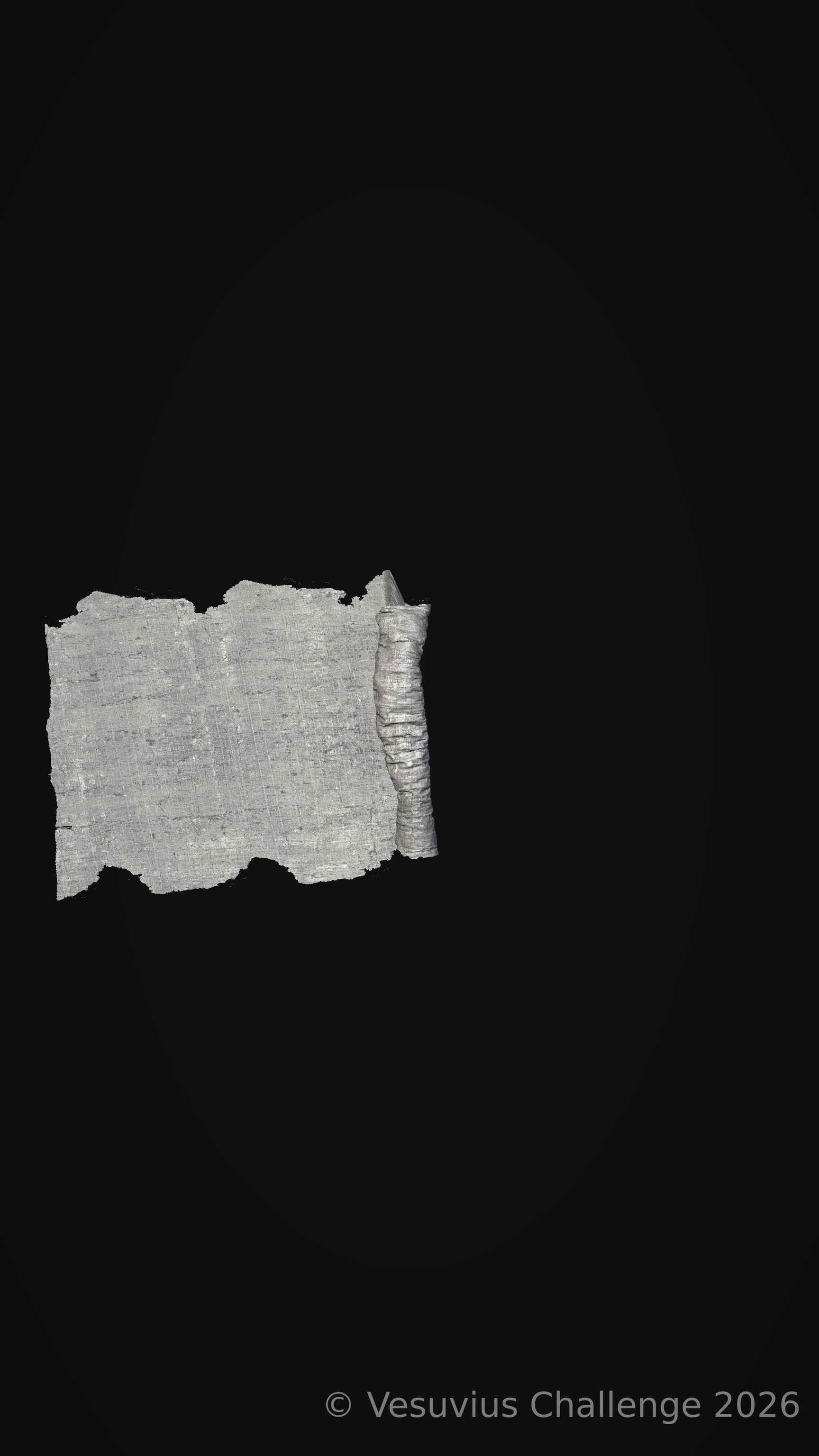
Imagine inheriting the finest bottle of wine ever made—a rare vintage unlike anything else in the world. Now imagine the bottle is so delicate that even touching the cork would shatter it. It’s there in front of you, a priceless treasure. But “you can’t drink it,” muses Giorgio Angelotti.
That’s the maddening predicament Angelotti and generations of other scholars have endured trying to decipher the Herculaneum scrolls.
The A.D. 79 eruption of Mount Vesuvius that ravaged Pompeii also buried the nearby town of Herculaneum, entombing its celebrated library at the Villa of the Papyri under 60 feet of ash and rock. Hundreds of papyrus scrolls survived the inferno thanks to that heavy blanket of volcanic debris. Instead of burning, they baked into brittle, misshapen lumps—preserved yet so fragile that archaeologists feared touching them.

The Villa of the Papyri collection is the only known library to survive from Greco-Roman antiquity. Still, its prized texts have long been impossible to read. Even the slightest brush can turn them to dust.
Now, nearly 2,000 years after the Vesuvian tragedy, the scrolls are giving up their secrets at last. Using particle accelerators and artificial intelligence, researchers finally have the ability to virtually “unwrap” the Herculaneum scrolls and read their contents.
Led by papyrologist Federica Nicolardi and a team of other historians, scientists, and AI experts like Angelotti, the discoveries are being unveiled in National Geographic. They have identified one scroll as potentially among the oldest in Roman history, while another could provide great new insights into Greek theology and the legendary gods of Olympus. Sometimes Nicolardi has to stop and remind herself how profound it is to be able to read these sealed-off texts after centuries of frustration and false hope.
“This is history,” she says, as she prepares to help present the findings at a conference in Naples, Italy, on June 25 (the conference will also be live streamed). “This is completely changing the discipline.”
Despite the fragility of the scrolls, the temptation to try to unfurl them has, time and again, proved irresistible. Ever since the Villa of the Papyri was unearthed in 1750, archaeologists have contrived all sorts of methods to force the scrolls open, from injecting them with mercury to painting them with ether or papyrus sap to soften them. Early attempts did yield some results, including the revelation that the collection consisted mostly of Greek-language works by Philodemus, a first-century B.C. philosopher and adherent of Epicureanism, a school of thought that emphasizes avoiding fear and pain in order to ensure pleasure. Beyond that, the gleanings were meager, and the unwrapping methods often destroyed the priceless papyrus.
On a recent visit to the Biblioteca Nazionale di Napoli Vittorio Emanuele III, a national library in Naples where most of the scrolls are stored, Nicolardi’s team pulled out a tray of them, compact and blackened, lying atop a bed of cotton dusted with ashy flakes—a reminder of how easily they fall apart. Angelotti once accidentally got some specks of ash on his fingers. Instead of brushing them into the trash, he dabbed a few on his tongue. They tasted like burnt wood—an echo, perhaps, of that hellish day in A.D. 79.
Especially exciting is the smallest scroll on the tray, which Nicolardi and company believe could shed light on the emergence of a major school of philosophical thought. In the 1980s, scholars attempted to open it by using a mixture of gelatin and acetic acid, hoping to soften the scroll so that small bits could be peeled off. While they glimpsed a few scattered letters, more than half the scroll was destroyed in the process. Today all that remains intact is the bottom half of the scroll’s final section, which Angelotti and other AI experts have now successfully extracted.
A detailed interpretation of the work is tricky—imagine analyzing a book when you can read only the bottom few lines of its final pages—yet what has emerged so far is striking. The author reflects on whether human beings can be morally perfect, and how to distinguish good from evil. The writer then contrasts “mechanical arts” such as blacksmithing and woodworking with “theoretical arts” like geometry—exploring, as Nicolardi puts it, “how arts can help people in general or how wise men should devote themselves to arts.” The text also touches on epistemology, probing the foundations and limits of knowledge: “We will inquire into something,” the author writes, “but we will not understand it, if in some way we depart from ourselves and from our own nature.”
The scroll’s themes align closely with the philosophical school of Stoicism, which prioritizes reason and virtue in pursuit of a good life. The presence of a Stoic text in a library devoted mostly to Epicurean works is not totally surprising. “Stoics and Epicureans were rival schools [but] debates and polemics between them were common,” Nicolardi explains.
It’s possible that the author was an Epicurean engaged in ideological debate, firing salvos in an ancient culture war. The author’s mention of a nephew and disciple of the Greek philosopher Chrysippus, who was a primary influence on early Stoicism, could help illuminate the origins of that school and its rivalry with Epicureanism.

Perhaps even more compelling is what the writing reveals about the scroll’s age. Nicolardi noticed that the author’s handwriting appears more archaic than the writing on other scrolls, with letters more angular and varied in shape. Based on this, she dates the papyrus to the second or possibly third century B.C., making it at least a century older than Philodemus’s works in the collection—and thus among the oldest scrolls ever found from Roman times.
Given the scrolls’ fragmentary nature, determining their titles is a considerable challenge. But Nicolardi and her team have confirmed another one: “On Gods, Book 8,” by Philodemus. They have not yet studied this text in full, but they have teased out some terms one might expect in a work of theology, like “providence” and “invisible entities.” Other phrases are head-scratchers, like this one alluding to broken pottery: “that the intellective principle is in the whole in the same way as / rather than in the potsherds.”
Most important is the number “8” in the title. Previously, scholars knew of only Books 1 and possibly 3 in the “On Gods” series, which explores the nature of the Greek gods. The discovery of Book 8 therefore seems to prove the existence of several unknown works—any one of which could turn up in the Herculaneum collection and further our knowledge of the pantheon of Greek gods.
This interpretive work is possible only because of technological advances. Since the early 2000s, University of Kentucky computer vision specialist Brent Seales has been developing a process to virtually unwrap the scrolls. His method involves capturing 3D images of their internal layers using x-ray tomography (like a hospital CT scan), which software then segments into patches and flattens for optimal reading.
After an early attempt to read the images failed, Seales’s team re-scanned some scrolls with a massive particle accelerator called a synchrotron for higher resolution—originally at eight microns and later down to two microns, dozens of times smaller than the width of a human hair.
They have had other ideas to improve the images since then. In certain scanning technologies, software can trace the complicated twists of neurons through biological tissues. Seales similarly traced papyrus fibers through the scrolls to help segmentation. He also developed an AI “ink hound” to automatically detect the texture of ink, which often looks like dried mud on scans, and helps render the scrolls readable.
Unfortunately, his team lacked the time and resources to adapt this kind of software, not to mention that training AI requires gargantuan amounts of data. So in 2023, Seales released all his team’s images and code publicly and teamed up with two Silicon Valley financiers to create the Vesuvius Challenge, which has awarded more than $1.8 million in prizes for help building ink-detection algorithms and, ultimately, unlocking the mysteries of the Herculaneum scrolls.
Some 27 scrolls are now being studied, but the procedure remains time-consuming. Specialists like Angelotti have to tweak the AI parameters for each individual scroll to produce the clearest possible image—a process that Seales likens to Hollywood special-effects wizards fussing over scenes frame by frame.

When Seales began his work, it sometimes took years between an initial scan and the recovery of readable text. “But we believe that ultimately, with automated results, ‘time to text’ will be 90 percent correct within a 24-hour period,” he says. Seales also sees a day when the technology can be used to read damaged works from other sites, like the Dead Sea Scrolls.
Meanwhile, more scrolls could be buried at Herculaneum, which has never been fully excavated. Nicolardi, for one, is eager to take advantage of this marriage between traditional papyrology and new high-tech methods to unlock more ancient secrets: “This evolution is happening to a discipline that was kind of ready for it.”
