
Who really wrote the Old Testament? These are the theories.
When analyzing the oldest books of the Bible, scholars have identified the work of various writers and editors. But how did the final version come to be?
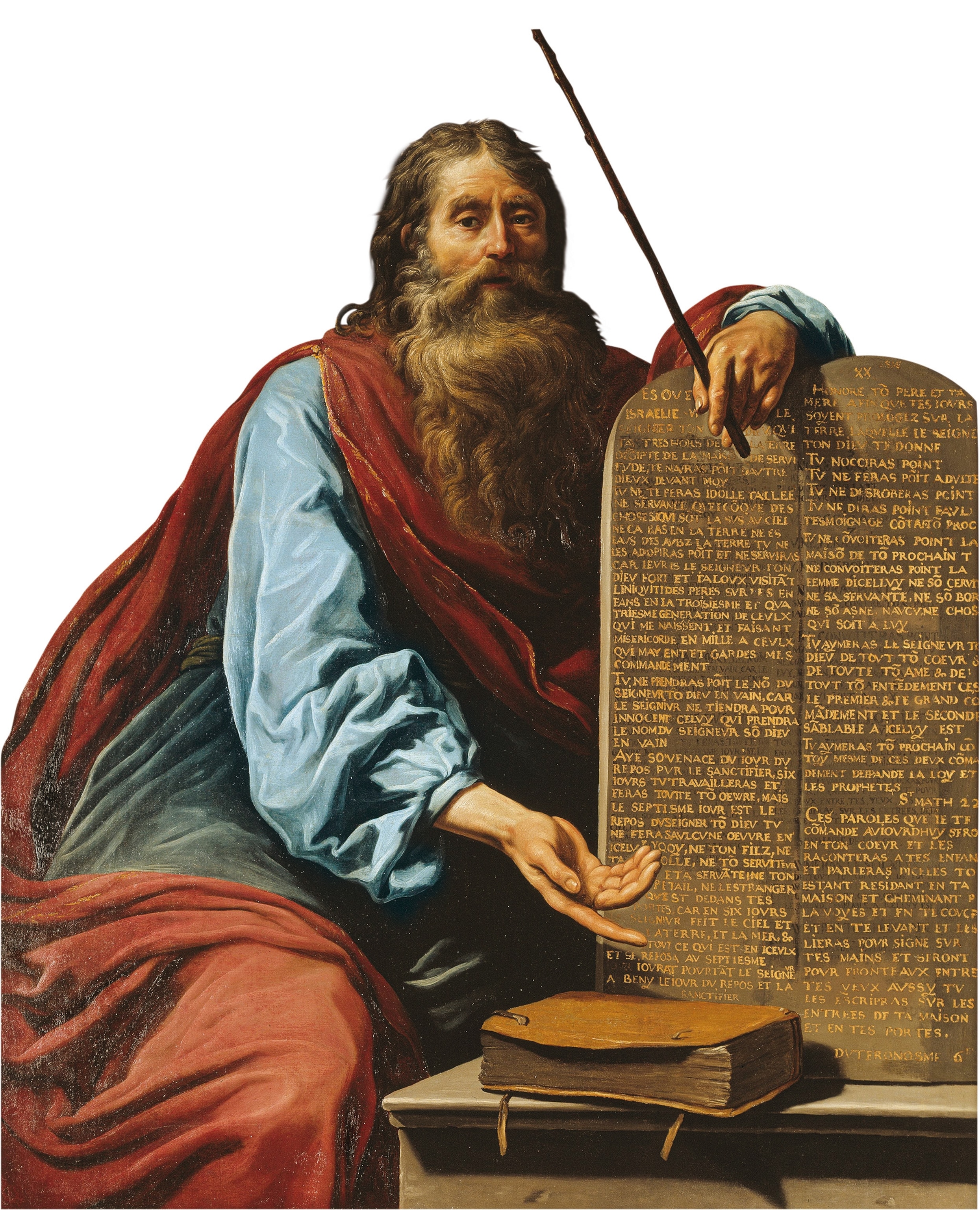
Of the 24 books that make up the Hebrew Bible, the oldest are the five core books of the Torah: Genesis, Exodus, Leviticus, Numbers, and Deuteronomy, collectively known as the Pentateuch. They narrate the creation of the world and the history of the Jewish people up until their arrival at the Holy Land. In both Jewish and Christian traditions, these texts are believed to have been written by a single author: Moses, the patriarch who led the Israelites out of Egypt and to whom, according to the Book of Exodus, God (also known as Yahweh) revealed the Torah.

But even in the early centuries of the Christian era, some doubted whether Moses really did write the five books of the Torah. And there are certain passages that don’t fit easily with, or support, the notion of him being the author, such as the one in Deuteronomy in which Moses recounts his own death: “Then Moses, the servant of the Lord, died there in the land of Moab, at the Lord’s command.” Another example is a line in the Book of Numbers that would be deeply ironic had it been written by Moses: “Now the man Moses was very humble, more so than anyone else on the face of the earth.”
Another curiosity is that throughout the Torah some episodes are recounted more than once, differing in focus and details, as if different versions by several authors had been combined.

The Book of Genesis includes two versions of the covenant that Abraham established with God to ensure himself numerous descendants and a new land to live in. One version, in chapter 17, stresses that to seal the covenant, God commanded: “Every male among you shall be circumcised.” But in the earlier version, narrated in chapter 15, there’s no mention of circumcision. The forthcoming birth of Isaac is also announced in two ways. In one version (chapter 17), God speaks directly to Abraham saying, “your wife Sarah shall bear you a son, and you shall call him Isaac.” But in chapter 18, the message comes through three heavenly beings who visit Abraham and Sarah.
Sometimes the work of more than one author appears intertwined in the same narrative. The most obvious case is that of Noah and the Flood. Verses include different details regarding the number of animals that should enter the ark (one pair of each species, or seven pairs of the “pure” and one pair of the “impure”) and whether a raven or dove was released to seek land.
In addition, analysis of the original Hebrew text reveals very different styles, expressions, and stages of language evolution. This is particularly evident in passages that include lines written in an archaic form of Hebrew. An analogy would be reading a text in English written partly in the style of Chaucer, partly in Shakespearean English, and partly in a contemporary style.
Although reasonable doubts had existed for a long time, the first modern writer to argue against Moses being the author of the Pentateuch was English philosopher Thomas Hobbes in his 1651 political treatise Leviathan. In 1753, the French physician Jean Astruc suggested the existence of two different authors in the Book of Genesis, and in 1780 the German theologian Johann Gottfried Eichhorn extended this claim to the entire Pentateuch.

The Yahwist
Finally, in 1878, German biblical scholar Julius Wellhausen formulated his “documentary hypothesis,” which is still widely accepted today or at least provides the starting point for any discussion of the dates and identities of authorship in the Torah. The documentary hypothesis maintains that within the first five books of the Bible, as they have come down to us, several different narrative strands can be distinguished that were written by different authors at different points in history and in different locations.
According to Wellhausen’s hypothesis, text from the oldest version of the Torah can be identified by certain common features. The most obvious is that God is referred to by the name Yahweh. Later, as established in the Book of Exodus, it would be forbidden by Israelite religious code to pronounce this name: “You shall not misuse the name of Yahweh your God.” (Note that English translations tend to render the name Yahweh as “the Lord.”) Another way to discern this oldest narrative strand is that the events chronicled—for example the destruction of Sodom and Gomorrah and the stories of Abraham and his nephew Lot—take place in the area around Jerusalem and in the mountains of Judah. The protagonists are the patriarchs of the 12 tribes that settled in those places: Reuben, Simeon, Levi, and Judah. The linguistic and narrative features of these sections have led to the theory that their author was a person connected with the Temple in Jerusalem when Jerusalem was the capital of the southern kingdom of Judah. Since Judah separated from the northern Jewish kingdom of Israel in 930 B.C., this author was likely writing around the 10th to ninth centuries B.C. The author has been dubbed the Yahwist for referring to God by the name Yahweh, and the source itself is known as “J,” short for the German word Jahwist.
Abraham, Sarah, and the Pharaoh
The northern author
Other sections of the Pentateuch are distinguished by the fact that God is referred to as Elohim instead of Yahweh; scholars call this source text “E.” The sources J and E often recount the same episodes but include different narrative details. For example, while the author of J writes that God’s revelation to Moses occurred on Mount Sinai, the author of E calls the place Horeb. As these two names refer to the same geographical feature, this suggests that the site of the revelation once had two separate designations. The events narrated in E take place in the northern region—the kingdom of Israel, which remained independent until it was conquered by the Assyrians in 722 B.C. The protagonists in E are the patriarchs of the tribes that historically occupied territory in the kingdom of Israel, such as the tribe of Benjamin.

The sections of the Torah belonging to source E would once have formed a complete separate text, similar to J, but with its own characteristics. Clues in the text point to the author of E having lived in the ninth century B.C., in the northern kingdom of Israel. The reverence shown in the text toward Moses has led to the hypothesis that the author of E (sometimes known as the Elohist) was one of the priests of the sanctuary at Shiloh, which belonged to the tribe of Levi, where Moses also hailed from. This would explain why there’s no mention in E of the later tradition that made Aaron a brother of Moses, and why Aaron is harshly criticized in E for his participation in the creation of the golden calf, an idol made by the Israelites while Moses was on Mount Sinai with God.

Merging the texts
So, between the 10th and eighth centuries B.C., each of the two kingdoms,Judah and Israel, had its own collection of narratives about the origins of the world and its people. Although the same in essence, the two accounts differed in certain linguistic features, in the geographical settings of some episodes, and the prominence of certain tribes.
However, this situation changed in 722 B.C., when the kingdom of Israel was destroyed by the Assyrians, and part of its population sought refuge in neighboring Judah and its capital, Jerusalem. The refugees, who brought with them their own sacred text, were welcomed in Judah. Perhaps it was thought that in order to facilitate the integration of the new Israelite community, it would make sense to produce a common sacred text that combined the two previous ones. It’s believed that an unknown author undertook this task around 700 B.C., using J as a general framework, the version that had been accepted for centuries in Jerusalem where this fusing of texts was likely done.
(How did the walls of ancient Jericho fall? Archaeology offers a clue.)

In the following decades, the priests of the Temple of Jerusalem promoted the writing of additional texts that clarified and completed the earlier merged version.In the sixth to fifth century B.C., an anonymous author made important additions to the composite text of J and E, adding a strand now identified by scholars as P (from the German Priesterschrift) or the “Priestly” source. These additions relate mainly to rituals of the Temple of Jerusalem. For example, P includes some details distinguishing between the pure and impure animals to go on Noah’s ark, even though at the time of the Flood, the Temple of Jerusalem and its purity laws didn’t exist yet. Source P, like source E, refers to God by the name Elohim—perhaps as a concession to the ancient version of the kingdom of Israel. But unlike E, P emphasizes the leadership of Aaron rather than Moses. This likely indicates that the author of P was a priest in the Temple of Jerusalem and considered himself a descendant of Aaron.
The puzzle of the Old Testament
THE NAME OF GOD
The first chapter of Genesis, which describes the world’s creation, was written around the sixth to fifth century B.C. and belongs to source P, likely written by a priest, or priests, who ascribes creation to God (Elohim in Hebrew). Chapter 11, however, which is attributed to J, the earliest source, refers to God not as Elohim but as Yahweh: “Yahweh came down to see the city and the tower, which mortals had built. And Yahweh said, ‘Look, they are one people, and they have all one language; and this is only the beginning of what they will do ... Come, let us go down, and confuse their language there, so that they will not understand one another’s speech.’”
THE SABBATH
The precept of the Sabbath as a day of rest is recorded in the Book of Exodus (chapter 20) and in Deuteronomy (chapter 5) in almost the same words. However, the justification of it differs. In Deuteronomy, part of source D, from around the seventh century B.C., observing the Sabbath is related to the flight from Egypt: “Remember that you were slaves in the land of Egypt and that Yahweh your God brought you out from there ... Therefore Yahweh your God has commanded you to keep the Sabbath day.” By contrast, in a part of the Priestly source in Exodus, the Sabbath rest is related to the creation of the world: “For in six days Yahweh made heaven and earth, the sea, and all that is in them, but rested on the seventh day. Therefore Yahweh blessed the Sabbath day and consecrated it.”
GEOGRAPHY
The sections of Genesis written in the ninth century B.C., and belonging to source E, mention locations in Israel (the northern Jewish kingdom) and tribes that settled there: “Then they journeyed from Bethel; and when they were still some distance from Ephrath, Rachel was in childbirth, and she had hard labor.” Jacob, Rachel’s husband, named the child Benjamin. Author J, based in Jerusalem, recounts Abraham’s movements through Judah (the southern kingdom): “He journeyed on by stages from the Negev as far as Bethel, to the place where his tent had been at the beginning, between Bethel and Ai ... and there Abram called on the name of the Lord.”
ABRAHAM
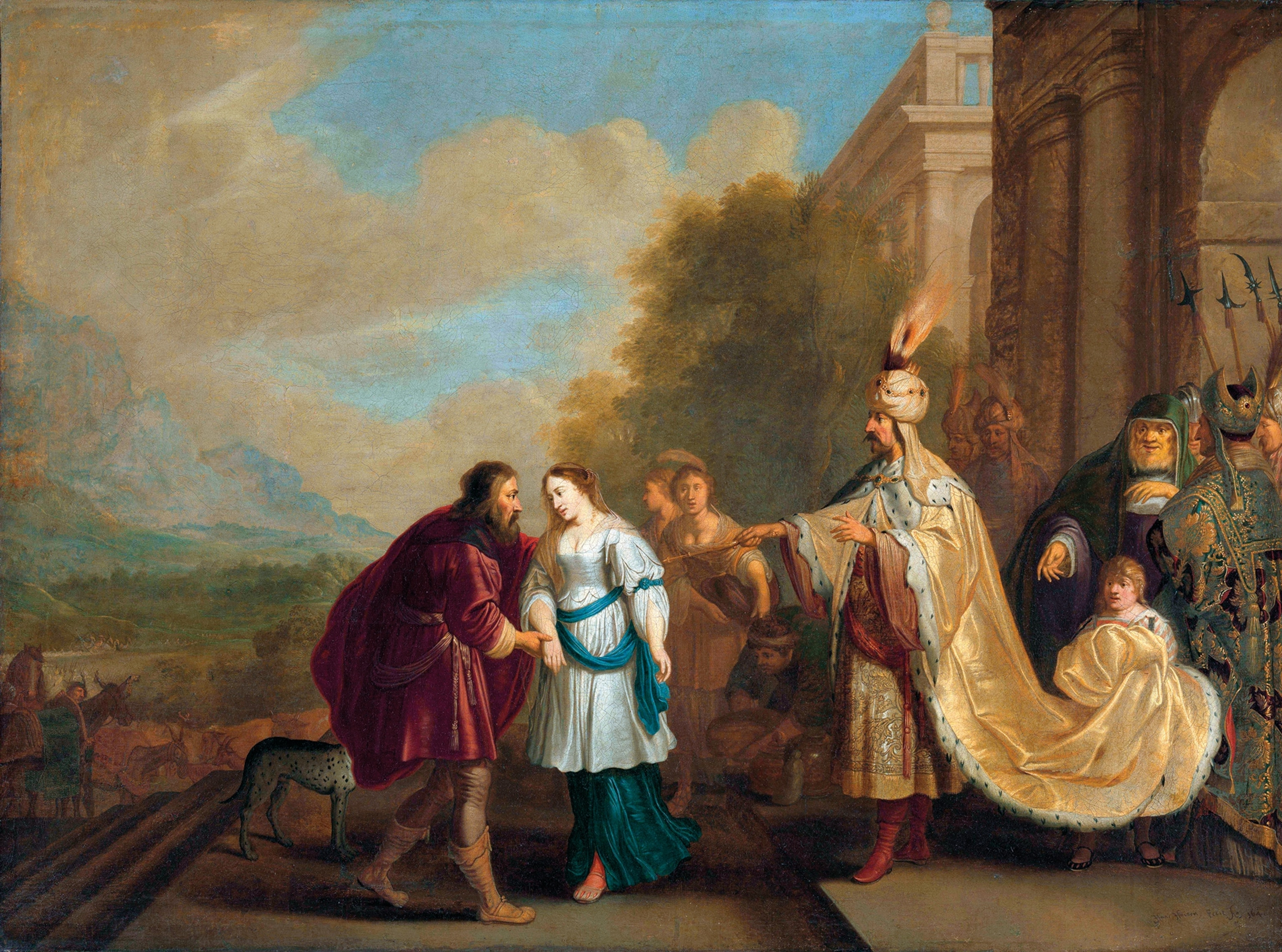
In Genesis, there are two differing accounts of Abraham lying to a king that his wife, Sarah, is his sister. The author of chapter 12 (likely J) writes: “When [Abram] was about to enter Egypt, he said to his wife Sarai, ‘I know well that you are a woman beautiful in appearance ... they will kill me... Say you are my sister.’” Chapter 20, written by E, sets the episode in the Negev region: “From there Abraham journeyed toward the region of the Negev, and settled between Kadesh and Shur. While residing in Gerar ... Abraham said of his wife Sarah, ‘She is my sister.’ And King Abimelech of Gerar sent and took Sarah.”
THE FLOOD
In the Book of Genesis, the story of the worldwide Flood was originally written by the author of J in the 10th or ninth century B.C. But hundreds of years later, the writer of P inserted some additional details. For example, source J briefly describes how Noah followed Yahweh’s command to build an ark, but then continues: “And Noah and his sons and his wife and his sons’ wives went into the ark to escape the waters of the flood.” At this point, the author(s) of P introduces a couple of lines related to the designation of animals for sacrifice in the Temple at the time they were writing: “Of clean animals, and of animals that are not clean, and of birds, and of everything that creeps on the ground, two and two, male and female, went into the ark with Noah, as God had commanded Noah.”

A few decades later, a major change would take place in the composition of the Torah, with the addition of a new book to the four that previously existed. In 622 B.C., while Josiah, king of Judah, was having the Temple remodeled, a new text was discovered there; it apparently contained an unknown part of the Law that God had dictated to Moses on Mount Sinai. This text was presented as a series of speeches by Moses himself while the rest of the Torah consists of the words that God dictated to him.Another major difference is that the author of this text insists there is just one God, one people, and one place of worship, namely the Temple of Jerusalem, and criticizes the other shrines scattered throughout the country. It seems the main aim of this newly discovered text was to encourage the centralization of religious life around the Temple in the capital, Jerusalem, and do away with other cultic centers.
The text was presented to King Josiah, who read it publicly in the Temple in front of all the people, priests, and prophets. When he’d finished, everyone pledged to obey the Law contained in the book, which was added as a supplement to the existing works. This text was regarded as a second Law, which is the meaning of its Greek name, Deuteronomy. The source is known by scholars as D. Some of the biblical books that recount the history of Israel and Judah from the time of David and Solomon onward may also belong to D. There are several distinguishing features in D: The author has a high opinion of Moses; the sacred mountain is called Horeb rather than Sinai; and the expression “Yahweh Eloheka”—which means “Yahweh your God,” combining the names used in J (Yahweh) and E (Elohim)—is used.
Much more than ancient copyists
Out of the desert
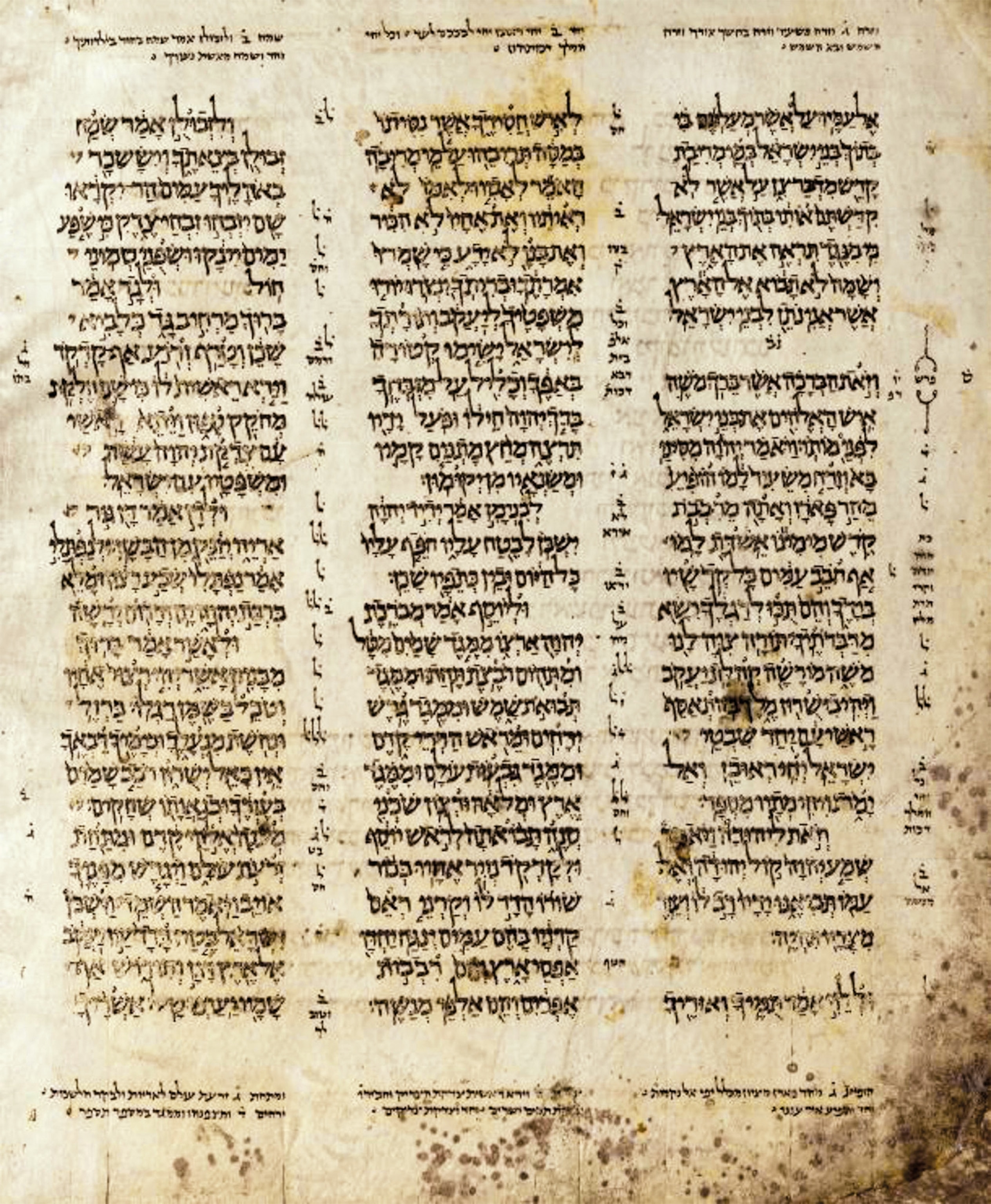
In 586 B.C., the Kingdom of Judah, its capital Jerusalem, and its Temple were destroyed by the Babylonian ruler Nebuchadnezzar II. Part of the population of Judah was deported to Babylon where they remained in exile for decades until the Persian king Cyrus the Great allowed them to return to their land to rebuild their country and their Temple while enjoying relative political autonomy. Sometime after the return from exile, a final intervention was made in the text of the Torah, shaping it into the form we know today. A new author gathered the texts that had previously been dispersed across different works into a single volume, adapting them to give them unity.
Some scholars believe that this final author was Ezra, a Jewish scribe, expert in the Law of Yahweh, and an official of the Persian king Artaxerxes. Ezra was sent to reform the religious practice in Jerusalem, although there’s some uncertainty about when this reform happened. If the king referred to was Artaxerxes I, Ezra’s mission must have taken place shortly after 457 B.C., but if it was Artaxerxes II, it would have been in the fourth century B.C.

The Book of Nehemiah explains how Ezra publicly presented this new Law, which was now compiled into a single corpus: “Accordingly, the priest Ezra brought the law before the assembly, both men and women and all who could hear with understanding ... He read from it facing the square before the Water Gate from early morning until midday, in the presence of the men and the women and those who could understand; and the ears of all the people were attentive to the book of the law.”
While the process of compiling the Torah seems to have ended with Ezra, the broader corpus we now call the Bible continued to evolve. Jewish priests granted the status of works revealed by God to other books that were part of the Jewish literary heritage. These included historical chronicles such as those of prophets Joshua, Samuel, and Kings; books attributed to latter prophets such as Isaiah, Jeremiah, and Ezekiel; and moral and poetic works such as Proverbs and the Song of Songs. All these texts formed the Jewish Bible, which in the first centuries after Jesus would become the core of the Christian Old Testament.
