Michelangelo and the Tomb that Tormented Him
During his years in Rome, Michelangelo took on some of the Renaissance’s most important and difficult commissions—from the Sistine Chapel to St. Peter’s Basilica. But nothing burdened him more than the tomb of Pope Julius II.

The warm torpor of summer still lingered in the long afternoons of September 1534, when momentous news reached Florence. Giulio de’ Medici, Pope Clement VII, had died on the 25th of that month, after allegedly eating poisonous mushrooms.

At the time, within the so-called New Sacristy of the Basilica of San Lorenzo in Florence (an architectural space conceived as a mausoleum for the Medici family), scaffolding was being erected under the watchful eye of Michelangelo Buonarroti. The artist, known to the world today as Michelangelo, was nearly 60 years old and had been commissioned to design the sacristy, which would mirror Filippo Brunelleschi’s Old Sacristy. But events overtook him. A few days earlier, he had left Florence for Rome, where he arrived on September 23, just two days before the pope’s death. Well acquainted with the inner workings of the Vatican, the news of Clement VII’s condition may have convinced him that he should travel to Rome and be present when the white smoke rose above the roof of the Sistine Chapel, announcing the election of a new pontiff. Clement VII, Michelangelo’s childhood friend and lifelong patron, had originally commissioned him to carry out two artistic projects that now hung in the balance: not only the unfinished mausoleum for the Medicis in Florence but also the splendid fresco of the “Last Judgment” that was to decorate the entirety of the Sistine Chapel’s altar wall.
Although Michelangelo still had the strength to pitch and chisel marble without breaking a sweat, he was already an old man for his time, and 1534 had been a difficult year for him. His father Lodovico had died, and he had not seen the young nobleman Tommaso de’ Cavalieri for many months. The two had met during the artist’s brief stay in Rome in 1532, and it appears that Michelangelo had fallen in love. It was in this context that Michelangelo left Florence and headed for Rome, a decision that would prove momentous for his legacy.

The new pope, Paul III of the Farnese family, knew of Michelangelo’s artistic talents, although he had never personally dealt with him before. In September 1535, he appointed Michelangelo chief architect, sculptor, and painter of the Vatican Palace, the pope’s residence. The title came with a generous monthly salary from the papal treasury, the highest ever received by an artist of the time.
The task that most absorbed Michelangelo during the years that followed was the completion of the “Last Judgment” fresco in the Sistine Chapel. The task was exhausting, even after the upper part of the chapel wall was tilted forward to make the angle slightly easier to work with. Michelangelo’s health was not as good as it had been 30 years earlier, when he had painted the vault of that same chapel. Then, in 1540, while painting the lower part of the wall, he fell from the scaffolding and had to spend more than a month in bed.
(Does this ‘secret room’ contain Michelangelo’s lost artwork? See for yourself.)
Commissions Throughout Rome

The Sistine Chapel was not the only project Michelangelo had taken on. In fact, over the years, he seemed to have left his mark in every corner of Rome. Modified under Michelangelo’s direction, the new palace of the Farnese family (the family of the pope) was built near Campo de’ Fiori square, not far across the river from Vatican City. He redesigned the Piazza del Campidoglio on Capitoline Hill, and the dome of St. Peter’s also bore his touch. Meanwhile in Florence, without Michelangelo, who never returned there, the construction of the Laurentian Library continued according to his designs. Michelangelo sent back to Florence a clay model of what would be the library’s monumental staircase. The artist controlled from a distance a team of laborers and artisans to complete the final touches on the sacristy of the Basilica of San Lorenzo. As if that were not enough, Pope Paul III wanted Michelangelo for a project in the Vatican: the Pauline Chapel. Among the countless major commissions Michelangelo had accepted on his return to Rome, he took on the most colossal project of all: the tomb of Pope Julius II.

This Renaissance pope had been a renowned patron of the arts, commissioning major projects from the greatest artists of the time: Michelangelo to paint the Sistine Chapel ceiling; Raphael to decorate his private rooms and the three loggias of the Apostolic Palace; and the architect Donato Bramante to build a new St. Peter’s in Rome to replace the existing basilica, which dated to the time of Constantine. The heart of this new building (the future St. Peter’s Basilica) was to be marked by the tomb of Julius II himself, which he had commissioned Michelangelo to build decades earlier, in 1505.
Personality Clash
The tomb had been one of Pope Julius II’s big projects, and forever marked his relationship of artistic patronage with Michelangelo. Julius II had always believed in the brilliance of Michelangelo. That said, there were quite a few clashes between the two men.
The outrage Michelangelo experienced in 1506 when Pope Julius II refused to receive him has been well documented. On that occasion Michelangelo reacted by leaving for Florence, determined never to return. The pope sent messengers and letters, writing to intermediaries such as the gonfalonier of Florence (an important city official), but nothing could change Michelangelo’s mind. Julius II, called the warrior pope by historians, had already been conquering territory for the Papal States. Finally, having taken the city of Bologna, Julius II received Michelangelo there and commissioned him to create a large bronze sculpture depicting him as a conqueror. Michelangelo accepted the task, but the work was destroyed when the Bentivoglio, the lords of Bologna, recaptured the city.
The Tomb that Could Never Be
(Did Michelangelo fake this iconic ancient statue?)
Expensive and Unfinished
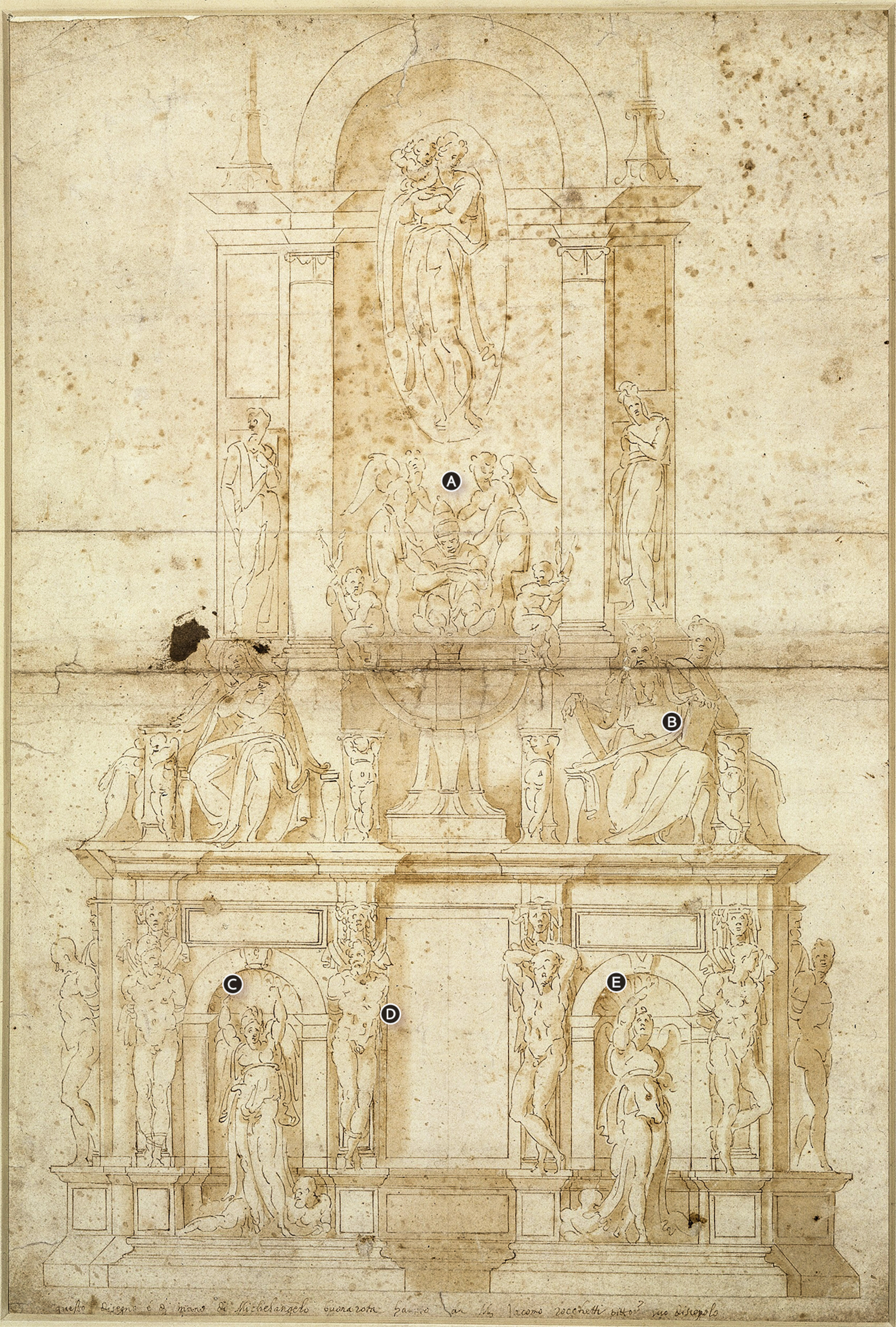
The tomb Michelangelo originally designed for Julius II was colossal, a four-sided monument that a person could walk under and into, covered with sculptures on every side. It was almost as if he wanted to compete with the legendary Mausoleum of Halicarnassus, one of the Seven Wonders of the Ancient World. Its towering architectural structure was to be divided into three levels, intended to house more than 40 marble sculptures, as well as some bronze reliefs. The monument was to be erected in the center of the new Basilica of St. Peter’s, then still under construction. The precise plan was for Michelangelo’s tomb for Julius II to be installed directly under the great dome (also by Michelangelo), where sculptor and architect Gian Lorenzo Bernini’s baldachin now stands.
The sculptures proposed for the mausoleum included representations of figures such as Moses, St. Paul, and, of course, St. Peter. These figures were designed to evoke the two sides of Pope Julius II: a pope who led the papal armies into battle, and a humanist prelate and patron of the arts and letters.

This project dogged Michelangelo throughout his life. After the death of Julius II in 1513, he signed successive contracts with the deceased pope’s heirs in which the number of sculptures decreased, while the price increased. Michelangelo was given a house in Rome’s Piazza Macel de’ Corvi (now demolished) where he lived for much of his life and where he stored all the marble blocks he had purchased for the mausoleum project. But from 1516 onward, he did not touch a single one of those blocks.
In this context, Michelangelo was being paid for doing absolutely nothing. He received more than 4,063 florins in payments connected with the project—more than for any other commission in his life. By comparison, he was paid 2,300 florins for the facade of the Basilica of San Lorenzo in Florence (which was never completed), and only 3,000 florins for painting the ceiling of the Sistine Chapel. When Michelangelo arrived in Rome in 1534, he was wealthy to a degree no artist had ever been before. Studies by art historian Rab Hatfield show that Michelangelo’s fortune was close to 45,000 florins. We also know that Michelangelo and Leonardo da Vinci used the same bank in Florence, but while Da Vinci deposited only 889 florins there in his lifetime, Michelangelo deposited almost 10,000. Conversely, despite his wealth, Michelangelo lived an austere and humble life.
But what was a huge financial deal for Michelangelo ended with the worst possible artistic result. Had he known, Julius II would have been outraged. The grandeur of the mausoleum that Michelangelo conceived during the pope’s lifetime and which was to be the focal point of the new Basilica of St. Peter’s was hugely diminished. The poorly finished facade, sparsely adorned with sculptures, expressed none of the extraordinary iconographic significance of the initial project. Thanks to Paul III, Michelangelo obtained permission to complete the project with the help of assistants, but out of everything he had already crafted between 1513 and 1516, and which was stored in his house in Macel de’ Corvi, he included only his sculpture of Moses in the final ensemble.
The Great Disappointment

The combination of funding being redirected for other papal projects and Michelangelo’s commitment to his other commissions proved fatal to the ambition of the artist’s initial designs. The tomb with more than 40 sculptures that was to preside over the new St. Peter’s Basilica was relegated to the minor basilica of St. Peter in Chains, where it was placed on one side of the transept. Strictly speaking, it is not a tomb but a cenotaph: a simple funerary monument, as Julius II is actually buried in St. Peter’s Basilica under a plain marble tombstone. The “tomb” displays only one sculpture made in its entirety by Michelangelo—the imposing figure of Moses. The other sculptures on display were made almost entirely by Michelangelo’s collaborators, while many of the sculptures that Michelangelo had already carved for the tomb (such as the nude “slaves,” now in the Louvre) remained unused in his workshop.
Retouching the Masterpiece
“Moses” is the centerpiece of the ensemble, and the statue was already completed in 1516. In 1542, as the day approached to transfer the work from his home to the Basilica of St. Peter in Chains, Michelangelo had second thoughts about the work.

Until then, Moses had been looking straight ahead, and his beard had also been positioned at the front. But following the comments of a friend who saw the statue in his home, the artist took up his hammer and chisel and began to chip away at Moses’ head to turn his face to the left. This fact is recorded in a letter from the period and has been verified by the historian and restorer Antonio Forcellino.
This was an incredible feat that only Michelangelo could achieve: twisting a finished marble head, also reworking the torso and a leg. Today this alteration is almost imperceptible, seen only in the turn of the beard as it reaches the hands and connects with the only fragment of beard that corresponds to 1516, as well as in the back of the neck, which is abruptly turned.
Michelangelo died in his studio in Macel de’ Corvi on a cold February day in 1564. Just six days earlier, he had been working on the “Rondanini Pietà.” Initially, he was given a burial in Rome, but when the news of his death reached Florence, Michelangelo’s former compatriots set out to claim his body. One of the artist’s nephews, Leonardo Buonarroti, secretly whisked away his remains, defying those in Rome who wanted to keep him buried there. In accordance with his wishes, Michelangelo returned once and for all to Florence, where, after a princely funeral in the Basilica of San Lorenzo, he was buried in the church of Santa Croce.
