The ancient Nigerian sculptures that rewrote African history
After a fragment was found in 1943 and dated to 500 B.C., the Nok terra-cotta sculptures shook up the Eurocentric academic consensus that no advanced cultures existed in sub-Saharan Africa that early.

In 1886, when Nigeria was a colony of the British Empire, the Royal Niger Company gained exclusive mineral rights over the Jos Plateau in central Nigeria, an area rich in tin ore and inhabited by the Berom people. In the foothills, access routes to the mines ran through an area called Nok. Over the years, with the exploitation of the mines and the local people who overwhelmingly provided the labor force, numerous fragments of ancient pottery came to light but were largely ignored.
One piece, too striking to be disregarded, appeared in 1928: a small monkey head, sculpted in terra-cotta. The mine manager, Lt. Col. John Dent Young, had that piece and other fragments transferred to a museum in the city of Jos, the provincial capital.
Fifteen years later, a miner found another terra-cotta head and took it home, where he used it as a scarecrow, apparently with some success. A British engineer noticed the piece about a year later, and brought it to Jos, where he showed it to Bernard Fagg, an archaeologist working in Nigeria as a civil administrator for the British Colonial Service.
Fagg immediately recognized the sculpture’s significance. It was stylistically similar to the monkey head discovered in 1928, and the features of both objects seemed unlike those of any known artistic tradition. He believed it could be the work of a historical African culture as yet unknown.
(The story of Nigeria's stolen Benin Bronzes, and the London museum returning them)
The search
Curious and enterprising, Fagg decided to investigate. He first talked to the miners, who told him they had found many sculptures of this type—but they were considered a bad omen and usually destroyed. Fagg decided to set out across central Nigeria in search of more pieces of the same style. He discovered that for years the inhabitants of the area had been uncovering similar terra-cotta pieces, not only in the gravel extracted from the mine but also in a range of locations, from beneath a hockey field to a rocky summit.
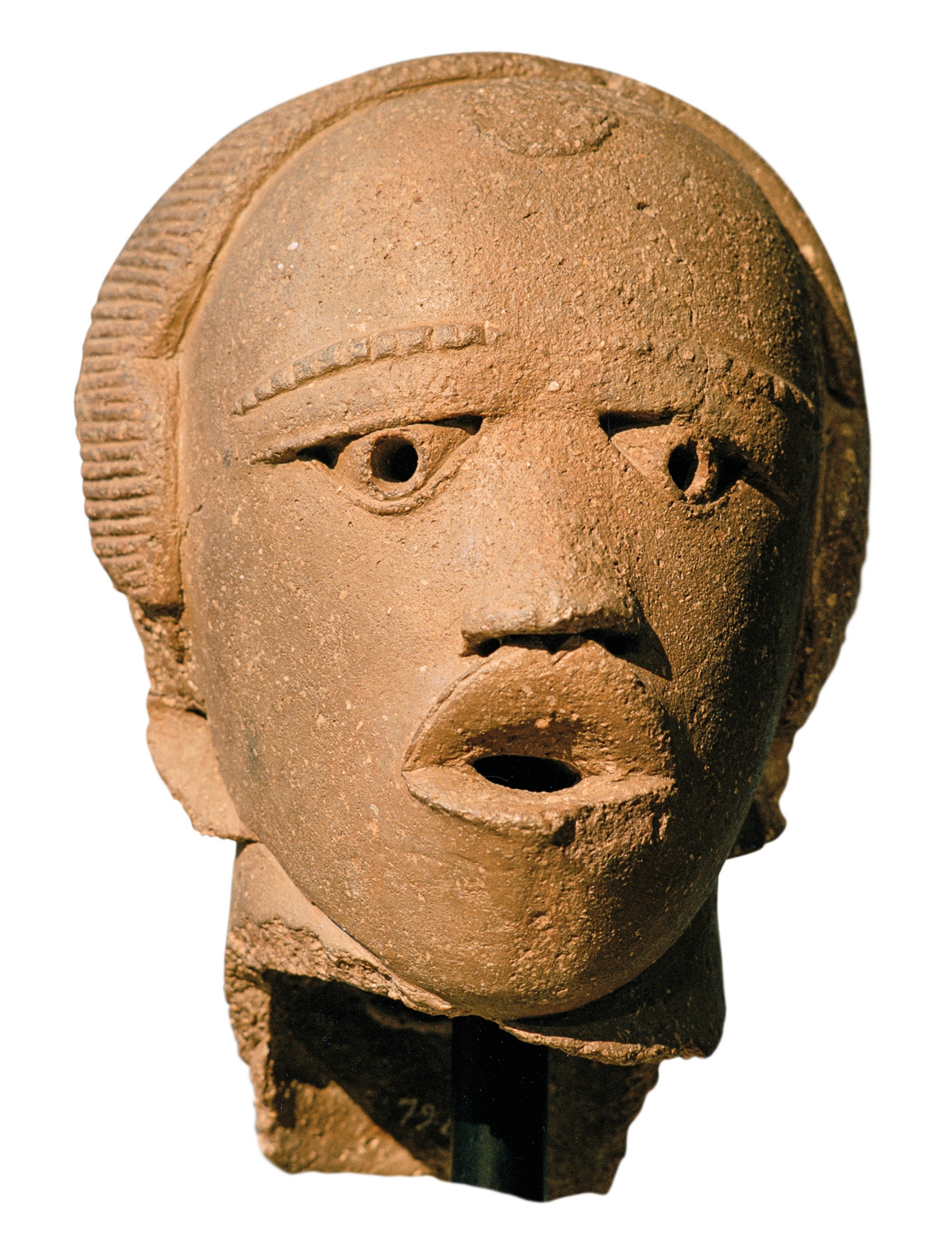
In the course of just a few years, through a campaign of purchase and persuasion, and as a result of his own excavations, Fagg managed to collect almost 200 terra-cottas stylistically similar to the scarecrow piece found in 1943, which is now known as the Jemaa Head, after the village where it was found.
Looted art
Dating the finds
The first answer Fagg sought was the historical period to which these remains belonged, and his initial findings were surprising. Analysis of the soil layers where the pieces were found yielded dates of around 500 B.C. If correct, this dating would rock the academic consensus of the time, which still held that no advanced cultures existed in sub-Saharan Africa at such an early date—that is, cultures with knowledge of ceramics, ones capable of creating such refined works of art.

Over the course of the following decades, Fagg had the pieces dated using other techniques as they became available. First, organic remains encrusted in the surface of the ceramic were studied using carbon-14 dating, and later, the terra-cotta itself was analyzed using thermoluminescence. The results of both analyses confirmed that the finds were indeed remarkably early, dating from 440 B.C. to A.D. 200. The Nok culture, as Fagg called it, was clearly identified as one of the oldest in sub-Saharan Africa.
(These archaeological findings unlocked the stories of our ancestors)
Further discoveries
In 1947, an exhibition at the British Museum drew international attention to the sculptures. Meanwhile, Fagg continued his research in Nigeria and founded the National Museum in Jos in 1952, one of the first public museums in Nigeria. The initial finds had been discovered in alluvial deposits; this meant the objects were found far from where they were made, having been carried along watercourses. But in 1961, Fagg gained access to a site that had been preserved intact, in Taruga, about 90 miles southwest of Nok. The find was groundbreaking: it included no fewer than 13 iron-smelting furnaces, evidence of a sizeable settled population. Nok figurines were found close by and even inside these furnaces, leading Fagg to suppose that they played some role in magical rites performed while the iron was being worked.

After Fagg returned to England to become curator of Oxford’s Pitt Rivers Museum, in 1964 (four years after Nigeria gained its independence), his daughter, Angela Fagg Rackham, and the Nigerian archaeologist Joseph Jemkur continued the research into the 1980s.
At this time, Bernard Fagg began writing his book Nok Terracottas (published in 1977), which would demonstrate to specialists and the general public the relevance of the Nok culture and its fascinating terra-cotta figures.
An artistic tradition
The statues were modeled without a potter’s wheel, by coiling strips of clay to create the rough form and then smoothing the surface. They have perforations in the eyes, nostrils, and mouth, which served not only an aesthetic purpose but also a functional one, as they allowed air to circulate and prevented the pieces from cracking. Once molded, they were left to dry in the sun before being fired in a kiln, a technique that is still in use in the region today.
Nok sculptures are relatively varied. There are heads as well as partial and full-length figures. The figures are generally individual, but some do appear in pairs or groups. Some full-body statues, in which the figures often appear kneeling, measure up to 28 inches high, while others are much smaller. Although animal sculptures have been found, most of the pieces represent people, both men and women, usually wearing jewelry, with sophisticated hairstyles and intense expressions. These details and adornments have made it possible to identify them as tribal chiefs, priests, musicians, or prisoners of war.

After Fagg’s initial theory about the use of the figures in iron-smelting rituals, various other hypotheses on their function have been put forward. One is that they served as totems, used to encourage good harvests or offer worship to ancestors, and that they could have been placed in shrines, although no traces of such shrines have been found.
(How were China's legions of terra-cotta warriors made? Experts have pieced it together.)
Recently German archaeologist Peter Breunig, who resumed research into Nok culture in the 2000s, has revised Nok chronology and formulated another theory. His team discovered that collections of fragments have been found in close proximity to places that were later interpreted as burial sites. It appears that these terra-cotta pieces had been deliberately buried, sometimes on a bed of stones associated with charcoal remains. These figures show signs of having been broken before burial. Based on the findings, Breunig proposes that the burial and destruction of the sculptures were part of complex funerary rites which, for now, still remain a mystery.
Features of the Nok figures
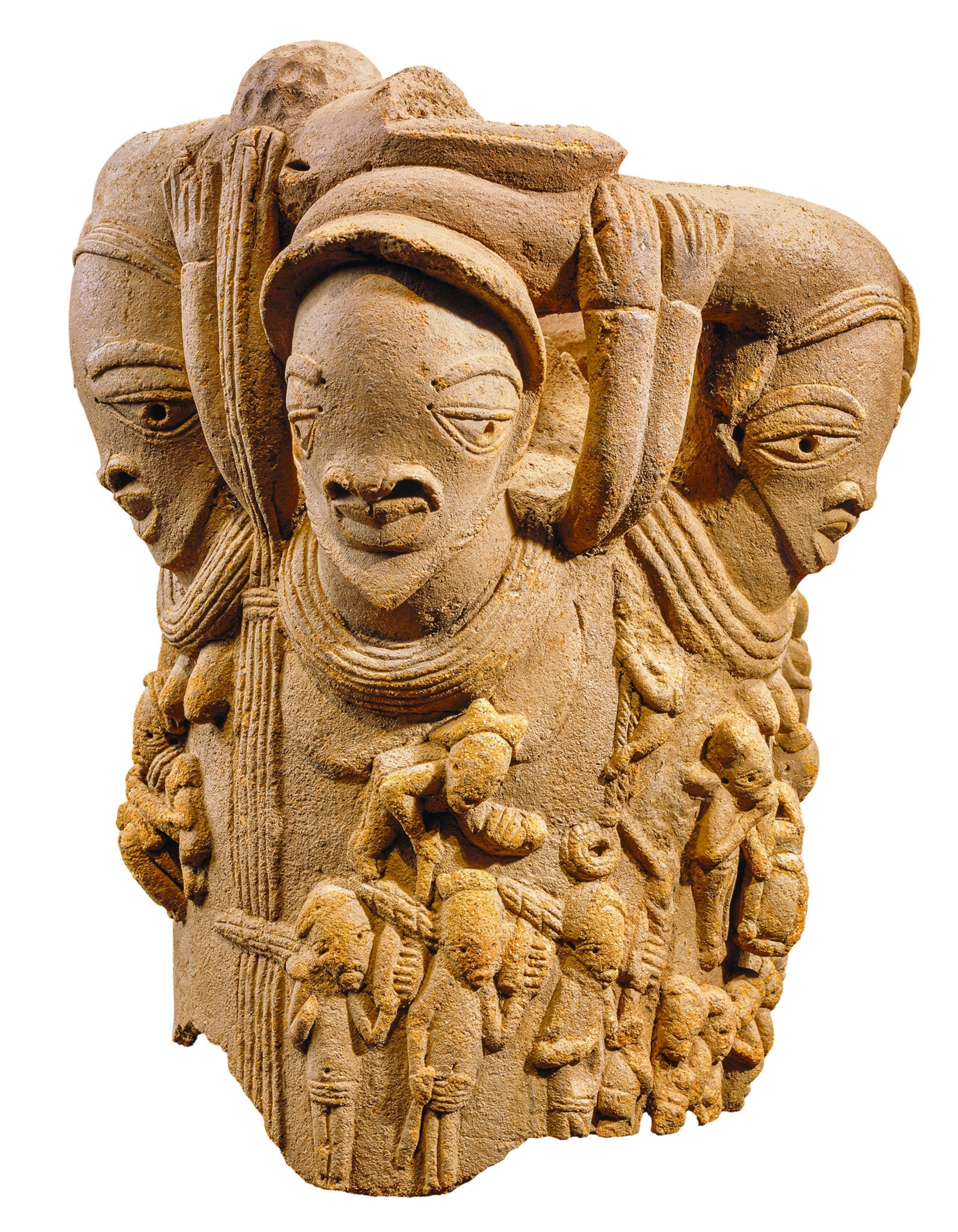
ANATOMY OF NOK STATUARY
• ELONGATED HEAD that is cylindrical, conical, or oval in shape.
• PERFORATIONS in the pupils, nostrils, mouth, and ears that also served as air vents for the firing process.
•TRIANGULAR EYES with eyebrows that often mirror the shape of the lower eyelid.
• MUSTACHE AND BEARD in some male statues. Small beards are depicted under their chins.
• NAKED TORSO FOR BOTH MEN AND WOMEN. The genitals are covered by a garment.
• JEWELRY. Large necklaces rest on the shoulders; there are bracelets on the forearms and anklets on the ankles.
• ELABORATE HAIRSTYLES for both men and women. Some figures are depicted with hair pulled into a bun. The buns are pierced with holes where feathers may have been placed. Some figures are depicted with braids that fall over their ears. In other instances, the hair is gathered over the forehead as if with a ribbon.


