Is this the world's oldest alphabet?
While excavating clay cylinders in Syria, archaeologists discovered a rare find: an early writing system. The script has given scholars the new challenge of reinvestigating the timeline of alphabetic symbols.

A 4,400-year-old name etched on a gift tag may be rewriting the history of the alphabet. An archaeological team, led jointly by Johns Hopkins University and the University of Amsterdam, was excavating a tomb in a mortuary complex in Umm el-Marra, in northern Syria, and stumbled upon a collection of clay cyclinders incised with symbols. Experts have recently confirmed this is likely to be alphabetical writing, pushing back the earliest known evidence of this system by half a millennium.
A rare find
Umm el-Marra was one of the ancient Near East’s oldest cities, strategically located at a crossroads of major trade routes between Mesopotamia and Aleppo. Archaeologist Glenn Schwartz and heritage consultant Hans H. Curvers began excavations at the site in 1994 to better understand the development of western Syrian societies, which is a relatively underresearched area of study.
In the early 2000s, they uncovered an Early Bronze Age elite necropolis high above the rest of the site, consisting of 10 mud-brick tombs, and equine tombs. This was an exceptional find in the region, as “there isn’t any other example of a whole collection of high-status tombs that were built over a sequence of centuries,” Schwartz says. “It is very unusual for elite tombs to be preserved well, as they are usually ransacked by looters.”
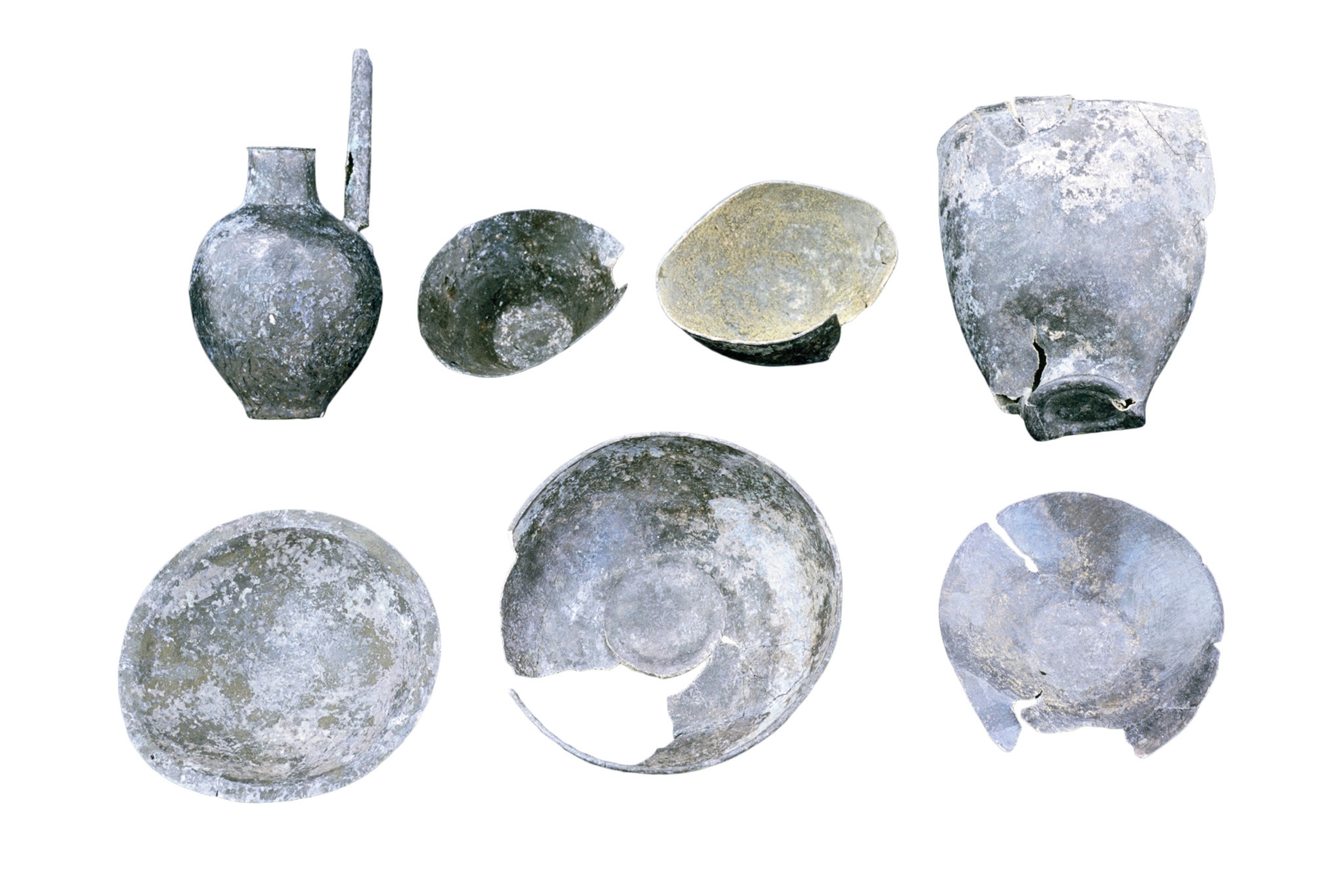
While excavating a better-preserved tomb in 2004, the team discovered six skeletons, along with a collection indicating a high level of economic status. Along with finding a huge stash of ceramic, silver, and bronze vessels, then graduate assistant Elaine Sullivan, an Egyptologist, chanced upon some unexpected objects: four finger-size clay cylinders.
(This ancient script has remained unsolved for over a century)
At first, Sullivan believed these were just clumps of dirt. She was about to throw them aside when she realized they were, in fact, artifacts. Taking a closer look, Sullivan and Schwartz noticed they were inscribed with symbols. “That’s when the idea that they might be writing first occurred to us,” said Schwartz.
The writing was unlike anything that had been seen before in Syria. The regional writing system of this era, familiar to scholars, was cuneiform, a wedge-shaped script invented originally in Mesopotamia, then copied by the Syrians and adapted to their own languages. Hoping that experts could weigh in and shed some light on the mysterious symbols, Schwartz decided to publish drawings of the preliminary report in 2006.
Symbols on a cylinder


Taking the plunge
The report, appearing in the American Journal of Archaeology, initially received no reaction. “I think people didn’t know what to make of them either,” Schwartz said. He decided to analyze the symbols himself, and started comparing them with alphabetical symbols from centuries later from different parts of the Middle East. He noticed similarities: “That’s when I got the idea that they might be alphabetic.”
In 2010, Schwartz published an article in which he suggested the symbols might be writing, and mentioned various possibilities, including the likelihood that they were alphabetic. His suggestions still received little attention. In 2019, Schwartz was invited to a conference in Milan on early writing, and he decided to take the plunge.
He tentatively presented the symbols, sending out copies of his conference article to experts. Two of them were Christopher Rollston, chair of the classical and Near Eastern department at George Washington University, and Madadh Richey, assistant professor of Near Eastern and Judaic studies at Brandeis University, in Massachusetts. Both supported his theory.
(Think customer service is bad now? Read this 4,000-year-old complaint letter)

A slow shift
In the 19th century, scholars believed the alphabet originated with the Phoenicians around 1050 B.C. Then, in 1905, British Egyptologist William Flinders Petrie discovered Proto-Sinaitic inscriptions at Serabit el-Khadim in the southwestern Sinai Peninsula, in Egypt.
Subsequent researchers, including American biblical scholar William F. Albright in the 1950s, realized the symbols were Semitic and alphabetic. The dating of the Sinai script to around 1800 B.C. gave scholars proof of an alphabetic system that predated the Phoenician language.
The discovery at Umm el-Marra now suggests that alphabetical writing may have not only emerged 500 years earlier than the Sinai script but also done so in a different location.
“Paradigm-shifting discoveries gain acceptance gradually, not rapidly,” Rollston said. He is confident that if more inscriptions are found, preferably longer texts, a solid consensus on the new script will develop.
(These ancient texts were once unreadable. Now technology is decoding them)
Treasures for the privileged