What Homer’s Odyssey tells us about ancient Greek colonization
After the collapse of Mycenaean society in the 12th century B.C. the Greeks ventured out to sea again in search of new lands – and no one personifies this better than Odysseus and his turbulent journey.

Night was falling on the palace of Alcinous, king of the legendary island realm of the Phaeacians. The island’s inhabitants had gathered in the atrium and courtyard of the sovereign’s great mansion to listen to Demodocus, a prestigious aoidos (singer or oral poet) to whom a Muse had given the gift of song in exchange for his sight. The hospitable king had sent for him to entertain the guests at a banquet held to honor the mysterious sailor shipwrecked on his shores. The elderly poet began to tell the story of how, in a stratagem devised by the famous Odysseus (known as Ulysses in Latin), a handful of Greek warriors had hidden inside a gigantic wooden horse and passed through the walls of Troy after a 10-year siege, and how the Achaean (Greek) army had finally conquered the city and put its inhabitants to the sword.

As he listened to this account of the massacre, the unknown castaway felt the full weight of a war he knew all too well. Finally managing to hold back his tears, he rose to his feet and announced, “I am Odysseus.” Then he started to recount, in his own words, the eventful journey that had taken him from the shores of Troy to the Phaeacians’ island on the seemingly never-ending quest to return to his kingdom, Ithaca. The journey had taken him across a sea populated by mysterious enchantresses, monstrous beings with captivating voices and homicidal intentions, man-eating giants, and strange, narcotized flower eaters.
Back to the sea
By way of mythical tales such as The Odyssey by Homer (whom tradition portrays as a venerable blind poet in the image of Demodocus), the Greeks of the Archaic era became reacquainted with the ancient sea their ancestors had utterly dominated four centuries earlier in the Bronze Age, during the height of the Mycenaean civilization. While The Iliad recounts legendary events dating back to that time, The Odyssey reflects a later setting in Greek history when, a couple hundred years after the collapse of Mycenaean society in the 12th century B.C., the Greeks finally ventured out to sea again, in search of new lands and trade contacts, on ships that had only a rudimentary square sail, a mast, a bowsprit, and oars.
Trade in the eastern Aegean Sea had gradually resumed from the 10th to the eighth century B.C. (when it is estimated that The Odyssey was composed): This materialized into the following expansion we call Greek colonization.
In this time of exploration and reacquaintance with the sea, Odysseus became a model of how to act in a universe full of dangers and mysteries. Before he became the famous sailor of The Odyssey, the king of Ithaca had been a formidable warrior who had fought on the frontline on the plain of Troy, but, in the course of his later voyage, he was transformed from an old epic warrior into the hero of a new world.
The return of the other heroes
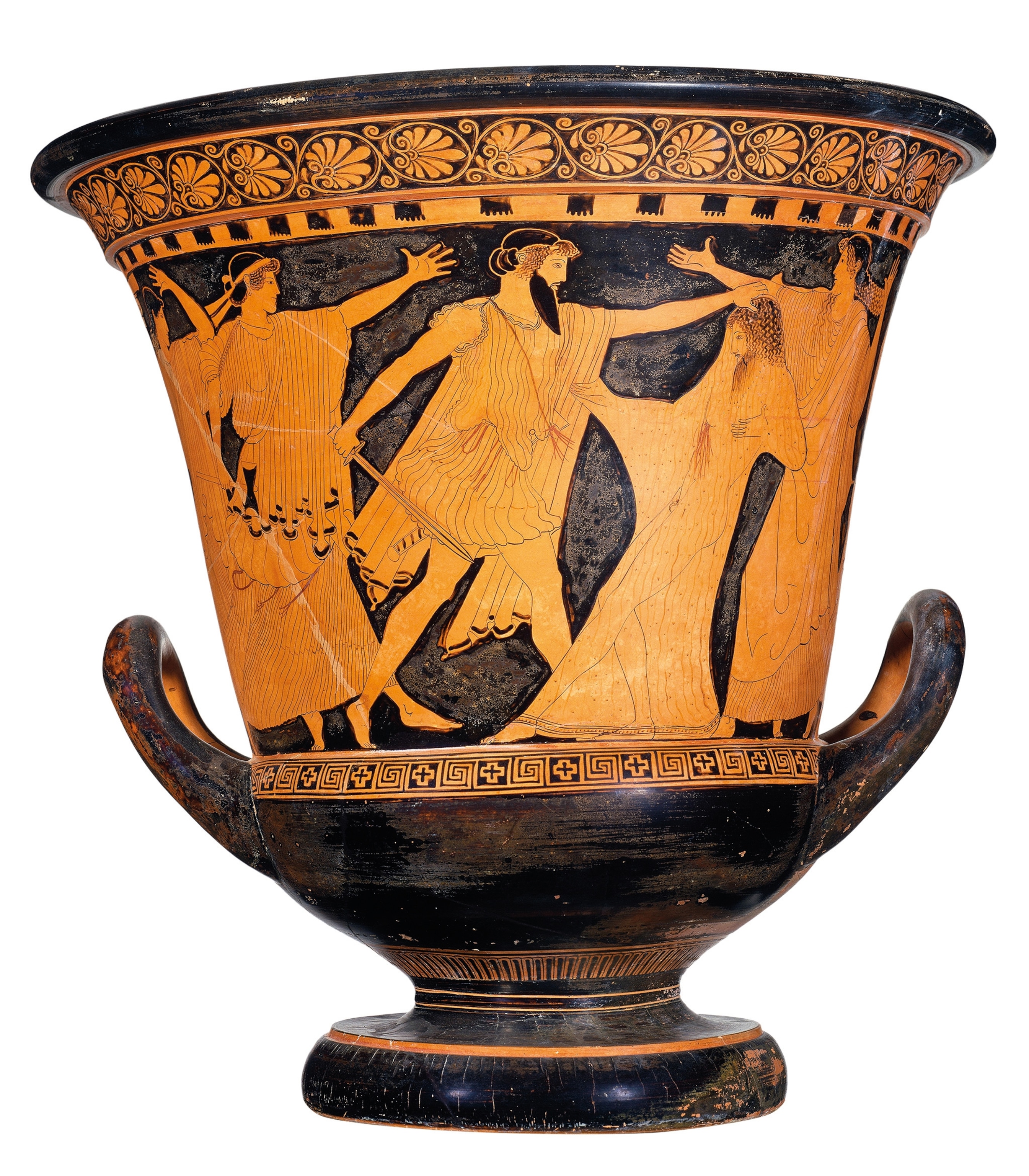
In some traditions, Diomedes and Idomeneus were also victims of conspiracies by their wives’ lovers, and fled to Italy, where they settled, as did Philoctetes, who found refuge in southern Italy. This area of the western Mediterranean was where the Greeks began to expand and colonize circa 770 B.C., which was when these dramatic tales of return took shape.
Odysseus the cunning
Clad in bronze armor and riding on magnificent chariots, the tide of men that Priam, Troy’s elderly king, beheld from his city walls was as impressive as it was terrifying. In that famous scene from Book Three of The Iliad, known as the theikhoskopia (view from the wall), Homer recounts that Priam called for Helen, the former queen of Sparta, who had sparked the war when she eloped (or by other accounts was kidnapped) with the Trojan prince Paris. He asked her to tell him who was the most outstanding of the Achaean warriors besieging his city.
Priam gazed at a distinguished figure who walked “like a bellwether up and down the ranks. A ram I’d call him, burly, thick with fleece, keeping a flock of silvery sheep in line.” “That is Laertes’ son,” Helen replied, “the great tactician, Odysseus. He was bred on Ithaca, a bare and stony island—but he knows all manner of stratagems and moves in war.”
Antenor, Priam’s wise counselor, recounts that when Odysseus, on an embassy to Troy, rose to speak, he “stood, and looked at the ground ... he launched the strong voice from his chest, and words came driving on the air as thick and fast as winter snowflakes.” The king and his counselor stress their fearsome adversary’s dominance both on the battlefield and in expressing his opinion (excellence in combat and in counsel being the qualities that define Homer’s great heroes). Homer employs the adjective polytropos (of many wiles, or of many paths) to set Odysseus apart. The term alludes to his cunning, his curiosity, and his resourcefulness in the face of uncertainty.

In The Iliad, Odysseus is repeatedly involved in actions requiring skills that transcend simple bravery, including full-out, head-on combat with the enemy, espionage, and complex diplomatic missions. One night, when the Achaeans intend to set out and raid the enemy camp in order to discover the Trojans’ intentions, it is Diomedes who dares to take on such a dangerous mission, but only if someone goes with him. All the heroes then offer to accompany him, but he picks Odysseus because he is “Shrewd ... and cool and brave, beyond all others in rough work … If he were at my side we’d go through fire and come back, the two of us. No man knows war as he does.”
Odysseus could fight as courageously as the most valiant of the Mycenaean warlords. A boar’s tusk helmet, which is clearly described in The Iliad as “a cap of hide with bands of leather crisscrossed, and on these a boar’s white teeth were thickly set, disposed with cunning on all sides,” which has been dated to Mycenaean times, points to him being one of them. Traces of an extremely powerful Mycenaean past have been discovered on the islands some scholars suggest he reigned over: Ithaca, Cephalonia and Leucas. However, Odysseus stands out from the other Mycenaean leaders for his ability to travel unknown paths and cross impassable frontiers, such as the gates of Troy or the land of the dead itself, where he speaks to the soothsayer Tiresias to discover what awaits him in the hazy realms of the future. This is the most difficult stage in the nostos, his return journey from Troy.
Rogue pirates or traders?
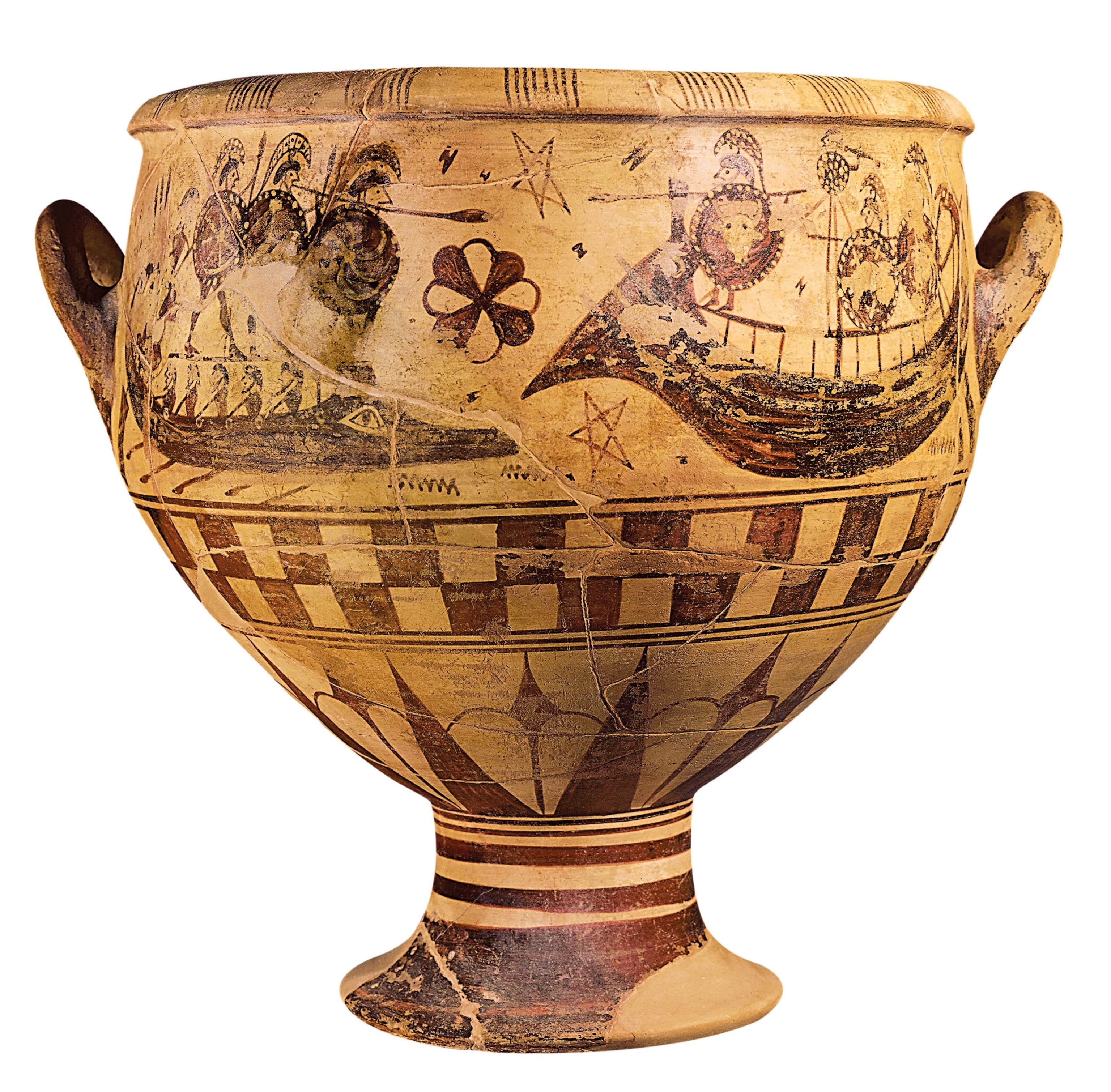
Once at sea, with a crew determined to protect their goods and eager to obtain more, what was the distinction between pirate and trader? Traders behaved like pirates and pirates looked like traders. When Odysseus’ son Telemachus sets out in search of his father, the goddess Athena appears before him in the guise of Mentes, pirate king of the Taphians, saying he has brought iron to trade; while Eumaeus, Odysseus’ faithful swineherd, was actually a prince kidnapped in childhood by Phoenician traders.
While The Iliad is dominated by determined old heroes constantly in pursuit of glory in battle, and whose weapons and mentality harken back to the distant Bronze Age, The Odyssey places its hero in a setting closer to the audience of the eighth century B.C., who could perceive their own historical events reflected in the sea voyage and the founding of a new home. Odysseus tells the Phaeacians how, after he left Troy, his fleet sailed into a storm that carried him far from the civilized world. He reached a mysterious place inhabited by the lotus-eaters, men addicted to an intoxicating substance that threatened to make his companions forget their mission to return home.
But this is merely the prelude to the next great stage in Odysseus’ voyage. He then reaches shores that are less civilized and more primitive than a Greek could ever conceive of: the land of the monstrous Cyclopes, one-eyed cannibalistic ogres who live in lush surroundings but are ignorant of agriculture and the laws of men. Since they have no ships, the Cyclopes have no contact with the outside world and have not cultivated the sacred duty of hospitality. When Odysseus passes through a thicket and discovers the cave of the Cyclops Polyphemus, his comrades beg him to flee immediately.

However, Odysseus, with his explorer’s curiosity, decides to wait for the Cyclops so that he can see what he looks like. The uncertainty and fear of a traveler who must navigate uncharted territory are underlined when Polyphemus returns and Odysseus calls on him to offer the hospitality customarily due to travelers. Polyphemus’ response is to devour two sailors per day. Odysseus offers him wine and sets a trap: “So, you ask me the name I’m known by, Cyclops? I will tell you ... Nobody—that’s my name. Odysseus and his companions blind the Cyclops while he sleeps off his drunkenness. When the rest of the Cyclopes come to his aid, Polyphemus can only tell them that “Nobody” blinded him.
This encounter might have been successful were it not for the fact that Odysseus had not yet completed his transition from an old epic hero, eager to make an eternal name for himself, to a hero capable of keeping a low profile when his survival is at stake. Acting just as an old epic warrior would, he later proudly proclaims that his name is “Odysseus, raider of cities.” Polyphemus takes advantage of this information to urge his father, Poseidon, the god of the sea, to punish Odysseus.
(An ancient city was left in ruins—but this remarkable statue was saved)
The triumph of cunning
Casualties increase among Odysseus’ men as the journey progresses and new dangers arise, until they reach another exotic place where the explorers sent out by the hero end up losing their humanity. They are in the domain of the sorceress Circe, daughter of Helios, the Sun god, who turns those who reach her shores into beasts with her magic wand.

But Odysseus, aided by the god Hermes (with whom he shares the epithet polytropos), manages to subdue the witch, who willingly offers him the keys to the successful completion of his journey: She shows him the route to the land of the dead, an essential step in his return home, and gives him crucial advice to combat the captivating and deceptive call of the Sirens.
With their bewitching song, the Sirens—birds with a woman’s face—lure sailors to their shore, where they are shipwrecked and devoured. But Circe advises Odysseus to plug his sailors’ ears with wax, while he, tied to the mast, can marvel at the beautiful stories they tell, whose protagonists may include him.
An epic of the domestic sphere
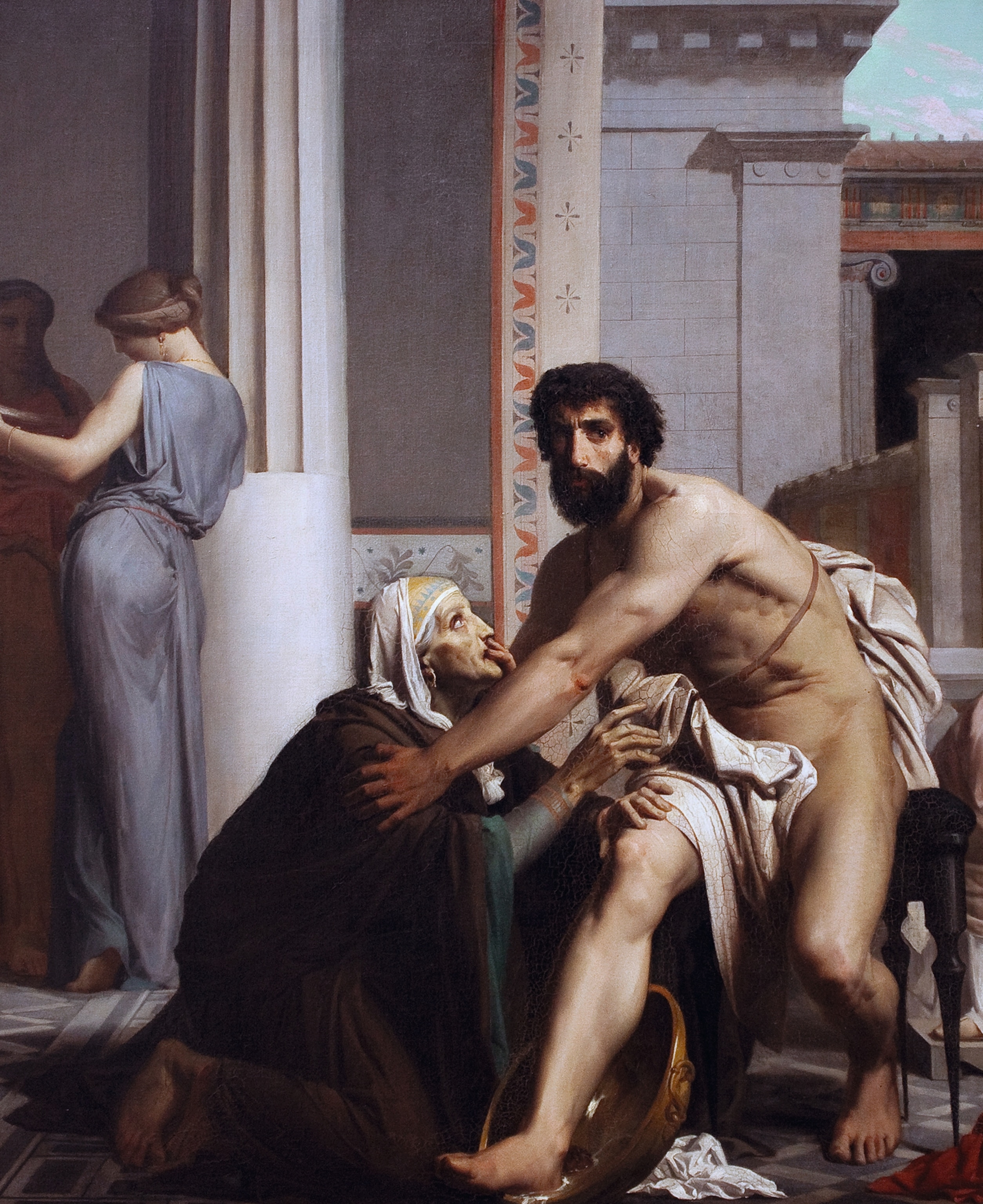
The hundred or so nobles who violate the laws of hospitality by devouring Odysseus’ goods are fought off and eliminated by a supposedly widowed woman (Penelope), a callow youth (Telemachus), a swineherd (Eumaeus), an oxherd (Philoetius), a retired king (Laertes), a faithful nurse (Eurycleia), an aoidos (Phemius), and a beggar (Odysseus himself). The battlefield is not the plain of Troy, but the homestead, and the combatants are not renowned warriors, but the humble inhabitants of the oikos.
The land of the dead is the farthest stage in the hero’s journey into the unknown. Shadows appear before Odysseus’ men, which only recover a certain glimmer after blood is drunk from a sacrificed animal. The shadows include many of the men who fought by Odysseus’ side at Troy, such as Achilles, who admits he would rather be a “slave on earth for another man … than rule down here over all the breathless dead,” and Agamemnon, killed by his wife and her lover “as a man cuts down some ox at the trough.” The heroes of The Iliad are shown here to have come to a rather ambiguous end, far from the triumphal glory and tragic defeats of their exploits in life. With this change in heroic values, in which the epics reach for more complex and human conclusions, the new hero must be capable of returning from war and resuming his place in the world.
It is in the underworld that Odysseus is given directions back to his homeland by the soothsayer Tiresias, and so he departs again on a voyage wracked by storms and sea monsters, which cause the entire crew to perish. Odysseus, alone, washes up on the goddess Calypso’s island. Overcome by nostalgia, he rejects the immortality she offers him and sails away on a raft built with his own hands. It is only then, after another shipwreck, that he reaches the domain of the hospitable Alcinous.

Alcinous opens the door to his kingdom by offering Odysseus the hand of his daughter Nausicaa, but Odysseus rejects her because he wishes to return to Ithaca and to his wife, Penelope. Our hero does not wish to found a new kingdom, but prefers his nostos, the return journey that would grant him everlasting glory.
Transported by the Phaeacians, Odysseus finally reaches the shores of Ithaca. His old kingdom, which he barely recognizes at first, has become hostile territory, endangered by a mob of suitors. After his 20-year absence, his home is on the brink of destruction, as nearly a hundred young aristocrats from Ithaca vilely squander the absent king’s wealth and pressure his wife, Penelope, to marry one of them and legitimize the usurpation of the kingdom. By making his own home a battlefield, Odysseus reclaims his position on the island and restores order by annihilating the pretenders to his throne.
But that is not enough; he needs his wife’s acceptance. Penelope, who has faithfully awaited Odysseus’ return, must recognize her true husband as the man who had come to claim the kingdom, who has so often hidden his identity during his journey. Although the goddess Athena has restored youth to both of them, Penelope does not recognize him, as she is waiting for a sign that proves Odysseus is standing before her.

At this crucial moment, the polytropic hero shows no sign of knowing how to resolve the situation. Then Penelope sends the spark that will reignite her husband’s versatile mind: “Eurycleia,” she says to her faithful maid, “move the sturdy bedstead out of our bridal chamber—that room the master built with his own hands.” Then Odysseus snaps out of his reverie and reveals himself, “Woman—your words, they cut me to the core! Who could move my bed?”
Odysseus had made his bridal bed from the trunk of an olive tree, with its roots still deep in the ground. He knew very well that it could not be moved: “Impossible task, even for some skilled craftsman—unless a god came down in person, quick to lend a hand.” This was the sign Penelope was waiting for. It is only when she accepts her husband’s identity that the hero’s return is complete.
Thanks to Odysseus, the Greeks of the Archaic era knew how to act in a changing world. The hero who adhered to the concept of warrior honor was long gone. In contrast to that static attitude, Odysseus represents the journey, with its opportunities and risks, and the ability to adapt to a world that is forever in motion.
(The Odyssey offers monsters and magic—and also a real look into the ancient world)
Women in The Odyssey
Even ancient scholars of epic poems stressed the importance of female characters in The Odyssey. Later, in the 18th century, it was suggested that it was composed for a female audience. In the 19th century, it was even posited that a woman wrote it, an idea taken up again at the end of the 20th century. More recently it has been suggested that Penelope is the poem’s true heroine. In a poem in which cunning is the sign of a hero, Penelope’s wits are what keep Ithaca safe in the absence of its king.
CIRCE, THE SORCERESS
Daughter of Helios, the sun god, Circe is a sorceress who turns men who approach her domain into beasts. However, she is unable to bewitch Odysseus, who has been given an antidote from the god Hermes. The poet Hesiod, in Theogony (written around the same time as The Odyssey), says that Circe and Odysseus fathered three children: Agrius, Latinus, and Telegonus.

THE GODDESS CALYPSO
Calypso, whose name means “the hidden one,” is one of the last survivors of an extinct race. As the daughter of the titan Atlas, a god, she is a minor goddess. She lived in solitude in a marvelous deep grotto on a lost island. Calypso keeps the shipwrecked Odysseus there for seven or 10 years (depending on the account), until the goddess Athena (the hero’s protector) persuades Zeus to order Calypso to release him.

PENELOPE, THE PROTECTOR OF THE OIKOS
Penelope is described as a woman of exceptional physical and intellectual features, capable of keeping the oikos, their homestead, running by deceiving the suitors who besiege her. She will tell them who she has chosen as her husband only after she has finished weaving the funeral shroud of her father-in-law, Laertes, which she secretly unweaves at night. Penelope seems to sense that the beggar who has arrived at the palace is her husband, but she keeps silent about it so no one will betray him to the suitors, who would kill him.

PRINCESS NAUSICAA
Nausicaa, the Phaeacian princess, finds Odysseus when he is shipwrecked. He appears to her and her companions naked and they flee in fear. She gives him food and clothing and falls in love with him, but Odysseus rejects her when her parents, Alcinous and Arete, offer him her hand in marriage.

