The Twisted History of Barbed Wire
Since the innovative first patent was registered by Joseph Glidden in 1874, barbed wire transformed cattle ranching across the west. But not everyone was happy with this invention.

Indigenous people populated the Great Plains and prairies of the American West for thousands of years prior to the arrival of Europeans. For many Nations (such as the Sioux, Cheyenne, and Blackfoot), bison were central to their way of life, providing food, tools, shelter, and clothing. They migrated alongside the great herds, which once numbered in the millions. In the mid-1800s, as the devastation of the bison was underway, cattle and their attendant handlers (the American cowboys) arrived. The seas of grasslands that once fed the vast herds of bison also served as prime fodder for beef cattle.
Cattle and cowboys roamed where they pleased on the prairies of public domain. Cattle trails went from western Texas, north through the Indian Territory of Oklahoma into Kansas, up through Nebraska, and into the Dakota Territory. Unhindered by fencing, annual cattle drives moved herds to processing facilities conveniently located near settled railheads in Abilene, Omaha, and other towns.
Newcomers Arrive

The status quo shifted when President Abraham Lincoln signed the Homestead Act in 1862, which specified that any U.S. citizen could lay claim to up to 160 acres of land in the West. The only requirements were to build a home there and to work on the land for five years. However, the lack of effective fencing limited farming and ranching practices—either to keep out the free-range cattle or to keep a farmer’s own livestock contained. Wooden fences were costly, with lumber on the prairies in such short supply that homesteaders often built sod houses. Rocks for stone walls (common in New England) were likewise scarce on these plains. Shrubs and hedges took too long to grow and used water that was also in limited supply: The mid-19th century was a time of drought. Desperate for a solution, the homesteaders soon found one in what came to be known as “barbed wire.”
The Development of Barbed Wire
Although a “wire fence” was patented in 1867, the idea for barbed wire as a method of fencing livestock started in 1868, when a man named Michael Kelly invented the basic design, which consisted of twisting two plain wires together to create a cable for barbs. Then in 1874, Joseph Glidden, a farmer based in De Kalb County, Illinois, received U.S. Patent #157,124, improving upon Kelly’s invention. He also developed a way to mass-produce barbed wire, bringing down its price. Glidden’s machine pulled two strands of wire tight around the barb, then wound the wires together around the regularly spaced spikes. As one satisfied user wrote: “It takes no room, exhausts no soil, shades no vegetation, is proof against high winds, makes no snowdrifts, and is both durable and cheap.”

While solving the homesteaders’ fencing problem, the introduction of barbed wire was most beneficial for large landowners, to the detriment of others. With the value of cattle rising, a land grab began, and landowners began to fence off vast swaths of land, including terrain that did not necessarily belong to them (often cutting off public roads and the best water sources). Indigenous people and the bison herds they followed could no longer move freely. Landless ranchers could no longer drive their cattle to market, nor could poor, small-scale farmers make use of the resources on the open range.
Indigenous people called barbed wire “the devil’s rope,” while the cowboys called it “the devil’s hatband.” Many despised the invention, which injured free-range livestock and bison, and ultimately took the lives of countless animals. Barbed wire’s low-profile design makes the wire difficult to see, and it was easily overlooked by animals unfamiliar with the fencing. The barbs caused lacerations and subsequent infections, and animals would become entangled when attempting to jump over or crawl under the fences.
One result of the standoff between landowners and landless cattlemen was the Texas fence cutting wars, in which masked gangs such as the Blue Devils and the Owls went on wire cutting sprees, threatening fence owners to prevent them from rebuilding. One note read: “You are ordered not to fence in the Jones tank, as it is a public tank and is the only water there for stock on this range . . . No good man will undertake to watch this fence, for the Owls will catch him.” The conflict ended primarily through legislative actions: In 1884, fence cutting was made a felony and illegal fences on public land were ordered to be removed. The amount of cutting declined, but it was heavy-handed enforcement by the Texas Rangers—even including one attempt to place bombs by the fences—that gradually put a stop to the practice.

The Growth of an Industry
Between 1867 and 1874, as many as 500 different types of spiked fencing were patented, with their inventors competing to improve effectiveness and capture a share of the market. As listed in Early United States Barbed Wire Patents by Jesse James (not to be confused with the outlaw), these fences were lined with “prods,” “spurs,” “prickers,” “teeth,” or “prongs.” It wasn’t until 1871 that Lyman P. Judson named his projecting metal points “barbs.” The term stuck, though Judson’s design did not survive.
Pioneers continued to tinker with the form, creating more than 2,000 unique homespun designs with inimitable names to match: the Underwood Tack, the Untorn Ribbon, the Necktie, the Hold Fast, and the Sunderland Kink, among numerous others. The most popular design, Glidden’s, was named the Winner, due to the inventor’s success in patent battles against competitors.
Today’s barbed wire is highly durable. Manufacturers mix steel with carbon fiber for more flexibility, without compromising strength. Top-grade barbed wire is now coated in a mixture that is 95 percent aluminum and 5 percent zinc to prevent corrosion, keeping it in good condition for decades.
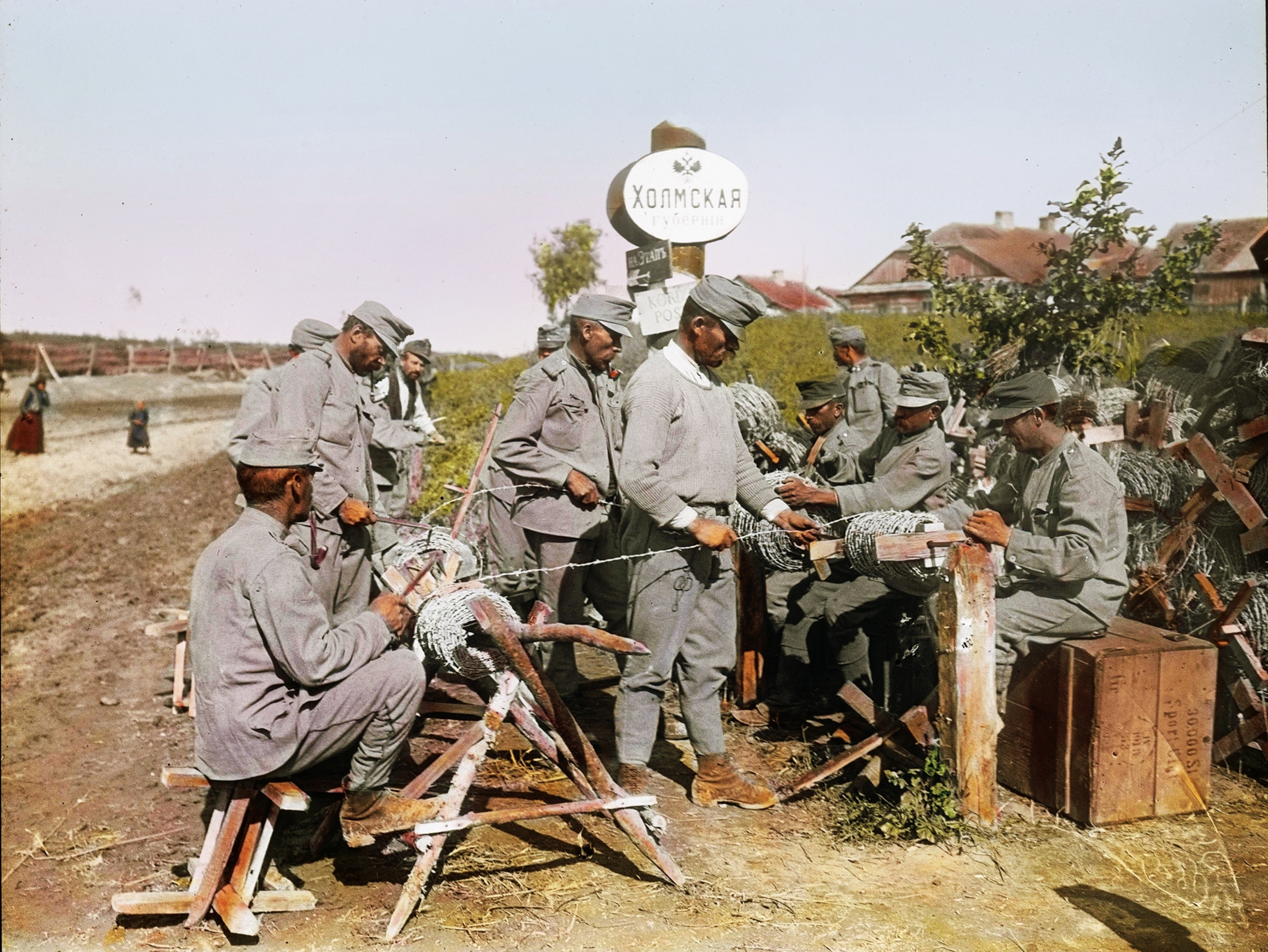
The Devil's Rope in Times of War
A Rusty Legacy

Barbed wire is ubiquitous across the world today, and its most common use (fencing for livestock) hasn’t changed, despite its great versatility; it was even used as telephone wire in some rural areas before insulated copper wire arrived. Moreover, barbed wire’s cultural resonance has hung on (quite literally) in the United States. There are barbed wire museums, competitions, and even an Antique Barbed Wire Society. There is also a growing movement of organized volunteer groups (such as the Barbed Wire Warriors of Colorado), who remove old barbed wire fences across the western United States to restore wildlife corridors for animals such as elk, deer, and moose—thus preventing injuries and opening up migration paths.
Along with the Colt pistol and the railroad, barbed wire is often listed as one of the three main technologies in “how the West was won.” From the enclosure of the open range to the electrified fences of the Nazi camps, the 158-year legacy of barbed wire is well entangled in history.
