This Ancient Egyptian Fashion Enchanted a Pharaoh
Fragments of a 4,500 year-old dress were stored in a museum’s basement for decades until one researcher pieced it back together, looking for answers about the mysterious relic.

More than 4,500 years old, the Egyptian bead net dress at the Museum of Fine Arts (MFA), Boston, is the first complete example of its kind. The better part of a century after its discovery, it was meticulously reconstructed over a period of three years.
The dress belonged to a female contemporary of Pharaoh Khufu (ca 2500 B.C.), builder of the Great Pyramid. The beads were found scattered over and around her mummified body, which had been lying inside a limestone sarcophagus in an undisturbed tomb beneath the famous Giza Plateau. As the sarcophagus was unmarked, the woman’s identity remains shrouded in mystery, but her burial on the Giza Plateau, the necropolis of kings, speaks to her prominence. Perhaps she was the wife of an upper-level bureaucrat, speculates Larry Berman, the MFA’s senior curator of Ancient Egyptian, Nubian, and Near Eastern art. In any case, she must certainly have been well connected to be buried there. A person’s residence, temporal or eternal— then as now— was a clear and unmistakable measure of status.

The tomb, G7440Z, was uncovered during the Harvard University-Museum of Fine Arts expedition in 1927. George Andrew Reisner, who supervised the excavation of the cemeteries surrounding the Pyramids of Giza, was “the undisputed master of arguably the most famous archaeological site in the world,” his biographer Peter Der Manuelian writes. Although Reisner would become the curator of Egyptian art for the MFA, he was happiest in the field, and his meticulous protocols helped set the template for evolving archaeological methods of excavation and documentation. Without these protocols, the dress could surely never have been stitched back together.
(How Jackie Kennedy helped save an iconic ancient Egyptian temple.)
Dress for the Occasion
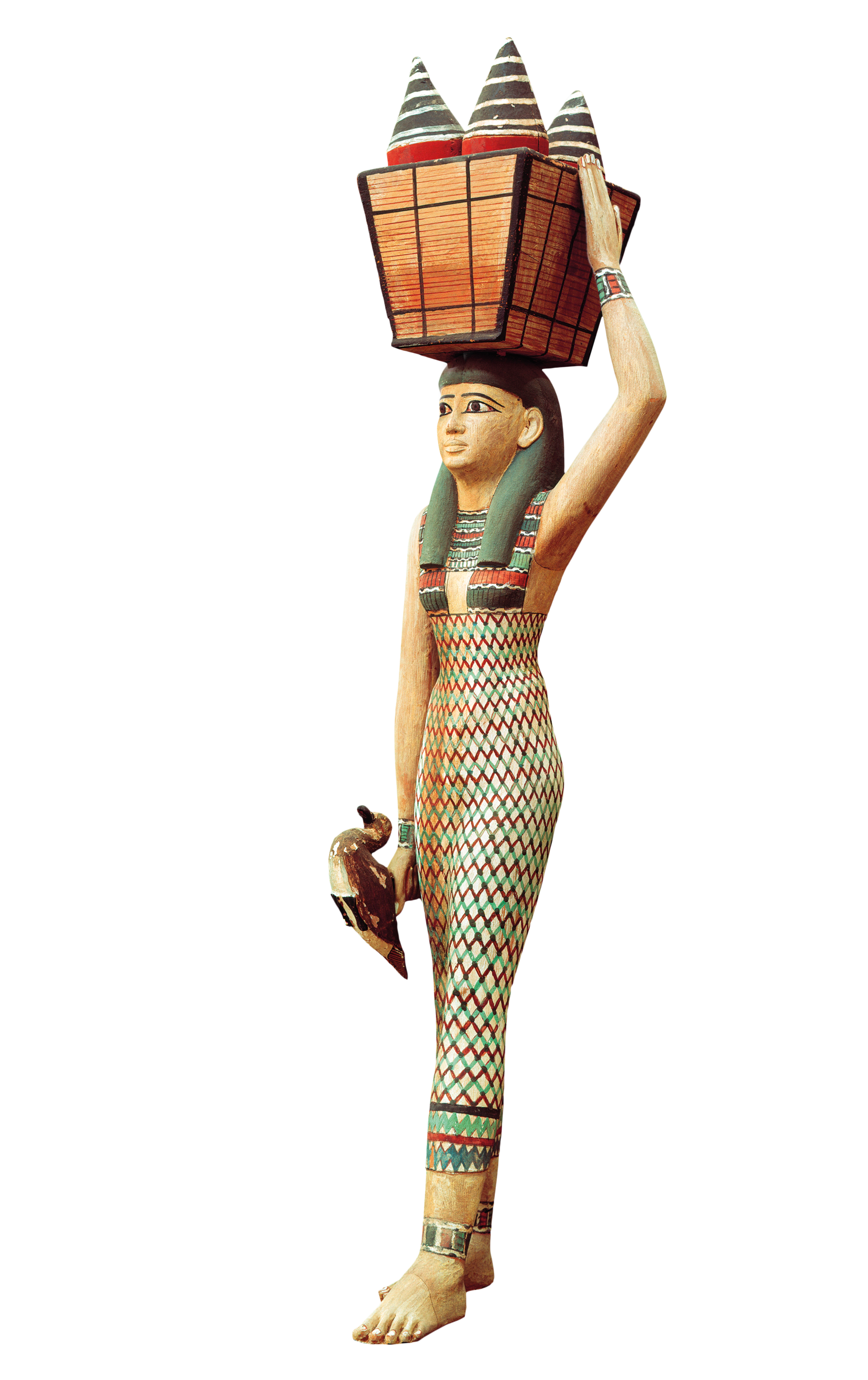
Two wooden statues are the most well-known of the pieces cited by scholars as possible examples of bead dresses. The pair, found in a tomb in Thebes, represent offering-bearers. While one exhibits a feather or scale-like structure, the other sports the more commonly seen diamond pattern.
A Charismatic Artifact
The dress was certainly not everyday wear; standard clothing for women in ancient Egypt was a plain sheath of raw linen. Many scholars assume the bead dress was either worn over or stitched onto another garment, and for special occasions only, not excepting one’s own funeral. However elusive, a literary reference to the use of bead net dresses does exist, in the Westcar Papyrus: “The heart of his majesty (King Sneferu) was made happy” by the sight of 20 young girls who are told to take off their clothes, don bead net dresses and row during a royal boating party on the Nile.
Due to the many requests from other museums to borrow the Boston dress, the MFA used beads recovered from another tomb in 1933 (this one looted, rendering a faithful reconstruction nigh impossible) to make an alternative that could travel on loan. A third dress, one with faience breast caps, was reconstructed in 1994, and can be seen in the Petrie Museum of Egyptian and Sudanese Archaeology in London.
How to explain the allure of the bead dress? “People can relate to it,” says Rita Freed, curator emeritus of the MFA’s Ancient Egyptian, Nubian and Near Eastern Art department. “It looks like something you could imagine yourself wearing. The ancient Egyptians are so far removed from us, yet they are us.”
“The brilliant faience beads suggest the radiance of the sun, which sets and rises in its daily cycle of resurrection. The blue-green color alludes to the green of renewal,” says Berman, thus “you have a recipe for birth in the afterlife . . . It was a dress,” he says, “for eternity.”


(Anonymous artists invented ancient Egypt's iconic style.)
Piecing the Dress Together
“As a research associate for a prospective MFA exhibit on the burial practices and funerary beliefs of the ancient Egyptians [‘Mummies and Magic,’ 1988], I was assigned the task of solving the mystery of the tiny round boxes and their bead contents,” the late Millicent Jick wrote several years after she solved the puzzle of the dress. The pieces of that puzzle (approximately 7,000 beads) had sat in 30 small boxes in the museum’s basement for 60 years. Jick sensed it was an object of major significance. But what would the beads look like when restored to their original form? Jick set to work. Reportedly, not one bead was left over when she was finished.
Egyptian Finery
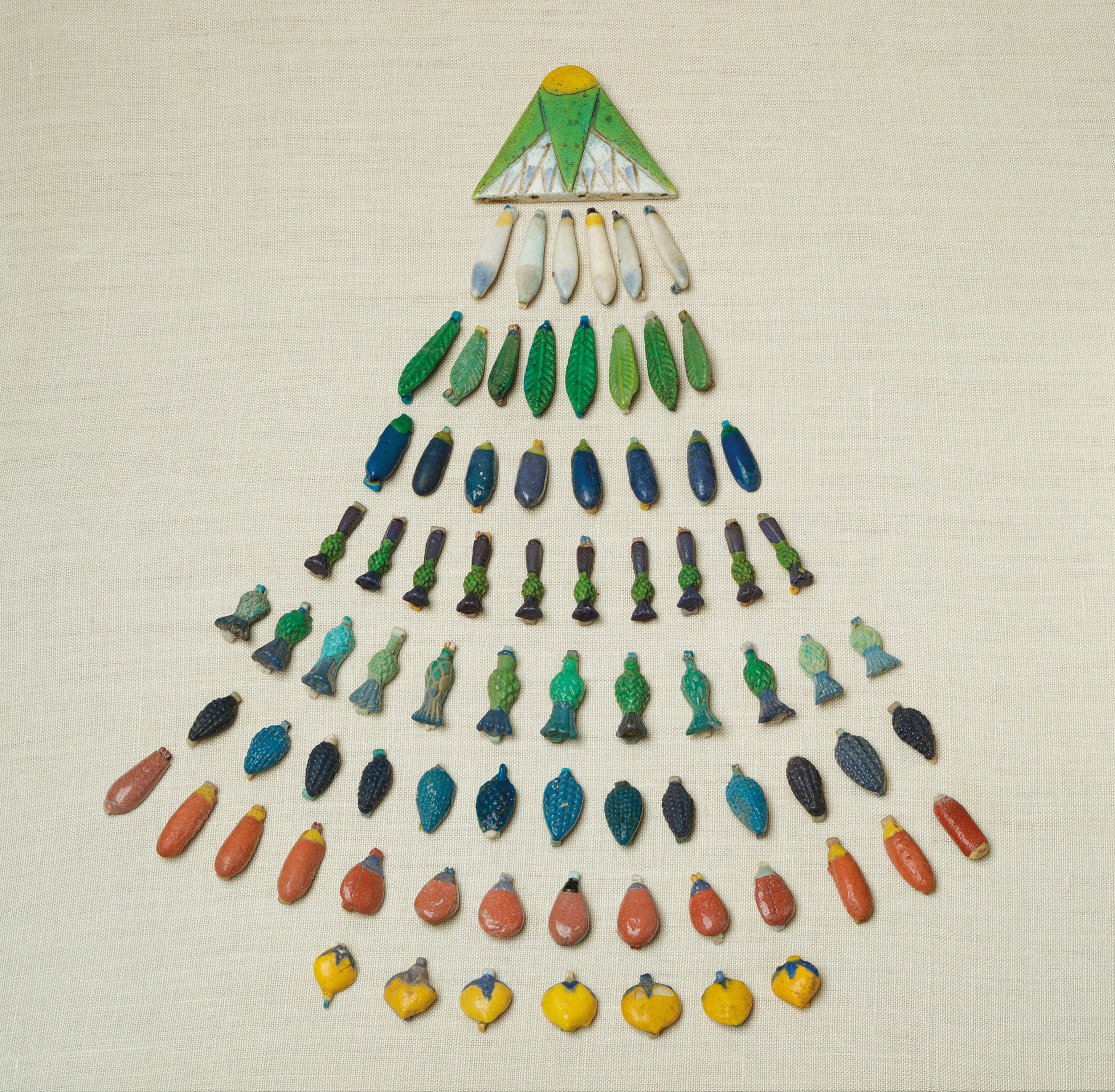
Reisner's system of documenting excavation fieldwork through photographs, explicit field notes, and meticulous drawings was of immeasurable help. Noel Wheeler, another archaeologist who worked on the tomb, had made a line drawing showing exactly where each bead was found on the mummy. A photographer had documented the remains in situ and in this photo, on the left-hand side of the body, Jick wrote, “the beads still retain their lozenge-shaped configuration and are clear and readable.”
That, together with net-patterned dresses depicted in Egyptian statuary and tomb wall paintings, and the evidence from an earlier excavation that had disinterred another woman also covered with beads, provided the clues that allowed Jick to reconstruct the dress still on exhibit at the MFA to this day.


