The Political Turmoil Behind Goya’s Black Paintings
After the expulsion of Napoleon’s forces, and with Spain under absolutist rule again, Francisco de Goya poured his existential pessimism into works known as the Black Paintings.

At the outbreak of the Peninsular War (also known as the War of Spanish Independence) in 1808, Francisco de Goya was already one of Spain’s most esteemed and sought-after artists. After settling in Madrid in 1775, at the age of 29, the painter did not take long to close in on the crown—first, painting designs for the tapestries destined to adorn the royal palaces, and later, working as a portraitist to the country’s aristocratic elite.

In 1789, Goya was appointed court painter, and later reached the height of his official career as first court painter to King Charles IV in 1799. The commissions he received in those years greatly improved his finances and social connections, and he even considered seeking a title of nobility. In letters to his merchant friend Martín Zapater, he wrote of riding with the Duchess of Osuna and recounted flirtations with the Duchess of Alba: “You’d have done better to come help me paint the Alba woman; yesterday she burst into my studio demanding I paint her face—and she got her way.” Far from a portrait, this was an invitation for Goya to do her makeup.
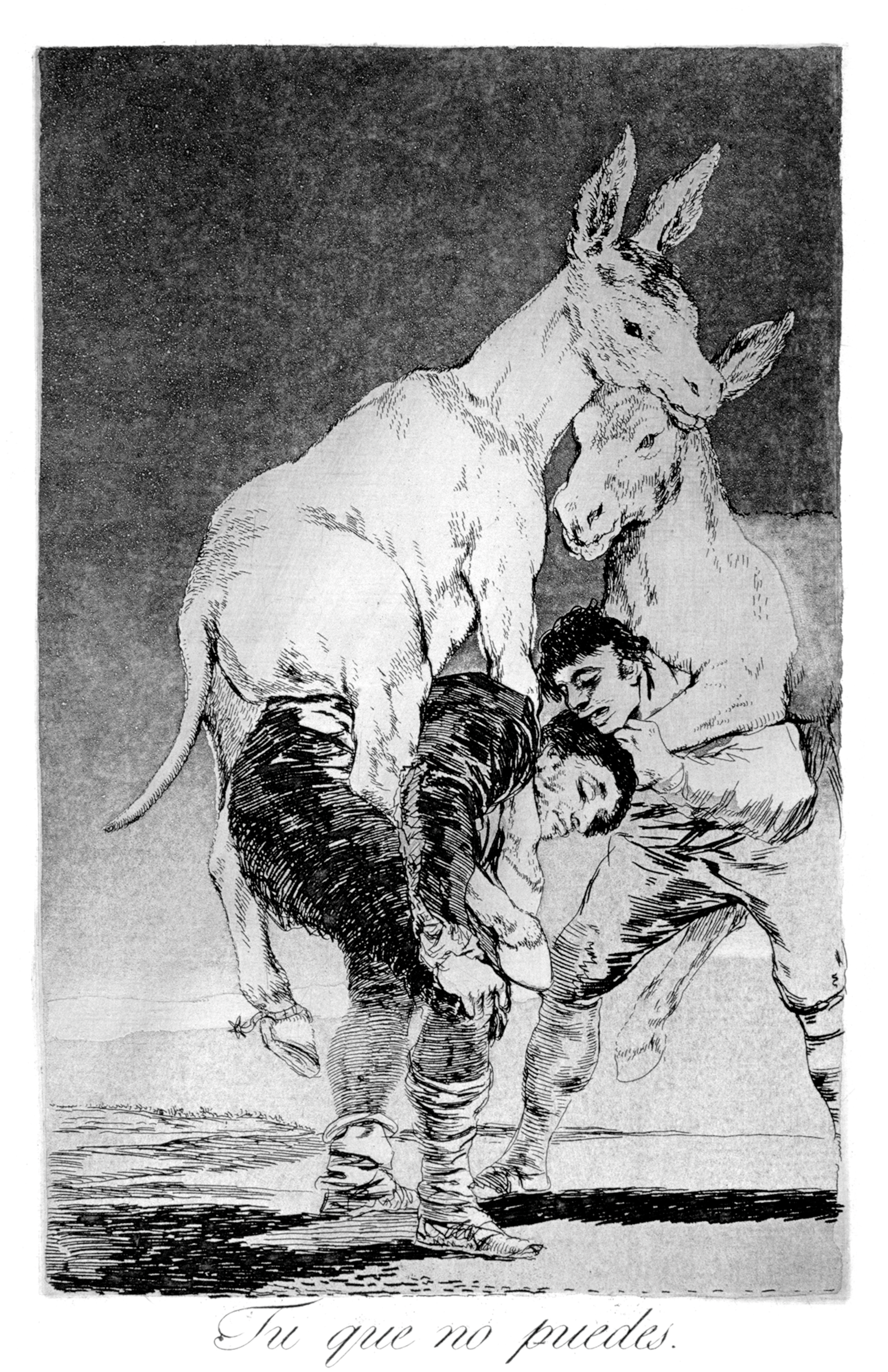
However, in the winter of 1792-93, his life took an unexpected turn. While in Seville, he fell gravely ill and was bedridden for several days. According to Goya, this was the result of a stroke, though today some speculate that he was suffering from symptoms of syphilis, or lead poisoning from the type of paint he used. In any case, he was left permanently deaf, a condition that profoundly affected his character and perspective on society. Out of this personal crisis emerged a new artist who not only went above and beyond the artistic conventions of his time but also chose to explore an inner world, broaching political and philosophical themes with uncompromising clarity and realism, and producing work independent of the customary commissions of his clientele. In 1799, he would publish the Los Caprichos series, a denunciation of social backwardness that includes the iconic print “The Sleep of Reason Produces Monsters.”
(How the Old Masters painted animals: dragonfly wings and butterfly dust)
The War of Independence
The Peninsular War of 1808–1814 plunged the now sexagenarian Goya into a new crisis, one he shared with all his compatriots. The incompetent Charles IV (advised by his corrupt Prime Minister Manuel de Godoy) invited Napoleon’s forces into the country to aid their invasion of Portugal. It was a trick: Portugal was not the only country on the menu. Napoleon imprisoned the hapless Bourbons, but he had underestimated the patriotism of the Spanish people. What followed was the bloodiest conflict in the country’s modern history.
Goya bore witness to the French occupation of Madrid, visited the city of Zaragoza (devastated by two sieges), and followed the conflict’s successive upheavals with anguish. His feelings were captured in the series of etchings entitled The Disasters of War, which he began during the fighting, although their content—the atrocities committed by both sides, and a biting criticism of the restored Spanish regime—meant they would not be published until 1863. Beyond their historical value, these unflinchingly macabre prints stand as a universal meditation on human violence and cruelty.


At the war’s end, Goya painted two famous canvases: “The 2nd of May 1808 in Madrid” (or “The Fight Against the Mamelukes”) and “The 3rd of May 1808 in Madrid” (or “The Executions”). These were patriotic works with which Goya said he sought to “perpetuate with the brush the most notable and heroic acts or scenes of our glorious uprising against the tyrant of Europe.” In these pictures, Goya stripped the history painting genre of its traditional distant grandiloquence by presenting events as if witnessed firsthand, eliciting deep and immediate feeling from the viewer.
The war also confronted Goya with the dilemma of how to respond to the French occupation. Some Francophile intellectuals, known as afrancesados, had thrown their support behind the foreign regime (led by Napoleon’s brother, who was crowned King Joseph I of Spain), which they saw as an opportunity to overcome the former Bourbon monarchy’s absolutism and religious intolerance. Goya shared this critical outlook, but did not align himself with the new government. Like many others, he tried to adapt, avoiding open conflict with the authorities. Publicly, he took commissions from all political factions, a wise and cautious means to secure a quiet life for himself and his family.
(The Louvre has a wild history of being robbed in broad daylight)
Nevertheless, at the war’s end, Goya found himself in a precarious position when the Bourbon monarch Ferdinand VII restored the old regime. In 1815, he was subjected to legal proceedings to assess his involvement with the government of the occupation. He was reproached, among other things, for having sworn allegiance to Joseph Bonaparte; for attending the investiture of the Marquis of Almenara, a known Francophile, as protector of the Royal Academy of Fine Arts of San Fernando; and for taking part alongside other prominent painters in selecting Spanish works to be sent to Napoleon’s museum in Paris. He escaped unscathed, thanks to his old friendship with the Duke of San Carlos, who oversaw the purges at the Royal Household. Even so, Goya fell out of favor as a court painter and was replaced by younger artists closely aligned with the monarch, such as Vicente López Portaña and José de Madrazo. In fact, from 1816 on, he received no further royal commissions. The king likely saw him as an old man (he was now 70), out of step with the times.

Widowed since 1812, Goya was living in the capital with his son, Javier, and his daughter‑in‑law, Gumersinda Goicoechea. His isolation deepened as his Francophile friends, most of whom had gone into exile in southwestern France, languished in miserable conditions: Bernardo de Iriarte died in Bordeaux in July 1814, while Juan Meléndez Valdés passed away in Montpellier in 1817. Only Leandro Fernández de Moratín, writing from Barcelona, maintained regular contact with the painter through their mutual friend the abbé Juan Antonio Melón.
Despite these difficulties, Goya’s creative energy in these years is striking. His work continued, thanks to private commissions obtained through old connections, and he was forced to accept all manner of requests to bring in money. Among these commissions is the painting “Saints Justa and Rufina,” which he made for the Cathedral of Seville in 1817, a work that belies the painter’s marked religious skepticism. He received the commission through his friend the historian Juan Agustín Ceán Bermúdez, who went to great lengths to persuade him that the painting should convey precisely the spirit of devotion that the artist so despised. As he wrote to the collector Tomás de Veri: “You surely know Goya, and you can imagine how hard it was to inspire in him ideas so opposed to his nature. I gave him written instructions for the painting, made him produce three or four sketches, and at last he is blocking in the canvas, which I hope will turn out to my liking.”
The painter also produced more intimate works aimed at shoring up the family finances. Chief among them is the series of 33 prints titled La Tauromaquia (Bullfighting). In all likelihood, he etched these scenes under the belief that there would be a home market for them and that, being an innocuous subject at the time, they would escape censorship. Sales, however, were disappointing—perhaps because Goya created images that were far removed from the lighthearted, heroic or anecdotal approach other artists had taken, and emphasized instead the most dramatic and morbid aspects of the sport, a metaphor for the immortal struggle of man against beast, or man and his own bestial nature.
A Devastating Critique
The Black Paintings
Shortly after the war ended, Goya began a controversial relationship with Leocadia Zorrilla, a woman 42 years his junior. Related to Goya’s daughter‑in‑law, Gumersinda, Leocadia’s role in the painter’s life remains an enigma. Some specialists believe Goya took her in as a housekeeper out of goodwill toward a woman in dire straits after her difficult divorce from a man called Isidro Weiss (she was accused of infidelity in 1811). Others, however, hold that Leocadia was the painter’s lover and that little Rosario Weiss was the child of their affair.

Whatever the case, from early 1819 Leocadia and her daughter lived with Goya at the Quinta del Sordo, a large estate of roughly 36 acres on the outskirts of the capital, on the banks of the Manzanares River. In all likelihood, Goya acquired the property to withdraw from the bustle of the city center and devote himself to more relaxed pursuits in the bucolic rhythm of the countryside.
Under its previous ownership, a two‑room country house had been built on the estate, with a garden and a well for drinking water. Shortly before going into exile in France, Goya left this property to his grandson, Mariano, then 17 years old. After his grandfather’s death, Mariano sold the land to a real estate developer in 1859. Thanks to the deeds of that sale, we know the original house had been enlarged by Goya and consisted of a “ground and first floor with several paintings on the walls, now deteriorated,” on a property that also included a gardener’s cottage, a henhouse, a shed for a steam engine, a pond, and two waterwheels. Eventually, after passing through the hands of several foreign owners, the house was demolished in 1909.

The Quinta del Sordo has gone down in history because inside, Goya created his famous Black Paintings—works likened to the Sistine Chapel of modern painting. They were a group of 14 oil paintings executed directly on the walls of two rooms: the dining room on the ground floor and the sitting room upstairs. The paintings remained until Baron Frédéric Émile d’Erlanger, who bought the property in 1873, decided to detach them from the walls and transfer them to canvas, a task carried out by Prado Museum restorer Salvador Martínez Cubells. The Black Paintings were shown to little acclaim at the 1878 Paris World’s Fair before being definitively bequeathed to the Prado Museum in 1881.


X‑rays have revealed landscape paintings beneath these works. It is possible that, after another bout of severe illness in 1819, Goya grew tired of these pictures, and took advantage of the Liberal Triennium—a three-year-period of relative tolerance and freedom of expression, following the 1820 uprising led by Rafael del Riego, which established a constitutional order—to settle scores with the old ills plaguing Spain: poverty, superstition, and religious fanaticism (the Inquisition was only definitively abolished in 1834). These allegorical scenes, painted between 1820 and 1823, have been linked to Los Caprichos, as they share the same hermetic character and a similar creative freedom. Goya painted them in absolute privacy, for himself, as an expression of his most intimate feelings, offering a bleak, phantasmagoric vision of Spain that, at that point in his life, must have felt like a nightmare.
Exile and Freedom
In April 1823, French troops restored the absolute power of Ferdinand VII, bringing the Liberal Triennium to an end. Fearing reprisals against liberals, Goya took refuge in the home of a friend, the canon José Duaso, a man highly respected at court. Goya soon decided it was best to leave Spain. To avoid losing his position as court painter, in May 1824 he requested a six‑month leave from the king to travel to the spa at Plombières, in eastern France. The leave was granted, but far from seeking a health resort, the painter decided to travel across France. In Bordeaux, he was received by the Spanish dramatist Leandro Fernández de Moratín, who described his arrival: “Goya has indeed arrived (deaf, old, clumsy, and weak, without a word of French and without any servant) and yet so cheerful and eager to see the world.” His wanderlust was such that by June he was already in Paris. In the capital he visited monuments and strolled through public places, as recorded in French police reports (it was typical for Spanish political exiles to be surveilled in France). In September of that year he returned to Bordeaux, where he would live with Leocadia and her children.

Again, his friend Moratín offered an excellent portrait of Goya’s life in France: “At seventy‑nine springs and with all his ailments, he neither knows what awaits him nor what he wants. I urge him to stay put until his leave expires. He likes the city, the countryside, the climate, the food, the independence; he enjoys the tranquility here. Since he arrived, he hasn’t suffered any of the troubles that plagued him back there; and yet at times he gets it into his head that he has much to do in Madrid, and, if allowed, he would set off on a bay mule with his cap, his cloak, his walnut stirrups, his wineskin, and his saddlebag.”
Goya returned to Madrid twice more, in 1826 and 1827, to settle financial matters and request his retirement. In general, he seems to have lived quietly in Bordeaux, but he did suffer from serious urinary problems. Though he accepted no further commissions, he painted portraits of his friends, sketched the hustle and bustle of street life, and even taught Rosario, Leocadia’s daughter, to paint. She would go on to be an artist in her own right, and several of her works are now housed at the Prado Museum.

At the age of 80, Goya tasted freedom, leaving some of his inner monsters behind. And still, he maintained a surprising creative vigor, experimenting with new techniques in The Bulls of Bordeaux series and impressionist painting in “The Milkmaid of Bordeaux”—an ode to youth and beauty with which he virtually closed his oeuvre, shortly before his death on April 16, 1828.
