Who was Constantine?
In the early fourth century A.D., Rome was notorious for persecuting Christians. Yet the night before battle, Constantine received a vision from God: if he embraced Christianity he would win. His decision would change the empire forever.

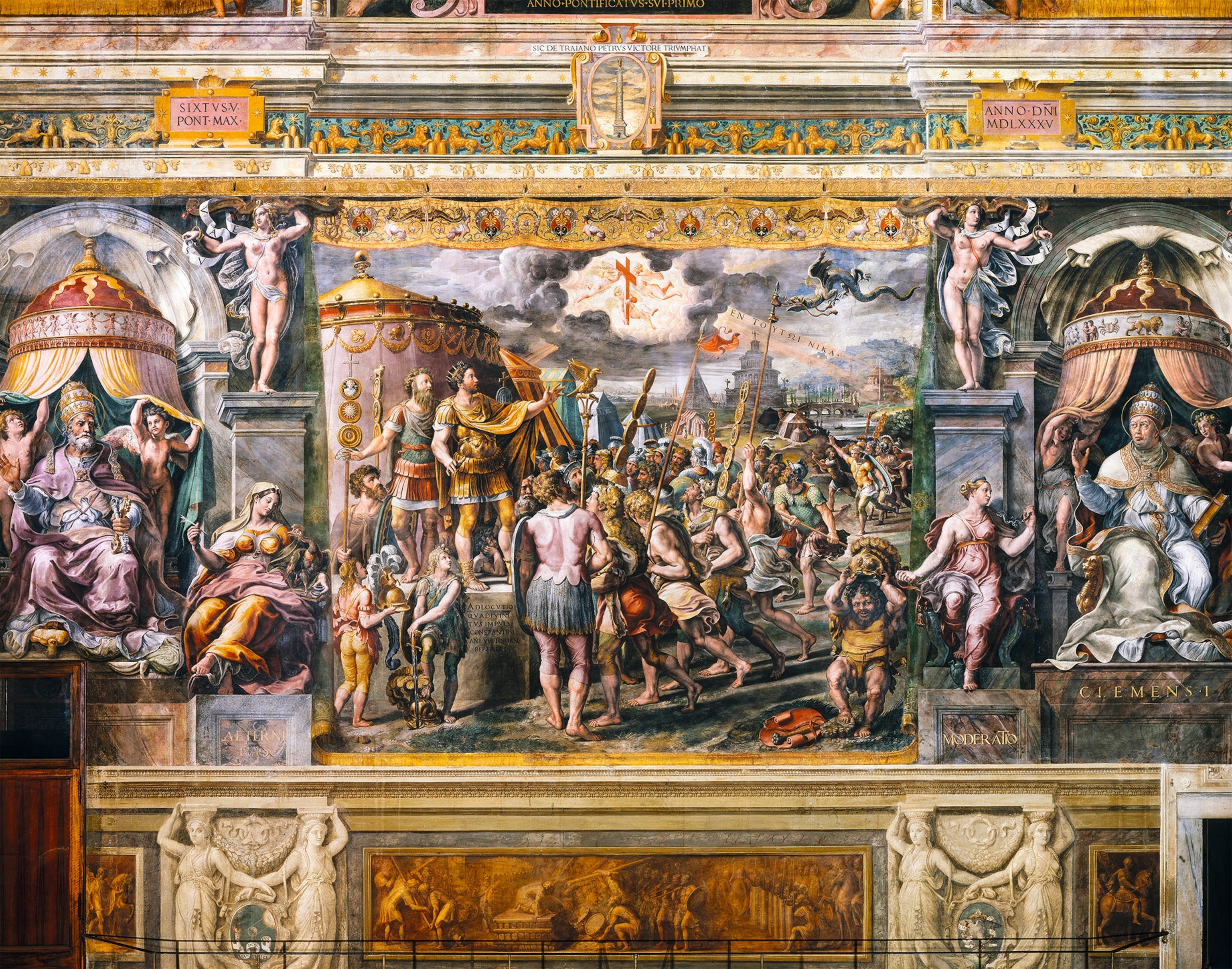
Popular myth has it that in October A.D. 312, on the outskirts of Rome, a moment of inner transformation reshaped the course of Western history: Constantine, on the brink of battle for the imperial throne, converted to Christianity. Constantine reportedly had a strange but powerful vision: a cross of light blazing in the sky, accompanied by the Greek words “Conquer by this” more commonly known in Latin as In hoc signo vinces, or “In this sign you will conquer.” When he emerged victorious at the Battle of the Milvian Bridge against his rival Maxentius for the throne of the Roman Empire, he interpreted his vision as a divine intervention from God. Christians in the Roman Empire had been a persecuted minority restricted to meeting in secret. Within just a few decades of the emperor’s conversion, the Roman Empire would be dotted with imposing churches, while some of the most emblematic temples of antiquity had been abandoned.

The struggle for power
Constantine was born into the military governing class of the late third century, the son of army officer Flavius Valerius Constantius “Chlorus” and his concubine Helena. The start of the fourth century was a turbulent time for the Roman Empire. After decades of civil wars and foreign invasions, Emperor Diocletian (r. 284–305) had tried to restore stability by introducing a system of government known as the Tetrarchy in 293. Each half of the empire, east and west, was governed by a senior emperor (Augustus) and a junior emperor (Caesar). Diocletian ruled the east with Galerius as his Caesar, while Maximian governed the west with Constantius Chlorus—Constantine’s father—as his junior.
When Constantius was sent to serve as Caesar under Emperor Maximian, he fell for the latter’s stepdaughter, Theodora. He left Helena to marry Theodora,with whom he had six more children. Meanwhile, Constantine was sent to live at the court of fellow emperor Diocletian in Nicomedia (modern-day İzmit, Turkey). Constantine was brought to Diocletian’s court as a political strategy—to keep him under watch and ensure the loyalty of his father, Constantius Chlorus. While in Nicomedia, Constantine took the opportunity to prove himself on the battlefield, serving under Caesar Galerius in campaigns against the Persians and Sarmatians. These victories boosted his reputation and kept his ambition for political power alive.
(Is this the real reason the Roman Empire collapsed?)

In 305, following the abdication of Diocletian and Maximian, Constantine’s father, Constantius Chlorus, became Augustus in the west alongside Galerius in the east, but Constantine was not promoted to Caesar. A year later, when Constantius Chlorus fell ill and died while fighting the Picts in Scotland, his army proclaimed Constantine as Augustus, over Severus II, the junior emperor. Galerius, however, wanting to assert his dominance over the empire, only agreed to Constantine attaining the rank of Caesar.
In the years that followed, Constantine aligned himself with Galerius against a common enemy: Maxentius, son of Augustus Maximian. Maxentius was expected to succeed his father but was also sidelined by the tetrarchs’ planned succession system, with the throne being transferred to other emperors. Lacking the formal backing of the tetrarchs, he forcefully came to power in Rome under the title princeps. Galerius considered Maxentius an impostor and laid siege to Rome in an attempt to capture him. Meanwhile, Constantine continued leading Rome’s campaigns against the Germanic tribes along the Rhine frontier. Following the death of Galerius, Constantine crossed the Alps into Italy in 312 with the goal of ending Maxentius’s rebellion and claiming control over Rome.

Fighting on the Tiber
As was customary before any major battle, both leaders sought guidance from the gods. Maxentius had his soothsayers consult the Sibylline books, an ancient collection of oracles. Encouraged by favorable omens, Maxentius decided to confront Constantine outside the safety of Rome’s walls on the Via Flaminia at the Milvian Bridge, where the road crossed the Tiber into the peninsula’s northern flank. Constantine, for his part, looked to the heavens in search of an omen. And he found one.
(How much do you know about the Roman Empire?)
A fatal last stand at the Milvian Bridge
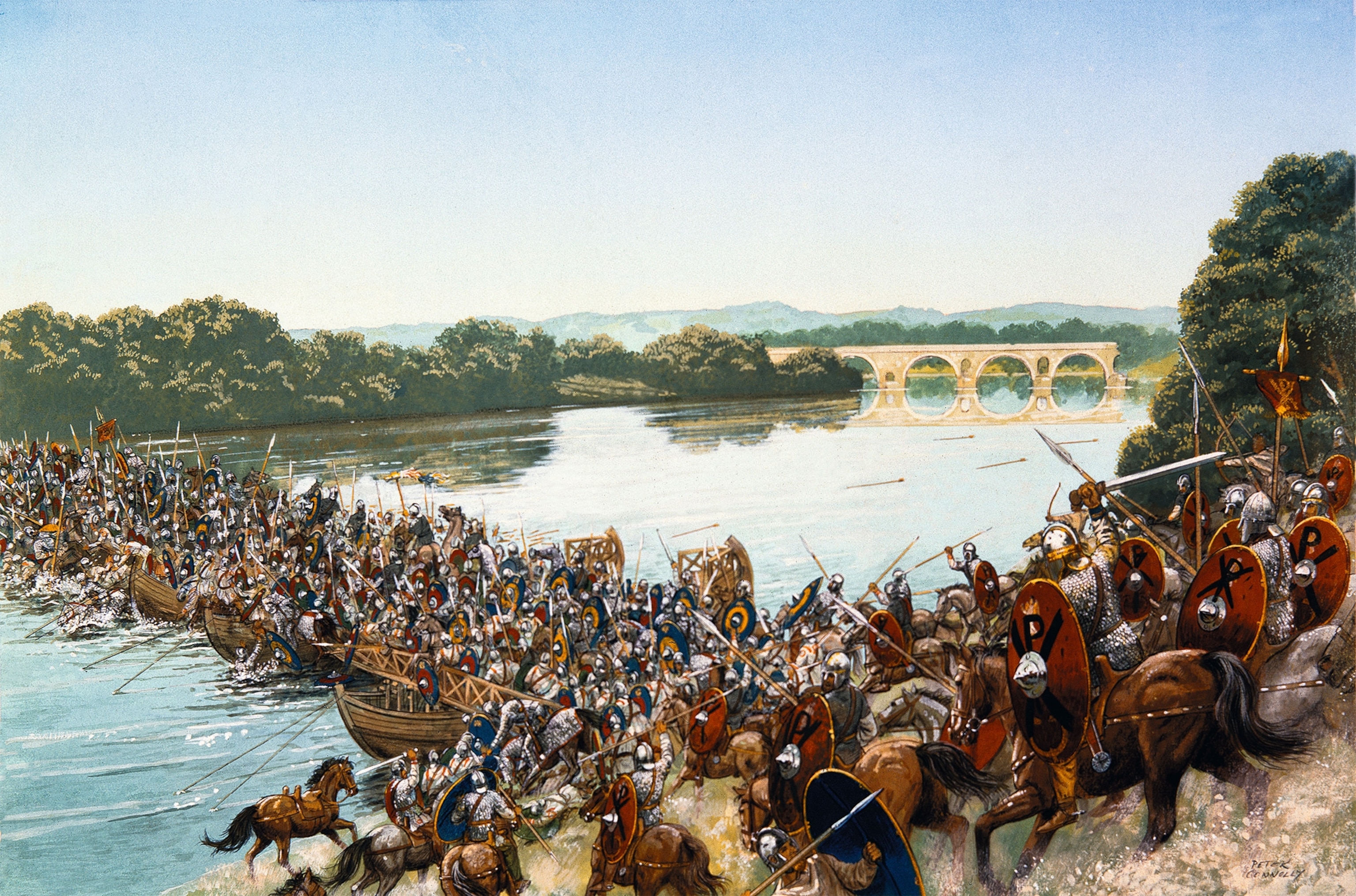
The crosslike symbol Constantine believed he’d seen was the Chi-Rho, a monogram formed by the first two letters of the name of Christ in Greek, (chi) and (rho). That same night, Constantine had a dream in which Christ commanded him to use this symbol in battles against his enemies. Constantine swiftly had the Chi-Rho symbol emblazoned on his army’s shields and helmets, as well as on the labarum, (imperial banner or standard) where it replaced the traditional eagle. He then marched against the troops of Maxentius who were spread out along the banks of the Tiber near the destroyed Milvian Bridge blocking the crucial crossing toward Rome. Constantine demolished his rivals. As Maxentius and his army fled, their pontoon bridge collapsed, killing Maxentius and leading Constantine to victory, which he was quick to attribute to the Christian God.
From vision to conversion
It has long been debated whether Constantine’s conversion really happened as suddenly as his contemporaries suggest. Before his conversion, Constantine, like his father, had worshipped Sol Invictus, a combination of several solar divinities, whose cult had been elevated to state religion and had come to symbolize royal victory under Emperor Aurelian (r. 270–275). Constantine had also likely come into contact with Christians while living in Nicomedia at the court of Diocletian. By the end of the third century, Christianity had become especially strong in the eastern provinces of the empire, where it had spread rapidly through a network of trade routes and dense urban centers, with some regions adopting it as a state religion well before it received official recognition from the Roman Empire.

An isolated figure
Constantine triumphantly entered Rome shortly after the battle in late 312, where he was acclaimed by the Senate. He was firmly committed to promoting Christianity, but the vast majority of the population in Rome still worshipped the pagan gods, so Constantine was cautious in publicly declaring his newfound faith. Perhaps as a reflection of this desire for political stability, the triumphal arch erected near the Colosseum in honor of his victory features pagan imagery and bears no Christian symbols, with the ambiguous inscription instinctu divinitatis, “by divine inspiration.” A year later, Constantine met with Licinius in Milan, then Augustus of the Eastern Empire. At Constantine’s initiative, the two rulers issued a proclamation of religious tolerance that came to be known as the Edict of Milan. It guaranteed freedom of worship across the Roman Empire, recognized the legal rights of Christians, and ordered the restitution of their confiscated property.

Constantine’s growing control over the empire gave him space to begin openly supporting Christianity through imperial patronage. Within Rome, Constantine commissioned the construction of the Basilica of St. John Lateran, which would become the pope’s cathedral. Beyond the city walls, the imperial building spree continued: The grand Basilica of St. Peter rose on Vatican Hill, on the very ground where the Apostle is believed to be buried. Along the Via Ostiense, the Basilica of St. Paul took shape, honoring another pillar of the early church. For the Christians of Rome, these monumental gestures were more than architecture—they were a powerful signal that, at last, the emperor stood with them.
Revenge in the Imperial Palace
Constantine took absolute control of the Roman Empire in 324, after defeating Licinius at the Battle of Chrysopolis (present-day Üsküdar, Turkey). To seal his triumph, he decided to convert the ancient city of Byzantium (present-day Istanbul), into a splendid imperial capital named after himself: Constantinople. Since he didn’t feel at home in Rome with its conservative elite, Constantine wanted to found a “second Rome” in this strategic enclave at the entrance to the Black Sea straddling Europe and Asia. On November 8, 324, a few months after the Battle of Chrysopolis, he physically marked out the periphery of the new city by marching around it, spear in hand. Then, six years later, Constantinople was officially inaugurated.
Just like Rome, the new city was built on seven hills and boasted several forums, a curia (Senate house), and imperial palaces similar to those that stood on Palatine Hill. The Baths of Zeuxippus, the porticoes of the city’s main boulevard known as the Mese, and other prominent sites around the city were adorned with works of art that had been plundered from pagan sanctuaries. In the center of a new porticoed forum, a large porphyry column was erected, topped with a statue of Constantine in the likeness of the sun god Apollo. What Constantine wanted most, however, was a city in which he could demonstrate his faith in the Christian God.

The Christian capital
Pagan features in the city of Constantinople were soon overshadowed by the impressive Christian buildings commissioned by Constantine. His Church of the Holy Apostles, conceived as an imperial mausoleum, dominated Constantinople from its vantage point on one of the highest hills in the city.
As well as enlarging the capital of his unified Christian empire, Constantine sought to strengthen the role of the church and make it the bedrock of the whole empire. He presided over the Council of Nicaea in 325, whose role was to settle theological disputes about the true nature of Jesus Christ. There, Constantine clashed with Bishop Arius and his followers, who argued that Christ was a being created by God but was not eternal. Their doctrine became known as the Arian heresy; whereas Constantine’s view, that the Son of God shared the same divine essence as the Father, prevailed and was encapsulated in the Nicene Creed, the basis of the Catholic Church to this day. Constantine also honored the holy sites of Christianity. In Bethlehem he ordered the Church of the Nativity to be built on the alleged site of Jesus’ birth. And on the hill known as Calvary or Golgotha in Jerusalem, the place thought to be where Jesus was crucified, he had a temple of Venus demolished and replaced with the Church of the Holy Sepulchre, also commonly known as the Church of the Resurrection. Constantine’s mother, Helena, who had converted to Christianity under her son’s influence, made a pilgrimage tour of the Holy Land during which she oversaw this ambitious building program, as well as numerous other pious works.

The last apostle
In the final years of his life, Constantine spent long periods of time in Constantinople, preparing a religious campaign against the Sassanian Persian Empire, but he died shortly after Easter 337. As was common practice among early Christians, he was baptized when he was already dying so as not to annul the purifying effect of the sacrament with new sins.

In line with imperial tradition, the Senate of Rome decreed that Constantine should be deified as Divus Constantius, and given the corresponding honors. In Constantinople, meanwhile, Christian funerals were held in the Church of the Holy Apostles, where Constantine’s body was reverently placed in the imperial mausoleum and designated as the “Thirteenth Apostle.” Constantine’s death marked the end of an era, but his legacy of uniting empire and faith would shape the course of both Rome and Christianity for centuries to come.
